
Cheap Aluminum CNC Machining Service: Where the Cost Actually Comes From
This page is for design engineers and sourcing staff comparing aluminum CNC quotes. It explains which part features drive price up, which aluminum grades are worth paying for, and how to tell a low quote from a low-quality one. By the end you should be able to read a quote line by line and know what to ask before you release a PO.
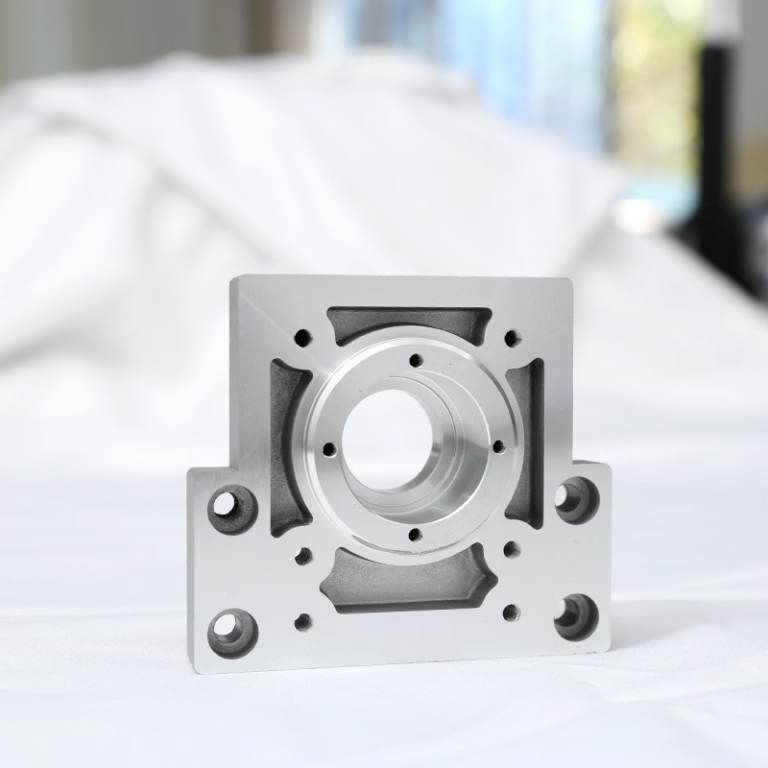
Cheap Is a Number, Not a Quality Level
A low aluminum CNC price is the result of specific decisions: machine choice, setup count, material grade, and how much inspection is done. Here is how those decisions show up on your part.
What Actually Makes Aluminum Machining Cheap or Expensive
Aluminum is soft, cuts fast, and machines at high spindle speeds. That is why aluminum parts are usually cheaper than the same geometry in stainless or titanium. But two shops can quote the same 6061 bracket at very different prices, and the gap is rarely about the hourly rate alone. It comes from how many setups the job needs, how much stock has to be removed, and how tight the tolerances are on the print.
The biggest single driver is setup count. A part that can be reached from one side on a 3-axis machine is quick. The same part with holes on five faces needs either multiple fixtures or a 5-axis center. Each extra setup adds fixture time, re-datum time, and an opportunity for stack-up error. When a quote looks unusually low, ask how many setups the shop planned. Sometimes the answer is one, sometimes it is a number that will not hold the tolerance you drew.
Second is material removal. A housing milled from a solid block wastes a lot of aluminum as chips. If the part is a simple plate, that is fine. If it is a deep cavity, a die casting or a fabricated weldment may be the cheaper route, with CNC only on the critical faces. Third is tolerance. Moving a bore from ±0.1 mm to ±0.005 mm changes the machine, the cutter, the inspection method, and often the scrap rate. Tight tolerance is worth paying for only where the function needs it.
- 1Fewer setups winDesign so most features are reachable from one or two directions.
- 2Loose tolerance where possibleReserve ±0.005 mm for mating and bearing bores, not every dimension.
- 3Standard stock sizesPlate and bar in common thicknesses cut material cost and lead time.
- 4Fillet what you canSharp internal corners need small cutters, which cut slower and break more.
Which Aluminum Grade You Should Specify
6061-T6 is the default for machined parts. It is weldable, anodizes well, holds a good finish, and is widely stocked. Most brackets, housings, manifolds and fixtures are 6061 and there is no reason to change. If a supplier suggests something else for a 6061 part, ask why before agreeing.
7075 is stronger and harder, and it machines to a sharper edge. It is the right choice for aerospace fittings, high-load brackets, and parts with thin walls that must resist bending. It costs more per kilogram and does not anodize to the same cosmetic standard as 6061, so use it for function, not for appearance. 2024 is another high-strength option for fatigue-loaded parts, but it has lower corrosion resistance and usually needs a protective finish.
For cosmetic panels and enclosures, 5052 and 5083 are common. They bend and form better than 6061 and resist salt water. 6063 is an extrusion alloy, best when the part starts as a profile rather than a block. ADC12 is a die casting alloy. If you are comparing a machined part against a casting, ADC12 is what the casting would be made from, and the tooling cost only pays off at higher volumes.
Aluminum Grades We Machine and Where They Fit
Pick the cheapest grade that meets the mechanical and finish requirement.
| Grade | Typical use | Machinability | Anodize look |
|---|---|---|---|
| 6061 / 6061-T6 | General machined parts, housings, brackets | Good | Uniform, clean |
| 7075 | Aerospace fittings, high-load thin walls | Good, sharper edges | Less uniform |
| 2024 | Fatigue-loaded structural parts | Fair | Needs protective finish |
| 5052 / 5083 | Panels, enclosures, marine parts | Fair | Good on sheet |
| 6063 | Extruded profiles, frames | Good | Good |
| 6082 | Structural parts, European prints | Good | Good |
| ADC12 | Die cast housings, then machined | Not machined from bar | Casting skin varies |
Design Changes That Cut Cost Without Hurting Function
Most aluminum parts carry a few features that cost more than they are worth. A 0.5 mm internal corner radius in a 30 mm deep pocket forces a long, thin cutter that must run slowly and can deflect. Opening that radius to 2 mm or 3 mm lets a stiffer cutter run faster and hold size. The corner still works if it is not a sealing surface.
Deep pockets in general are expensive. If a pocket is deeper than four times its width, chip evacuation gets harder and tool life drops. Sometimes the answer is to split the part into two pieces and bolt them together. That sounds like extra work, but it often removes hours of roughing and lets you use standard plate thickness.
Threads and tapped holes add little cost when they are standard metric or UNC sizes in a normal depth. They add real cost when they are deep, small, or in a difficult-to-reach face. Specify thread depth as 1.5 times diameter unless the joint needs more. Engraving and laser marking are cheap for characters 1.5 mm and taller; finer text needs a different process and a different price.
Finally, decide early which surfaces need a cosmetic finish. Bead blasting a whole part is quick. Polishing a whole part to a mirror is slow and is usually only needed on a visible face. Masking the rest keeps the price down and the result consistent.
- 1Corner radiiUse at least 1/3 of pocket depth where the corner is not sealing.
- 2Pocket depthKeep below 4× width when possible for chip clearance.
- 3Split the partTwo bolted pieces can be cheaper than one deep machined cavity.
- 4Marking sizeKeep laser-marked characters at 1.5 mm minimum height.
How to Tell a Low Price From a Risky One
A cheap quote is not automatically a bad quote. The question is whether the shop has planned the inspection and the process, or whether it is hoping the parts come out right. Ask what is measured, on what equipment, and whether reports come with the shipment. A shop that inspects 100% of parts before shipment can usually answer that in one sentence.
Material traceability matters more than most buyers expect. Recycled or mixed aluminum can machine differently from one bar to the next, which shows up as porosity or inconsistent finish after anodizing. Ask for the mill certificate for the grade you specified. If the shop cannot name the mill, that is a signal.
Finish is the other common surprise. Anodizing thickness, color consistency, and whether the coating is clear, colored, hardcoat or conductive all change the price. Hardcoat anodizing builds a thicker layer and can close tight tolerances, so it should be planned before the bore size is final. Conductive anodizing is used where the part must ground an electrical path.
Lead time is part of cost too. A quote that is 20% cheaper but arrives two weeks late can cost more than the difference in a product launch. Our own historical late-delivery probability is below 2%, and we start production within 24 hours of a released order. If a price seems too low, ask what happens if the parts are late or out of tolerance. The answer tells you more than the number.
What to Send and What to Expect Back
The more of this you include, the faster and more accurate the quote.
| Item | What to send | Why it matters |
|---|---|---|
| 3D model | STEP or Parasolid | Defines geometry without translation errors |
| 2D drawing | PDF with tolerances and finishes | Shows what is critical and what is free |
| Material | Grade and temper, e.g. 6061-T6 | Changes cost and machinability |
| Finish | Type, color, masking areas | Adds process steps and lead time |
| Quantity | Prototype to 10,000+ | Sets machine and fixture choice |
| Critical features | List of dimensions that must hold | Focuses inspection effort |
Questions Engineers Ask About Aluminum CNC Cost
Is a cheap aluminum CNC quote always lower quality?
No. A low price can come from good planning: fewer setups, standard stock, sensible tolerances. It becomes a problem when the shop has not accounted for inspection, material grade, or finishing.
Ask what is inspected, what equipment is used, and whether reports ship with the parts. If those answers are vague, the low price is probably borrowed from somewhere else in the process.
What tolerance can we hold on aluminum parts?
We work to ±0.005 mm (±0.0002 in) on critical features where the process supports it. That level needs stable fixturing, temperature control, and a defined inspection method.
Most aluminum parts do not need that. Run ±0.05 mm or looser on non-critical dimensions and reserve the tight tolerance for mating bores and bearing seats. The part will cost less and be no weaker.
Which surface finish should I specify?
As-machined aluminum is typically Ra 1.6–3.2 μm. A high-quality machined finish is Ra 0.8–1.6 μm, and a fine finish is Ra 0.2–0.8 μm.
Only ask for the fine range on sealing faces, sliding surfaces, or optical mounts. Cosmetic faces are usually bead blasted or anodized, which hides tool marks at much lower cost.
Can you anodize and machine in one order?
Yes. We handle clear, colored, hardcoat and conductive anodizing, plus plating, powder coating, black oxide, blasting, brushing and polishing.
Tell us the finish before the bore sizes are frozen. Hardcoat adds thickness and can change a tight fit, and masking decisions affect both appearance and price.
What is the smallest order you accept?
There is no minimum order quantity. We run one prototype and we run 10,000+ part runs on the same process.
For low quantities, the setup and programming cost is spread over few parts, so the unit price is naturally higher. That is normal, not a penalty.
How do you protect our design files?
Uploads are treated as secure and confidential, and we sign an NDA on request before files are shared.
We hold ISO 27001:2022 for information security, alongside ISO 9001:2015, IATF 16949:2016 and ISO 13485:2016 for quality.
Send the Model, Get a Real Number
Upload your STEP file and drawing. We return a quotation and a free DFM analysis within 12 hours, with the cost drivers called out so you can decide what to change.
Quotation in 12 hoursFree DFM analysis100% inspection before shipmentNo minimum order quantity









