
Cheap CNC Machining Services Without Losing Tolerance
This page explains where the cost of a machined part actually comes from, and how a low unit price can still hold ±0.005 mm. Written for design engineers and sourcing staff who compare quotes from several shops. After reading it you can tell which parts are worth quoting cheap, which are not, and what to check before you release a PO.
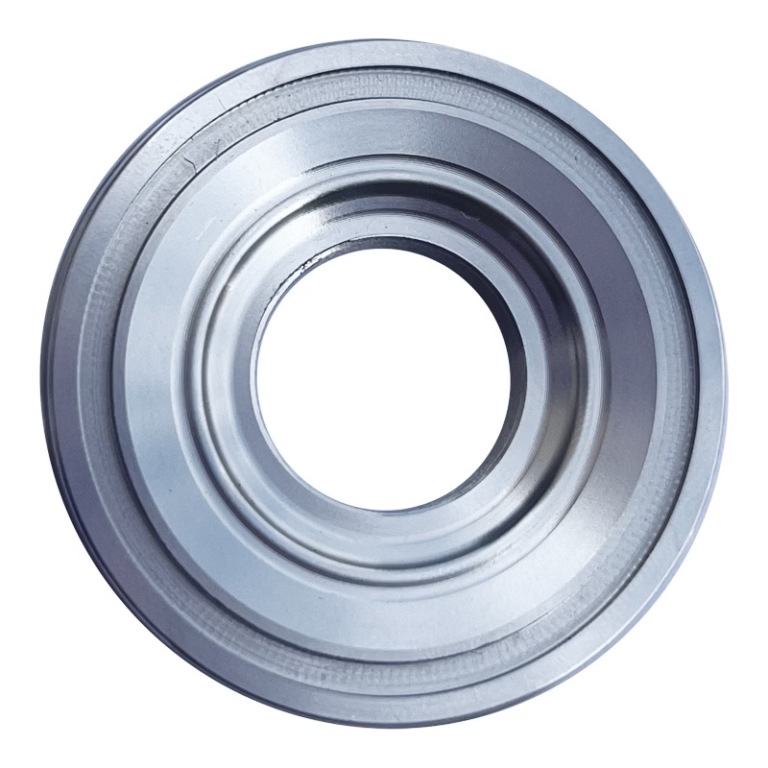
Where the Money in a Machined Part Actually Goes
A machining quote is not one number. It is setup, programming, stock removal time, fixturing, inspection and finishing, added together with a margin. For a single prototype, setup and programming often dominate. For a 5,000-piece run, cycle time and material dominate. That is why the same supplier can look expensive on one RFQ and cheap on another. The part geometry decides which line item wins.
Consider two parts cut from the same 6061 block. One is a plain bracket with six drilled holes and a faced back. The other is a housing with a 0.05 mm wall, two deep pockets and a true-position callout. The bracket may run in four minutes of spindle time. The housing can run forty. Material cost is identical. Labor cost is not.
So the first question when you shop for cheap CNC machining services is not "who is cheapest". It is "what in this part is expensive, and can the design let go of it?" Relaxing one non-critical tolerance or deepening a corner radius often removes more cost than switching suppliers.
- 1Setup and programmingFixed cost. Spread over quantity, it shrinks fast on repeat orders.
- 2Cycle timeDriven by feature count, depth-to-diameter ratio and surface finish.
- 3Material7075 and titanium cost several times more than 6061 per kilogram.
- 4Inspection and finishingCMM time and anodizing add cost but are rarely optional on visible parts.
Design Choices That Cut Price Before the Quote
Most of the price is locked in when the model is finished. By the time an RFQ reaches a machine shop, the only levers left are toolpath strategy and batch size. Change the model instead, and the savings persist on every future order.
Pocket depth is the single biggest time sink on a mill. A pocket deeper than four times the cutter diameter forces a smaller tool, slower feed and more passes. Shallow the pocket or open a corner and cycle time can drop by half. Sharp internal corners do the same thing: a cutter has a radius, so a 0 mm corner demands EDM or a lot of pecking. Give the corner the tool radius and it machines in one pass.
Threads and holes are cheap when they follow standard drill sizes. A Ø6.8 mm pilot for an M8 thread is one drill. A Ø6.5 mm hole for a press-fit dowel needs reaming, which adds an operation and a gauge. On a 10,000-piece run that difference is real money.
Text and logos are another quiet cost. Engraved artwork can need a 0.5 mm cutter and hours of fine stepping. Laser marking handles the same job in seconds, and our minimum character height is 1.5 mm.
None of this means designing a loose part. It means spending tolerance where the assembly needs it and leaving the rest alone.
Which Parts Fit Low-Cost Sourcing
A quick read on where a low unit price is realistic and where it is a warning sign.
| Part profile | Cost outlook | What to watch |
|---|---|---|
| Simple bracket, 3-axis, ±0.1 mm | Low unit cost at any quantity | Deburr and hole position |
| Turned shaft, Ø10–60 mm | Very low at 500+ pieces | Roundness, thread gauge |
| 5-axis housing, thin walls | Moderate, sensitive to batch size | Chatter, wall thickness |
| Tight flatness under 0.02 mm | Higher cost, needs stress relief | Distortion after machining |
| Mirror finish Ra 0.2 μm | Hand polishing, hard to automate | Inspection under light |
| One-off prototype | Setup dominates, price is setup | DFM feedback quality |
How a Shop Keeps Its Price Low Without Cutting Corners
Low price usually comes from machine utilization, not from skipped steps. A shop that runs 127 CNC machines across three plants can group similar parts, keep spindles loaded and buy stock in volume. Our Dongguan and Singapore plants hold 16 simultaneous 5-axis centers, 12 four-axis mills, 27 three-axis machines and 16 mill-turn centers. That mix matters: a part that needs one turning op and one milling op can finish in a single mill-turn setup instead of two fixtures.
Batch size is the other lever. There is no minimum order quantity here, so a single prototype and a 10,000-part run both go through the same route. Tooling and programming are amortized differently, but the process does not change. That keeps the prototype result comparable to the production result.
Material choice moves the number more than most engineers expect. Switching from 7075-T6 to 6061-T6 on a non-structural cover can cut material cost sharply and machine faster. Stainless 316L is gummy and slow; 303 machines freely. If corrosion is not the driver, 303 often wins on price.
Finishing is where hidden cost sits. Anodizing a part with a masked thread and a laser-marked face needs extra handling. Bead blasting before anodizing gives a uniform matte look and hides tool marks, so a slightly rougher as-machined surface becomes acceptable. As-machined Ra 1.6–3.2 μm plus bead blast is a common low-cost combination.
- 1Group similar partsShared setup across a family cuts per-part programming time.
- 2Mill-turn in one setupRemoves a second fixture and the position error that comes with it.
- 3Right-size the material6061 or 303 stainless instead of 7075 or 316L when loads allow.
- 4Pick a finish that hides tool marksBead blast plus anodizing costs less than polishing to Ra 0.2 μm.
What to Verify Before Trusting a Low Quote
A price that is 40% below the next quote is not automatically a bad sign. It is a question. Ask what is excluded. Common gaps are material certification, first-article inspection, surface finish and packaging. If those are not in the quote, they will appear on the invoice or in the scrap bin.
Tolerance claims need evidence. We hold ±0.005 mm on qualified features and inspect 100% of parts before shipment, with raw material checks, in-process monitoring and final inspection. Reports are available on request. Ask any supplier for the same: which features are measured, on what equipment, and what happens to a part that fails.
Certification matters when your part enters a regulated build. Our quality system carries ISO 9001:2015, IATF 16949:2016 for automotive, ISO 13485:2016 for medical devices and ISO 27001:2022 for information security. If your program needs one of these, confirm the certificate covers the plant that will actually cut your part, not a sister site.
Finally, test the communication loop. Send a drawing with one ambiguous callout and see whether the shop flags it or machines it. A supplier that asks a question before cutting is usually cheaper in total, because a scrapped batch costs more than any discount.
Line Items to Confirm in Writing
| Item | Why it matters |
|---|---|
| Material grade and cert | 6061 vs 7075 changes both price and strength |
| Tolerance per feature | Blanket ±0.005 mm on every surface is unnecessary |
| Surface finish spec | Ra callout drives polishing time directly |
| Inspection scope | First article vs 100% inspection are different prices |
| Finishing and masking | Masked threads and logos add handling steps |
| Packaging | Bulk bag vs tray-packed parts affects damage rate |
Questions Engineers Ask About Low-Cost Machining
Is a low quote a sign of lower quality?
Not by itself. Price is mostly a function of machine utilization, batch size and how much hand work the part needs. A shop with loaded spindles can quote lower than a busy job shop with one machine.
What matters is what the quote includes. Ask about material certs, inspection scope and finishing. A low number with those items listed is fine. A low number with them missing is not a comparison.
What tolerance can we realistically expect at a low price?
±0.005 mm is achievable on qualified features, but applying that to every surface raises cost with no benefit. Most parts only need tight tolerance on a few mating or locating features.
Mark those features on the drawing and leave the rest at general tolerance. The shop can then plan passes and inspection time where they matter.
Do small orders cost more per part?
Yes, because setup and programming are fixed. There is no minimum order quantity here, so one prototype is possible, but the per-part price reflects the setup work.
If the design will go to production, order a small batch first to validate the process, then scale. The second order carries no new programming cost.
Which materials keep the price down?
6061-T6 aluminium and 303 stainless are the usual answers. Both machine fast, hold tolerance well and are widely stocked. 7075 costs more per kilogram and cuts slower.
Titanium, Inconel and 316L are available, but they are chosen for corrosion resistance or strength, not for price. If a part does not need those properties, switching the alloy is often the largest single saving.
How fast can parts ship?
Quotation and DFM analysis come back within 12 hours. Production can start within 24 hours of approval, and parts typically ship in 3–5 days.
Complex 5-axis work with finishing takes longer, and the quote will state the real date rather than a generic one.
How is confidentiality handled?
Uploads are secure and confidential, and an NDA is available on request. Designs are not shared outside the project team.
Our information security system is certified to ISO 27001:2022, which covers how customer data is stored and accessed.
Send a Drawing and See the Real Number
Upload your model and get a quote with DFM feedback within 12 hours. No minimum order quantity, from one prototype to 10,000+ parts.
12-hour quote100% inspectionNo MOQNDA on request









