
Cheap Price CNC Metal Machining: Where the Cost Actually Comes From
This page breaks down what makes a CNC metal part cheap or expensive. It is written for engineers and buyers comparing quotes. After reading it, you can look at a price and tell which cost drivers you control and which ones you cannot.
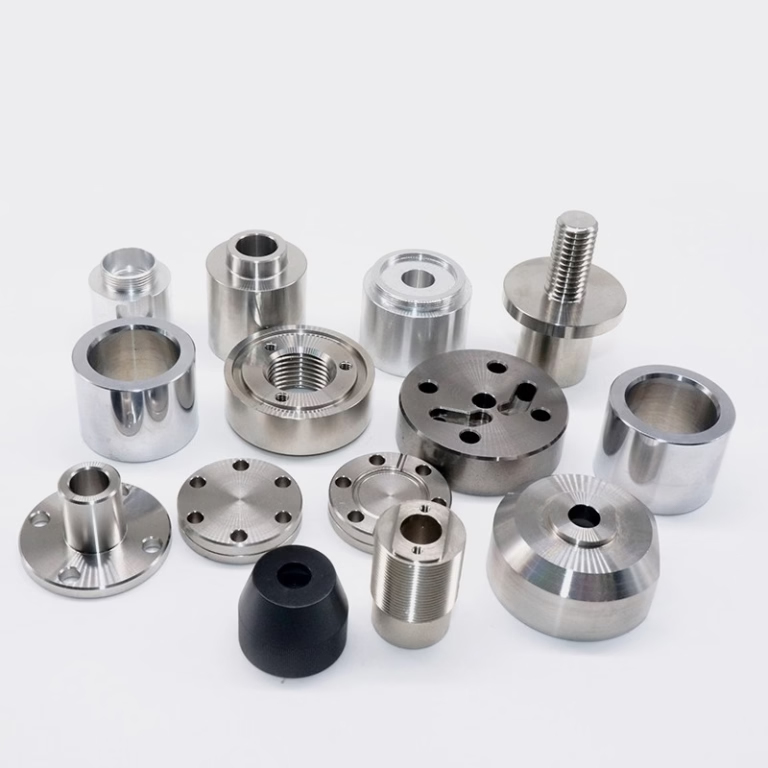
A price is a list of decisions
Every CNC metal quote is the sum of a setup cost, a run cost, a material cost and a quality cost. Change one and the number moves.
What a cheap price CNC metal quote is made of
A machined metal part carries four cost groups. Setup covers programming, fixture building and first-article inspection. Run cost is machine time multiplied by the hourly rate of the machine that cuts the part. Material cost is the block you buy minus what the chips take away. Quality cost is the inspection and documentation you ask for.
Cheap quotes usually win on one or two of these, not all four. A shop with 16 simultaneous 5-axis machining centers can put a complex part on the right machine in one setup, which removes several operations and several fixtures. That is where the real savings sit. Not in cutting the hourly rate.
The mistake buyers make is comparing hourly rates across shops. A shop at a lower hourly rate that needs four setups can cost more than a shop that finishes the part in two. Ask how many setups and how many operations the quote assumes. That number explains the price better than anything else.
Material choice moves the number just as fast. A 6061-T6 aluminium bracket and a 17-4PH stainless bracket of the same shape can differ by several times in raw stock cost and in cutting time. Stainless work-hardens, so feeds and speeds drop, and the tool spends longer in the cut.
- 1SetupProgramming, fixturing, first article. Paid once per order, not per part.
- 2RunMachine time × hourly rate. Driven by features, not by part size alone.
- 3MaterialStock cost plus scrap rate. Titanium and nickel alloys cost more to remove.
- 4QualityInspection, reports, traceability. Scales with how much paperwork you need.
Part features that raise the price, and the ones that do not
Deep pockets with small corner radii are the classic cost driver. A 3 mm radius in a 40 mm deep pocket forces a long, thin tool at low feed. Widen the radius to 6 mm and the same pocket can be cut with a shorter, stiffer tool. Cycle time often drops by a third with no change in function.
Tolerances matter only where you tighten them. A general ±0.1 mm callout on a bracket is normal work. A ±0.005 mm callout on the same bracket adds in-process measurement, temperature control and slower finishing passes. Put the tight tolerance only on the mating surfaces and the datum features.
Thin walls behave the same way. Below roughly 1 mm on aluminium, chatter and deflection force the machinist to take lighter passes. The part may still pass inspection, but it takes longer. If the wall is not structural, thicken it.
Features that are cheap: through holes, open pockets, outside profiles, chamfers, counterbores. Features that are expensive: deep narrow slots, sharp internal corners, threads in hard material, and surfaces that must be ground after milling.
- 1CheapThrough holes, open pockets, outside contours, standard chamfers.
- 2ModerateModerate depth pockets, cross holes, simple threads, flatness callouts.
- 3ExpensiveDeep narrow slots, sharp internal corners, thin walls under 1 mm.
- 4Very expensiveGround surfaces, mirror finishes, features needing 5-axis access from many angles.
Material and tolerance effect on unit cost
Rough relative ranking for the same part geometry. Use it to pick a material before you ask for a quote.
| Material | Machinability | Stock cost | Typical use |
|---|---|---|---|
| 6061-T6 aluminium | Excellent | Low | Brackets, housings, fixtures |
| 7075 aluminium | Good | Medium | Aerospace, high-strength parts |
| 303 stainless | Good | Medium | Shafts, fittings, small parts |
| 304 / 316L stainless | Fair | High | Food, medical, chemical exposure |
| 17-4PH stainless | Fair | High | High-strength corrosion-resistant parts |
| 4130 / 4140 steel | Moderate | Medium | Structural and automotive parts |
| Ti-6Al-4V titanium | Poor | Very high | Aerospace, implants |
| Inconel | Very poor | Very high | Hot sections, extreme service |
| C36000 brass | Excellent | Medium | Valves, connectors, electrical parts |
| POM / PEEK plastic | Excellent | Low to high | Insulators, wear parts, seals |
Quantity, lead time and how they interact with price
One prototype and a 10,000-part run are different problems. On a single part, setup dominates and material is a small share. On a long run, setup is spread thin and cycle time per part becomes the whole conversation. That is why a shop quoting both will push you toward different processes.
GreatLight runs no minimum order quantity, from one prototype to 10,000+ part runs. Production can start within 24 hours of a released order, and parts normally ship in 3–5 days. Those figures assume the design is frozen. A change after cutting starts resets the setup cost.
Rush work costs more because it interrupts the schedule, not because the cutting is faster. If a delivery date is loose, say so. The shop can sequence the job into a gap and often hold the lower price.
Prototype quantities are where cheap price CNC metal work is most useful. You pay for one setup and a few parts, check fit and function, then commit to the production run with confidence. Skipping that step is how a design flaw becomes an expensive tooling mistake.
- 11–10 partsSetup dominates. Focus on design for fewer setups.
- 2100–1,000 partsCycle time and material yield start to matter more.
- 310,000+ partsPer-part cycle time and scrap rate drive the price.
How to check that a low quote is not a hidden cost
A quote below the market usually has an assumption behind it. Find the assumption. It may be a loose tolerance, a deleted inspection step, a longer lead time, or a material grade substitution. None of those are automatically wrong. They are only wrong when you did not agree to them.
Ask three questions before you place the order. Which tolerances are inspected, and how? Which material certificate comes with the parts? Who pays if the first article fails? The answers separate a lean shop from a shop that is simply guessing.
GreatLight inspects 100% of parts before shipment and runs raw material check, in-process monitoring and final inspection, with reports on request. The plants hold ISO 9001:2015, IATF 16949:2016, ISO 13485:2016 and ISO 27001:2022. For regulated work, that documentation is part of the deliverable, not an add-on.
Uploads stay confidential and an NDA is available on request. If your drawings carry IP you would rather not share broadly, say so before sending files.
- 1Ask for the inspection planWhich features are measured, with what instrument, at what frequency.
- 2Ask for the material certMill certificate or test report, matching the grade on the drawing.
- 3Ask about first articleWho reviews it, and what happens if dimensions are out.
- 4Ask about the NDASign before files move if the design is sensitive.
Where a cheap price CNC metal supplier fits in a real program
Machined metal parts rarely stand alone. A common path is machining plus a secondary process: anodizing for wear and appearance, electroless nickel for corrosion, black oxide for tooling, or laser marking for traceability. Each adds a line item and usually a day or two.
When a design is not yet stable, machining and 3D printing can be combined. Metal prototypes from SLM printing avoid tooling cost, and the machined version can follow once the geometry stops moving. This is cheaper than committing to a production route too early.
For larger assemblies, the 4,000 mm maximum processing size and the Ø400 mm rotary table cover most housings, frames and manifolds. Parts that fit inside 750 × 1,150 × 550 mm travel are the everyday work. Above that, ask early, because not every shop has the envelope.
The practical rule: send a drawing and a target quantity. You get a quotation and a free DFM analysis within 12 hours, which tells you which features are pushing the price and what to change. That feedback is worth more than a small discount on the first order.
- 1FinishingAnodizing, plating, powder coating, bead blasting, laser marking.
- 2PrototypingMachining plus SLM printing for early iterations without tooling.
- 3Size envelopeUp to 4,000 mm; medium and compact travels for routine parts.
- 4Feedback loopQuotation plus DFM analysis within 12 hours of file upload.
Questions engineers ask about cost
What makes a CNC metal part cheap to machine?
Few setups, open geometry, loose tolerances on non-critical faces, and a free-machining material.
If the part can be cut from one side with a 6 mm or larger end mill, the price drops quickly.
Does a tighter tolerance always cost more?
Only on the features where you apply it. A ±0.005 mm callout adds measurement and slower finishing passes on that feature.
Keep general tolerances loose and tighten only mating surfaces and datums.
Can I get a cheap price on one part?
Yes. There is no minimum order quantity, from one prototype to 10,000+ part runs.
On a single part the setup is spread over one piece, so the unit price is higher than a run. The DFM feedback still applies.
How fast can parts ship?
Quotation and free DFM analysis come back within 12 hours. Production can start within 24 hours, and parts normally ship in 3–5 days.
Those times assume the design is frozen and the material is in stock.
Which materials give the best cost-to-strength ratio?
6061-T6 aluminium for most brackets and housings, 303 stainless for small corrosion-resistant parts, 4130 or 4140 steel where strength is the priority.
Titanium and Inconel are chosen for service conditions, not for cost.
How do you protect my design when I request a quote?
Uploads stay secure and confidential, and an NDA is available on request.
Send the NDA before files if the design is sensitive.
Send a drawing, get a price and a DFM review
Upload your files and we return a quotation with a free DFM analysis within 12 hours.
12-hour quoteNo MOQ100% inspectionNDA on request









