
Cheap Price CNC Precision Machining Service
This page explains how a low unit price is actually produced in CNC precision machining, and how to tell a lean quote from a risky one. It is written for design engineers and sourcing staff who compare quotes on the same drawing. After reading it you can name the cost drivers on your part and ask the right questions before you release a purchase order.
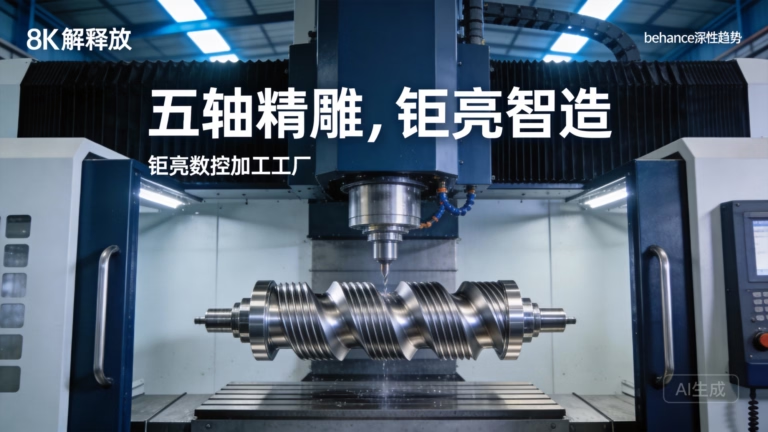
What a cheap price actually buys
A low number on a quote is a result, not a strategy. These four sections show which inputs decide it.
The four things that set a CNC precision price
Every quote for a machined part comes down to machine time, setup time, material, and inspection. Machine time is the hourly rate multiplied by cycle time. Setup time is the hours spent fixturing and proving the program, divided by the batch size. Material is bar stock or plate plus the metal you turn into chips. Inspection is the measuring labor and any reports you require.
When a supplier quotes far below everyone else, one of these four has been squeezed or left out. Sometimes that is legitimate: a shop with a 16-station pallet pool really does run unattended. Other times the setup hours were simply not counted, and the difference reappears later as a schedule slip or a rejected lot.
The useful question is not who is cheapest. It is which cost driver your part is dominated by. A one-off bracket with a simple profile is dominated by setup. A 10,000-part bushing is dominated by cycle time and material yield. That single fact tells you what to negotiate and what a supplier can realistically cut.
Cycle time: the biggest lever on a cheap price
Cycle time is where most of the money sits on a repeating order. On a mill-turn center running aluminum, a well-programmed part may take 3 minutes; the same geometry with poor tool paths and a slow spindle ramp can take 9. The hourly rate barely changes, so the part price triples.
Tool selection matters more than most drawings suggest. A 12 mm high-feed cutter in 6061 removes material quickly at moderate spindle load. Switch to a small 4 mm end mill on the same pocket and you add passes, wear tools faster, and lose time on every part. Tool reach also decides whether the part can be cut in one setup or needs two.
Roughing strategy is the second lever. Adaptive or trochoidal paths keep radial engagement low and let the machine run near its feed limits without chatter. On 17-4PH stainless, that difference is large: the material work-hardens, so a timid pass glazes the surface and forces a second operation. Get the engagement right and the same feature cleans up in one pass.
Which parts suit a low unit price
Use this to judge whether your own part belongs in the low-cost bracket.
| Part profile | Best process | Why the price stays low |
|---|---|---|
| Simple turned pin, high volume | Mill-turn center, bar feeder | Short cycle time, minimal handling, little scrap |
| Flat plate with 2D pockets | 3-axis mill, large pallet | Few setups, easy fixturing, fast roughing |
| Prismatic housing, 4 faces | 4-axis mill | One setup replaces three, less re-fixturing error |
| Complex contoured impeller | 5-axis simultaneous | Higher rate, but fewer setups and fixtures |
| Thin-wall 0.5 mm section | 5-axis, light passes | Needs slow feeds, so price rises, not falls |
| Tight concentric bores ±0.005 mm | Mill-turn in one chucking | Concentricity from one setup beats re-chucking |
| Prototype, 1–5 pieces | 3-axis or 5-axis, no fixture | Setup dominates, so material choice drives the total |
| Large frame 4,000 mm | Gantry-class 3-axis | Travel is the limit; fixturing and handling add cost |
Material choice moves the number more than the hourly rate
Aluminum 6061 and 6061-T6 machine fast, hold ±0.005 mm without fuss, and cost little per kilogram. They are the default for cheap price CNC precision work, and for good reason. 7075 is stronger but gummier and eats tool life. 2024 machines cleanly yet corrodes without a finish, so anodizing is not optional.
Stainless 303 is the free-machining grade and behaves well on a lathe. Switch to 304 or 316 and you lose roughly a third of your cutting speed plus more tool changes. 17-4PH in the H1025 condition is tougher still, and if the drawing calls for H900 after machining, remember that heat treatment moves dimensions. Plan a finishing cut after treatment, or hold the tight tolerance before it.
Titanium TC4 (Ti-6Al-4V) and Inconel are a different conversation. Both hold heat at the cutting edge, so speeds drop and coolant strategy dominates. On these grades, a 20 percent cheaper hourly rate saves less than a 20 percent better tool path. Plastics sit at the other end: POM and PA cut quickly but move with temperature, so rough, cool, then finish.
Where cheap quotes hide cost
Inspection is the line item most often thinned to reach a low number. A shop that checks every part with a caliper is cheaper than one running a CMM with a written report. On a cosmetic bracket, that is a fair trade. On a hydraulic manifold with a 0.005 mm bore tolerance, it is not.
Ask what the inspection plan looks like before you compare prices. First article with a dimensional report, in-process checks at fixed intervals, and a final inspection on the critical dimensions is a reasonable baseline. If a quote includes nothing beyond a visual check, the saving is real but so is the risk of a rejected lot arriving at your dock.
Finishing adds hidden cost too. Anodizing, electroless nickel, and bead blasting are usually outsourced, and outsourcing brings handling, minimum batch charges, and turnaround time. A quote that omits finishing is not cheaper; it is incomplete. Bring the finish into the same quote so the comparison is honest.
Freight and packaging belong in that same comparison. A 300 kg casting needs a crate and a pallet, not a box. Suppliers who quote ex-works and then add crating later are not lying, but the total you pay is higher than the number you approved.
Design changes that lower the price without lowering quality
A few drawing edits routinely cut unit price by double digits. Add a small corner radius where an internal pocket meets a wall. A sharp internal corner needs a small cutter, and a small cutter needs slow feeds and gentle passes. A 2 mm radius lets you use a 6 mm cutter and finish the wall in one pass.
Set tolerances where they matter. A ±0.005 mm callout on a non-functional face forces extra measuring and slower cutting for no benefit. Keep the tight band on the bore that fits a bearing or a shaft, and open the rest to ±0.05 mm or the general tolerance block. Engineers who mark only the functional dimensions usually get a lower quote and the same working part.
Thread and hole standards are another easy win. Metric coarse threads, standard drill sizes, and holes deeper than 3× diameter all behave predictably. Deep small holes need peck drilling and long, fragile tools. If a hole can be 12 mm instead of 8 mm at the same depth, the price usually drops.
Finally, consider the batch. Setup is a fixed cost spread across the run. Going from 50 to 200 pieces often cuts the unit price sharply because the programming and fixturing are already done. Prototype pricing and production pricing are different animals, and it is worth asking for both at the same time.
Questions engineers ask about low-cost precision machining
Can a cheap price CNC precision supplier still hold ±0.005 mm?
Yes, but only when the process is chosen for that tolerance. Holding ±0.005 mm needs a finish pass at low depth of cut, a stable fixture, and a machine in good condition. The cost of that tolerance shows up in cycle time, not in the hourly rate.
What you should check is the inspection method. A tolerance that tight is meaningless without a measuring plan that can resolve it. Ask for the gauge and the report before you accept the quote.
Why is a one-off prototype so expensive per part?
Setup dominates. Programming, fixturing, tool selection, and first article inspection are the same work whether you make one part or one hundred. Spread over a single piece, that fixed cost is large.
There is no minimum order quantity here, so a single prototype is possible. It just carries the full setup burden. If the design is likely to iterate, ask about pricing for the second and third revision before you start.
Does a lower hourly rate always mean a lower part price?
No. Cycle time decides the price more than the rate does. A shop charging more per hour but running an efficient tool path and a pallet pool can beat a cheaper shop with slow programs and manual load.
Compare on the finished part, not on the rate card. If a supplier will not break the quote into material, machining, and finishing, ask them to.
Which materials give the best cost-to-precision ratio?
Aluminum 6061-T6 is the usual answer for tight tolerance work at low cost. It machines fast, holds size, and takes anodizing well. Stainless 303 is the next step up when you need corrosion resistance.
Move to 17-4PH, TC4, or Inconel only when the application demands the strength or heat resistance. Each step up raises tool wear and cuts the achievable removal rate.
How do I avoid surprise charges after the quote?
Put finishing, packaging, and freight in the same document. Ask whether first article inspection is included and what the report covers. Confirm the material grade and temper in writing, since 6061 and 6061-T6 price differently.
A complete quote makes comparison honest. An incomplete one always looks cheaper until the invoice arrives.
What lead time should I expect on a low-cost order?
Quotation and DFM feedback come back within 12 hours, and production can start within 24 hours of approval. Standard parts ship in 3–5 days.
Add time for outsourced finishing and for freight, especially on large or heavy parts. Those are the two steps most often left out of a delivery estimate.
Get a quote you can actually compare
Send the drawing and quantity. We return a quote with material, machining, finishing, and inspection broken out, plus DFM notes, within 12 hours.
12-hour quote±0.005 mm100% inspectionNDA on request









