
Cheap Price High Precision CNC Machining Services
This page explains where the money actually goes in a high-precision CNC job, and which choices keep the price low without losing the tolerance. Written for design engineers and sourcing staff who compare quotes, it helps you spot the difference between a cheap quote and a cheap part. By the end you can judge whether a supplier's price is realistic for the tolerance and finish on your drawing.
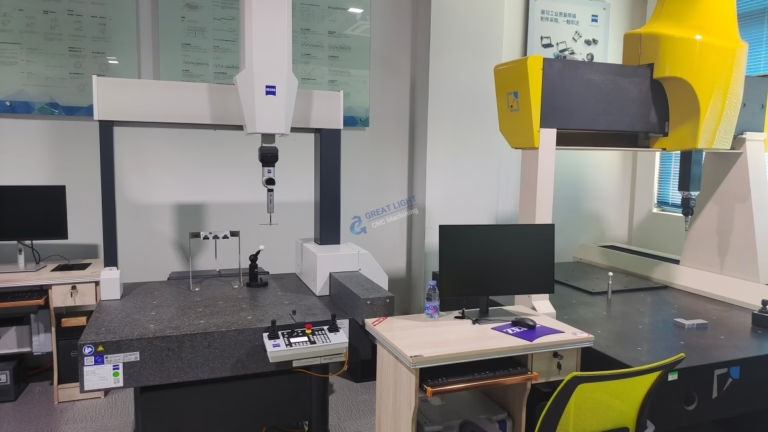
What cheap price high precision actually means in a machine shop
Low unit price and tight tolerance are not opposites. The cost sits in the setup, the tooling and the inspection plan, not in the spindle hour alone.
Where the money goes in a high-precision job
Take a bracket that must hold ±0.005 mm on two bores 180 mm apart. The spindle time is maybe 20 minutes. The real cost is the fixture, the probe cycle that finds the part before cutting, the temperature soak, and the CMM check afterward. When a quote comes back far below the others, something in that list got skipped.
Five-axis work changes the math. One setup on a simultaneous 5-axis center removes four handoffs on a 3-axis machine. Fewer setups mean fewer datum shifts and less scrap. On a job with angled faces or deep pockets, that often lands cheaper than a 3-axis quote, even though the hourly rate is higher.
Material choice swings the number more than most engineers expect. A 6061 aluminium housing at 200 pieces is a commodity job. The same housing in 17-4PH stainless needs slower feeds, more tool wear and a stress-relief step. Same drawing, roughly three times the machining cost.
Volume is the last lever. Setup and programming spread across a run. One prototype carries the full fixed cost; 10,000 pieces carry almost none. That is why a cheap prototype and a cheap production part are priced on completely different logic.
- 1Setup countEach extra orientation adds fixture time, datum risk and inspection points.
- 2Tool reachDeep pockets force long, thin tools. Slow passes, more chatter risk, higher cost.
- 3Tolerance bandMoving from ±0.05 mm to ±0.005 mm adds probing, slower finishing and a CMM step.
- 4Surface finishRa 0.8–1.6 μm comes off the machine. Ra 0.2–0.8 μm needs a second operation.
Which machine keeps the price down for your part
Part geometry decides the machine, and the machine decides the price. A flat plate with holes on one face belongs on a 3-axis mill. Adding a fourth axis pays off when holes sit on multiple sides of a shaft or a cube, because the part indexes instead of being re-fixtured by hand.
Simultaneous 5-axis earns its rate on contoured surfaces, impeller blades, and ports that meet at compound angles. A Ø400 mm rotary table covers most of that work. For long parts, our largest travel is 4,000 × 400 × 150 mm, which handles extruded profiles and long rails in one pass.
Mill-turn centers cut the cost of round parts with milled features. A shaft with cross holes, flats and a thread normally travels between a lathe and a mill. On a mill-turn center it comes off in one cycle, holding concentricity without a second datum.
For a part that only needs general tolerance, asking for ±0.005 mm raises the price for nothing. We flag those dimensions in the DFM review. Relaxing one non-critical bore from ±0.005 mm to ±0.05 mm can cut a finishing pass and a probe cycle from the route.
- 13-axisPrismatic parts, one dominant face, holes in a single plane.
- 24-axisShafts and cubes with features on several sides, moderate volume.
- 35-axisContoured surfaces, compound angles, deep cavities, one-setup work.
- 4Mill-turnRound parts with milled features that must stay concentric.
Tolerance and finish versus cost drivers
Typical route changes as the tolerance band tightens. Figures are our standard capability, not a price list.
| Requirement | Typical route | Cost impact |
|---|---|---|
| General, ±0.1 mm | 3-axis, as-machined finish | Baseline |
| ±0.02 mm, Ra 1.6–3.2 μm | 3-axis plus finish pass | Moderate, one extra pass |
| ±0.005 mm, Ra 0.8–1.6 μm | Probing, temperature control, CMM | High, inspection drives it |
| Ra 0.2–0.8 μm | Grinding or polishing after CNC | High, second operation |
| Hardened steel 45 HRC+ | Rough, heat treat, finish | High, extra handling |
| Thin wall under 1 mm | Light passes, soft jaws, stress relief | High, cycle time up |
Material and finish choices that hold the price down
Aluminium 6061-T6 is the cheapest way to hit tight tolerance on a machined part. It cuts fast, holds dimension, and anodizes cleanly. When a design allows 6061 instead of 7075 or stainless, the price drop is real and the function often survives.
Stainless 303 machines better than 304, and 304 better than 316. If corrosion resistance allows, 303 is the economical pick for small turned parts. Titanium TC4 and Inconel cut slowly and wear tools; they belong where temperature or weight forces the choice, not as a default.
Plastics are cheap to buy and tricky to hold. POM and ABS are stable. PEEK costs more per kilo and needs sharp tooling and light passes. On thin plastic walls, cycle time rises because clamping pressure has to stay low to avoid bowing.
Finishing is where quotes drift apart. Bead blasting and tumbling are low-cost batch operations. Hardcoat anodizing, electroless nickel and laser marking add steps. Laser marking needs a minimum character height of 1.5 mm to stay legible, so shrink the mark or drop it if space is tight.
- 16061-T6Fast, stable, anodizes well. Default for tight-tolerance aluminium.
- 2303 stainlessFree-machining grade. Cheaper than 304 or 316 for small parts.
- 3Bead blastingBatch finish, low cost, hides light tool marks.
- 4Hardcoat anodizingWear surface. Adds a vendor step and thickness allowance.
Inspection and certification behind a low price
A cheap price only holds if the parts pass. We check raw material on arrival, monitor dimensions during the run, and inspect before shipment. Reports are available on request. Our qualification rate is 99.99%, and that number comes from catching drift early, not from inspecting harder at the end.
The four certificates that matter to most buyers are ISO 9001:2015, IATF 16949:2016, ISO 13485:2016 and ISO 27001:2022. IATF covers automotive and EV work, ISO 13485 covers medical devices, and ISO 27001 covers how we handle your files. Uploads stay confidential, and we sign an NDA on request.
Lead time is part of the cost story. A quote and DFM analysis come back within 12 hours. Production can start within 24 hours, and parts ship in 3–5 days. Our historical late-delivery probability is below 2%. A low price with a slipped date costs more than the part.
There is no minimum order quantity. One prototype and a 10,000-piece run both go through the same quoting route. On the prototype, the DFM note is where we usually find the cost. A small change to a corner radius or a hole depth can remove a tool change or a second setup.
- 1Incoming materialGrade and condition verified before the first cut.
- 2In-processDimensions checked during the run so drift is caught early.
- 3Final100% inspection before shipment, reports on request.
- 4FilesSecure uploads, NDA available on request.
Questions engineers ask before sending a drawing
How can the price be low and the tolerance still be ±0.005 mm?
Tight tolerance is a process choice, not a material cost. It needs probing, a controlled temperature, sharp tooling and a CMM check. We keep those steps in the route and take cost out elsewhere: fewer setups, right-sized machines, and a DFM pass that relaxes dimensions that do not need to be tight.
A quote that is far below the field usually dropped one of those steps. Ask what the inspection plan is before you compare the number.
What file format and information do you need for a quote?
A STEP or IGES model plus a 2D drawing with tolerances, finish and material. If the drawing is incomplete, tell us which dimensions are critical. That is enough for a quote and a DFM analysis within 12 hours.
Uploads stay confidential, and we can sign an NDA before you send anything.
Is a small order still worth quoting?
Yes. There is no minimum order quantity. A single prototype carries the full setup cost, so the unit price is naturally higher than a 10,000-piece run, but the same DFM review applies.
For prototypes, the useful question is not the unit price. It is how many changes the DFM note saves before you commit to a production tool.
Which materials give the best tolerance per dollar?
Aluminium 6061-T6 is the easiest to hold at ±0.005 mm. Stainless 303 is the economical stainless for small turned parts. Brass and copper machine well but cost more per kilo.
Titanium and Inconel cut slowly and wear tools, so the same tolerance costs more. Choose them for temperature, weight or corrosion needs, not by default.
How do you handle thin walls and easy-to-bow parts?
Light passes, soft jaws and, where the geometry allows, a stress-relief step between roughing and finishing. Clamping pressure stays low to avoid distorting the part in the vise.
Cycle time goes up, so the price goes up. Sending us the wall thickness early lets us quote the real route instead of revising later.
What finishing options ship with the machined parts?
Anodizing in clear, colour, hardcoat or conductive; electroless nickel, zinc, silver and gold plating; powder coating and black oxide; bead blasting, tumbling, brushing and polishing; laser marking and engraving.
Laser marking needs a minimum character height of 1.5 mm. Plan the mark area on the drawing so it does not land on a sealing face.
Send a drawing, get a quote and a DFM note
Share your model and tolerances. We reply with a quotation and a free DFM analysis within 12 hours, and we tell you which dimensions are driving the price.
12-hour quoteNo MOQ100% inspectionNDA on request









