
China CNC factory: a smart budget purchase for machined parts
This page is for engineers and sourcing managers who need to compare a China CNC factory smart on real capability, not on the lowest number in an inbox. It covers machine selection, tolerance limits, material and finishing choices, and the cost drivers that decide whether a quote is realistic. Read it and you can tell which parts belong in China, which do not, and what to verify before releasing a PO.
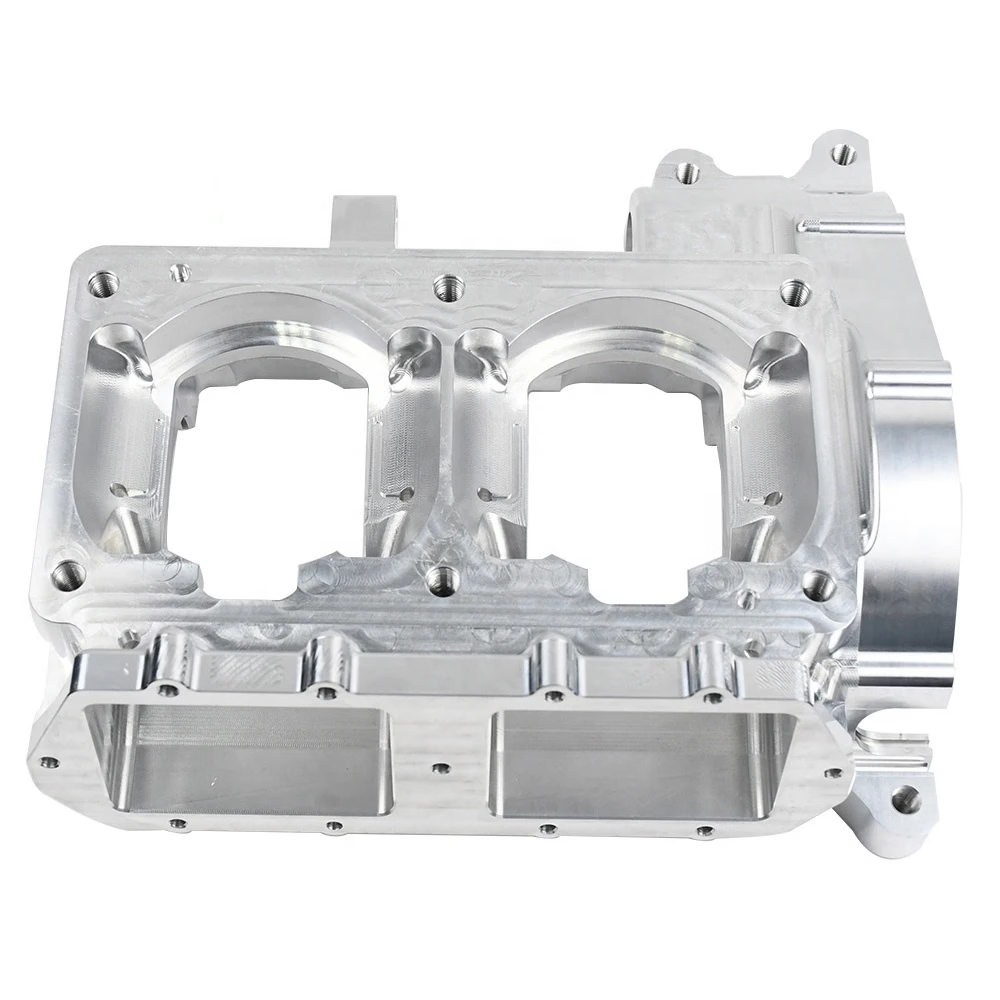
What a budget purchase actually means
A low unit price is easy to quote and hard to hold. The useful question is which cost you are buying down.
Where the money goes in a machined part
A CNC quote is not a single number. It is setup time, programming, fixture or soft jaw work, machine hours, tool wear, inspection and finishing. On a 10-piece order the setup is spread over few parts, so setup dominates. On a 5,000-piece order the cycle time dominates. That is why the same part can look cheap from one shop and expensive from another: they are quoting different scopes.
- 1Setup and programmingOne-time cost, spread across the batch size.
- 2Machine hoursCycle time times the hourly rate of the chosen machine.
- 3Tooling and fixturesCustom jaws, form tools, or a soft-jaw set for the second op.
- 4Inspection and finishingCMM time, anodizing, plating, laser marking, packing.
Three-axis, four-axis or five-axis: pick by geometry
A three-axis mill cuts from one direction. If the part has features on four sides or a contoured surface, it needs refixturing, and every refixture adds a small position error. Four-axis machining adds a rotary table, so a shaft or a housing with radial holes can be cut in one setup. Five-axis simultaneous machining tilts the tool and the table together, which reaches undercuts and keeps a single datum through the whole part.
Rotary work matters more than people expect. A 16-station shop with simultaneous five-axis centers can hold a true position on angled bores that a three-axis shop can only approximate. For a simple bracket with through-holes and a flat face, three-axis is faster and cheaper. Buying five-axis time for that part is wasted budget.
Our shop runs 127 high-precision CNC machines: 16 simultaneous five-axis centers, 12 four-axis mills, 27 three-axis machines and 16 mill-turn centers. Maximum processing size is 4,000 mm, with travels of 4,000 × 400 × 150 mm on the large frame, 750 × 1,150 × 550 mm and 600 × 600 × 600 mm on medium frames, and 500 × 500 × 450 mm or 500 × 310 × 200 mm on the compact machines. The rotary tables take a Ø400 mm part.
- 1Three-axisPrismatic parts, flat faces, pockets, through-holes on one or two faces.
- 2Four-axisShafts, bushings, radial hole patterns, parts cut around an axis.
- 3Five-axisUndercuts, angled bores, impellers, medical and aerospace contours.
- 4Mill-turnTurned parts with milled features, done in one cycle.
Which machine fits which part
Match the geometry first, then check the tolerance and finish you actually need.
| Part feature | Recommended machine | Why it fits |
|---|---|---|
| Flat plate with through-holes | Three-axis | Simple fixturing, short cycle, low hourly rate |
| Shaft with radial holes | Four-axis | One setup, no re-chucking error around the axis |
| Angled bore and undercut | Five-axis | Reaches the feature without a custom angle plate |
| Turned body with milled slots | Mill-turn | Turning and milling in a single cycle |
| Large frame up to 4,000 mm | Large-travel three-axis | Fits the 4,000 × 400 × 150 mm envelope |
Tolerance and finish: what raises the price
Tolerance is the single biggest driver after geometry. A general machining callout of ±0.1 mm runs at a normal rate. Tightening the critical dimensions to ±0.005 mm (±0.0002 in) means slower feeds, more passes, temperature control and more inspection time on the CMM. Only the features that mate should be called tight. A blanket tight tolerance on every dimension is the most common way to overspend on a part that does not need it.
Surface finish works the same way. As-machined surfaces sit at Ra 1.6–3.2 μm. A high-finish callout of Ra 0.8–1.6 μm is normal for sealing faces and bearing bores. Fine finishing down to Ra 0.2–0.8 μm needs a finishing pass and sometimes a polishing step. If a cosmetic surface is only visible when the unit is open, the fine finish is money you will not recover.
Two more details change the quote: hard materials and thin walls. Stainless 17-4PH, titanium TC4 (Ti-6Al-4V) and Inconel cut slower than aluminium 6061 and wear tools faster, so cycle time goes up. A wall thickness below 0.8 mm on a 100 mm part usually needs support, light passes and a stress-relief plan, and that shows up as extra hours.
Inspection is the last lever. We run raw material checks, in-process monitoring and a final inspection on 100% of parts before shipment, with reports on request. If your drawing needs first-article and full dimensional reports on every piece, say so at quote time. Adding it after machining costs more than quoting it up front.
- 1General tolerance±0.1 mm on non-mating dimensions keeps the rate normal.
- 2Tight tolerance±0.005 mm reserved for bores, fits and datum features.
- 3High finishRa 0.8–1.6 μm for seals and bearing surfaces.
- 4Fine finishRa 0.2–0.8 μm needs an extra pass or polishing.
Material choice and its effect on the quote
Aluminium 6061-T6 is the default for prototypes and enclosures. It cuts fast, holds tolerance well and takes anodizing cleanly. The 7075 grade is stronger and used for structural brackets, but it is harder on tools and costs more per kilogram. For die-cast housings, ADC12 covers most electronic enclosures.
Stainless shows up in medical and food-contact work. Grades 303 and 304 machine easily. Grade 316L and 17-4PH are tougher and slower to cut, so plan for longer cycles and a higher price per part. If a part only needs corrosion resistance, 303 often does the job at a lower cost than 316L.
On the tool steel and alloy side, 4140 and 4340 are common for fixtures and shafts, and 4130 for welded frames. Titanium and Inconel are aerospace and medical grades. They machine at a fraction of the aluminium rate and need sharp tooling and coolant discipline. We keep these in stock as bar and plate, and we check the mill certificate before the first cut.
- 1Aluminium6061, 6061-T6, 2024, 5052, 5083, 6063, 6082, 7075, ADC12.
- 2Stainless303, 304, 316, 316L, 420, 430, 431, 440C, 17-4PH (SUS630).
- 3Steel1018, 1045, 4130, 4140, 4340, A36, tool steel.
- 4Titanium and specialTA1, TA2, TC4 (Ti-6Al-4V), Inconel, magnesium AZ31B / AZ91D.
How to check a supplier before you send a PO
Ask what machines will run your part, not what machines the company owns. A shop with five-axis centers may still schedule your bracket on a three-axis mill to hit the price, which is fine if you know it. Request the process plan: fixturing, operation sequence, and where the datums are picked up.
Certifications are a filter, not a guarantee. ISO 9001:2015 covers quality management. IATF 16949:2016 applies to automotive work, ISO 13485:2016 to medical devices, and ISO 27001:2022 to information security for your files. Four certificates on the wall do not mean your part is right; they mean the process is audited. Look for the inspection record on your job.
Confidentiality is worth settling early. Uploads should be secure and confidential, and an NDA should be available on request before you send a drawing. Our NDA page sits at the link below, and we sign customer paper as well.
Then test the response time. We return a quotation and free DFM analysis within 12 hours, and production can start within 24 hours. Parts ship in 3–5 days on standard jobs. Historical late-delivery probability is below 2%. Those numbers are the ones to compare against another factory's promise, because a promise without a date attached is not a plan.
- 1Process planAsk for fixturing, operation order and datum callouts.
- 2Inspection recordRequest the report for your specific job, not a sample.
- 3NDASign before drawings go out, on your paper or ours.
- 4Response clock12-hour quote and DFM is a testable number.
Order size, finishing and total landed cost
There is no minimum order quantity here. A single prototype and a 10,000-part run both go through the same shop, though the economics differ. For a prototype, quote the part as designed and let the DFM note tell you what to change before tooling is cut. For a production run, the soft jaws and the fixturing get amortized, so the unit price drops.
Finishing usually happens at a second supplier, and that adds transit and handling. Anodizing in clear, colour, hardcoat or conductive form, electroless nickel, zinc, silver and gold plating, powder coating and black oxide, bead blasting, tumbling, brushing and polishing, plus laser marking with a minimum character height of 1.5 mm. If the finish is cosmetic, send a sample or a Pantone reference; colour matching by description alone invites a rework loop.
When you compare a China CNC factory smart, build the landed number: part price, finishing, inspection reports, packing, freight and the cost of one rework cycle. A quote that is 20% lower but adds a rework loop is not lower. Batch size, tolerance, material and finish are the four inputs you control. Change any one of them and the quote moves.
- 1Batch sizeLarger lots amortize setup and fixtures.
- 2ToleranceCall tight only on mating features.
- 3MaterialTitanium and Inconel add cycle time, not just stock cost.
- 4FinishAnodizing, plating and marking add a second handling step.
Common questions
How do I know if a part should be made in China at all?
If the part is machined metal or plastic, fits inside a 4,000 mm envelope, and the drawing is complete, it is a normal candidate. The decision turns on volume and tolerance, not on geography.
Parts with a tolerance looser than ±0.1 mm and a simple shape can be made anywhere. The advantage appears when the shop has the specific machine the geometry needs, such as a simultaneous five-axis center or a mill-turn cell, and the batch is large enough to amortize setup.
What tolerance can a China CNC factory hold on a production run?
We hold ±0.005 mm (±0.0002 in) on critical features and inspect 100% of parts before shipment. General dimensions run at ±0.1 mm unless the drawing says otherwise.
Tolerance holds when the process is chosen for it. A tight bore cut on a five-axis machine in one setup is more stable than the same bore cut across three re-fixturings on a three-axis mill. That is a process decision, made before the first chip.
Does the quote include finishing and inspection reports?
Finishing is quoted as a line item, so you can see the cost and drop a step you do not need. Inspection reports are available on request and should be stated at quote time.
If you need a full dimensional report or a first-article inspection on every piece, tell us before machining. Adding it later means a second pass over the parts and a longer schedule.
How fast is a quote and how fast is production?
Quotation and free DFM analysis come back within 12 hours. Production can start within 24 hours after the drawing and PO are settled. Standard jobs ship in 3–5 days.
Historical late-delivery probability is below 2%. Treat both numbers as the baseline you hold any supplier to, including us.
Can you sign an NDA before I send drawings?
Yes. Uploads are secure and confidential, and an NDA is available on request. We can sign your document or use ours.
Send the NDA first if that is your process. Nothing gets quoted until the paperwork is in place.
Is there a minimum order quantity?
No minimum. One prototype is fine, and so is a run of 10,000+ parts.
Small lots carry more setup per part; large lots carry more tooling investment. The quote reflects which one you are ordering.
Send a drawing and get a real number
Upload your files and we return a quotation plus free DFM analysis within 12 hours. No minimum order quantity, uploads secure and confidential.
12-hour quote + DFM100% inspection before shipmentNo minimum order quantity3–5 day shipping









