
China CNC Lathe Processing Service
This page explains how turning works, what a China CNC lathe processing service can hold on diameter and finish, and which parts belong on a lathe rather than a mill. It is written for design engineers and sourcing staff who need to judge a quote, a tolerance callout, or a supplier's machine list before releasing a drawing.
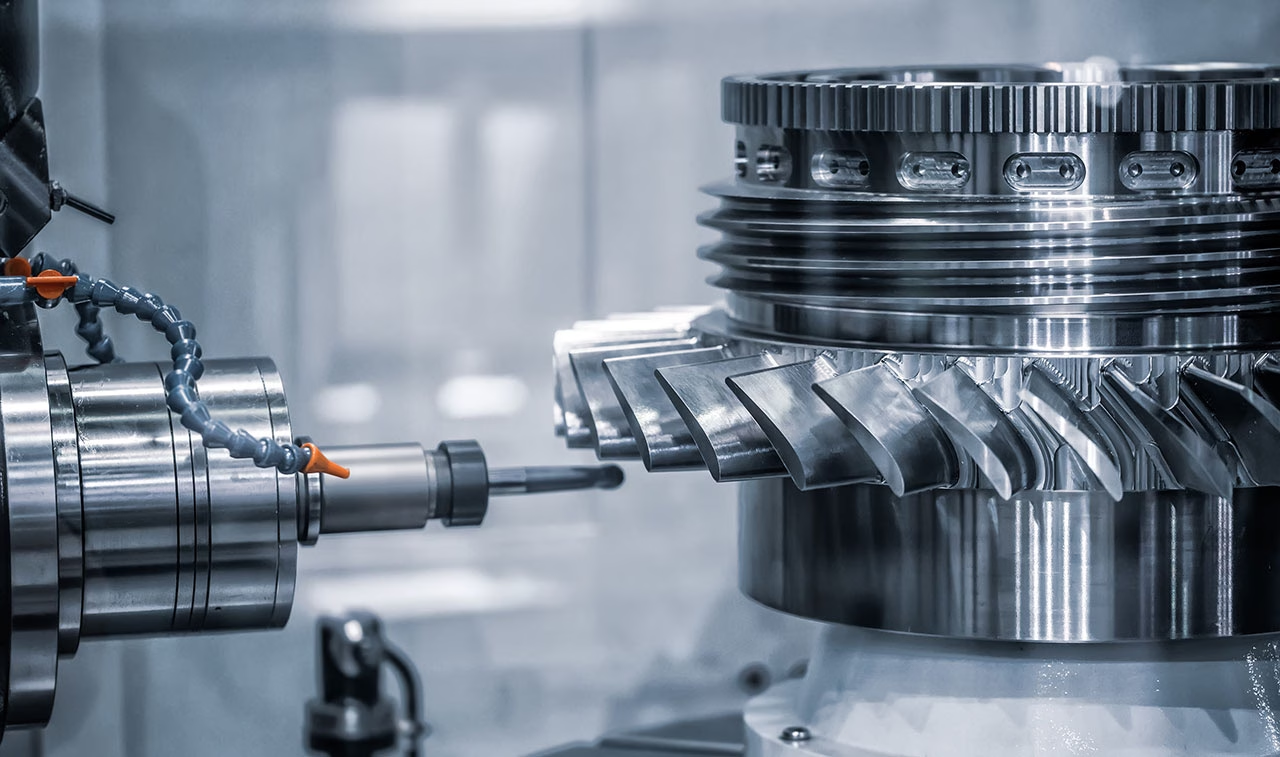
What a lathe actually does to your part
Turning holds the workpiece in a chuck or collet and rotates it while a single-point tool feeds along the surface. The part spins; the tool stays on its axis. That geometry is why a lathe controls diameter, concentricity and roundness so well, and why it struggles with a deep rectangular pocket on the side of a shaft.
The practical consequence is a split in how you design. Anything that is nominally round, or can be described by a series of diameters along one centerline, is lathe work. A housing with a bolt circle on the face is still lathe work once live tooling is added. A flat plate with ribs on both sides is not.
For a China CNC lathe processing service, most of the engineering value sits in how the part is held. Chuck jaws, collets, soft jaws bored in place, a mandrel for thin-wall tubes: the workholding decision usually matters more than the spindle speed. Get that right and ±0.005 mm on a diameter is routine. Get it wrong and no amount of inspection saves the run.
- 1Good lathe partsShafts, bushings, pins, fittings, valve bodies, hubs, spacers, threaded studs
- 2BorderlineThin-wall sleeves and long slender shafts, where deflection drives the tolerance
- 3Poor lathe partsFlat plates, deep side pockets, large asymmetric bosses on a long axis
2-axis, mill-turn, and when multi-axis earns its cost
A 2-axis lathe cuts along Z and X. It turns outside diameters, faces, bores, grooves and threads, and it does that work fast and cheap. Most turned parts never need more. If the drawing has one centerline and no cross-features, a 2-axis machine is the correct answer and quoting anything else adds cost for nothing.
Live tooling adds a rotating tool head, so a C-axis lathe can drill and mill on the face or the side of the part without a second setup. That removes one workholding move and one re-datum, which is where concentricity quietly drifts. Mill-turn centers go further: they hold the part once and finish both ends plus cross-features, which is why they suit valve bodies, manifolds and small gearbox housings.
Multi-axis turning pays off when the alternative is three separate setups. It does not pay off when the part is a simple pin. Ask the supplier how many setups the quote assumes; that number tells you more about the price than the hourly rate does.
- 12-axisSingle centerline, OD and ID work, threads, grooves, faces
- 2C-axis with live toolingCross-holes, flats, face slots without a second fixture
- 3Mill-turnBoth ends and cross-features in one clamping; best for complex housings
Turning capability at a glance
Figures below describe the equipment and inspection scope on the shop floor.
| Item | Specification | Notes |
|---|---|---|
| General tolerance | ±0.005 mm (±0.0002 in) | On diameters and bores under stable workholding |
| As-machined finish | Ra 1.6–3.2 μm | Default for non-cosmetic surfaces |
| High finish | Ra 0.8–1.6 μm | Turning with a controlled feed and nose radius |
| Fine finish | Ra 0.2–0.8 μm | Usually after lapping or fine boring |
| Maximum part size | 4,000 mm | Long shafts and tubes along the turning axis |
| Rotary table | Ø400 mm | For mill-turn work on larger housings |
| Inspection | 100% before shipment | Material check, in-process monitoring, final check |
| Qualification rate | 99.99% | Across shipped turned parts |
Metal choice changes the turning strategy
Free-machining grades exist for a reason. 303 stainless and 12L14 turn with short chips and good surface finish at high feed, which keeps cost down on bushings, spacers and fittings. They are a poor choice when corrosion resistance or weldability matters. That is when 304, 316 or 316L come in, at lower cutting speeds and a shorter tool life.
Aluminium is the easy case. 6061-T6 and 7075 machine cleanly, hold tight diameters, and take anodizing well, so they cover most brackets, housings and prototype shafts. Copper and brass alloys such as C36000 turn almost as easily and are common in electrical and fluid-handling parts.
Titanium and the nickel alloys change the rules. TC4 (Ti-6Al-4V) and Inconel work-harden at the cut, generate heat in the tool rather than the chip, and spring back against the insert. Speeds drop, cycle times rise, and a rigid setup stops being optional. Turned titanium is realistic on this equipment, but the quote will reflect the cutting time.
- 1Easy to turn6061-T6, 7075, 303, C36000 brass, POM, PEEK
- 2Moderate304, 316L, 17-4PH, 1045, 4140, C110 copper
- 3DemandingTC4 titanium, Inconel, magnesium AZ31B, thin-wall 316L
From drawing to shipped turned parts
Every job starts with a DFM pass. We look at wall thickness, undercut access, thread relief, the datum callouts and whether a feature can be reached without a second setup. The quotation and that analysis come back within 12 hours, and the notes are yours to keep whether or not you place the order.
Production can start within 24 hours of a released drawing and confirmed material. Standard turned parts ship in 3–5 days. Long shafts, hard alloys and multi-setup mill-turn work take longer, and we say so up front rather than after the fact. Historical late-delivery probability sits below 2%.
Inspection is not a final step only. Incoming bar stock is checked against the certificate, in-process checks run at the machine, and every part passes a final dimensional check before packing. Reports are available on request. Uploads stay confidential and we sign an NDA when a program needs one.
There is no minimum order quantity. One prototype and a 10,000-part run go through the same first-article process, which is why prototype feedback transfers cleanly to production.
- 1Quote and DFMWithin 12 hours, including setup count and tolerance risk notes
- 2First articleDimensional report on request before the run continues
- 3FinishingAnodizing, plating, black oxide, blasting, polishing, laser marking
When a lathe is the wrong call
Turning is the wrong process for parts whose primary geometry is planar. A manifold block with intersecting bores on several axes, a bracket with large pockets on two faces, or a thin plate with a tight flatness callout will be cheaper and more accurate as milled parts, even if a few holes are round.
It is also the wrong call when the feature sits far from the centerline on a long part. Tool reach and part stiffness both fall away, and chatter appears in the finish before it appears in the dimensions. Redesigning the feature into a separate turned insert is often cheaper than forcing it.
A short list to check before you send a drawing: is the part mostly round, is there one dominant centerline, can the tolerances be measured on a diameter, and does the quantity repeat? Four yes answers point to a lathe. Two or fewer usually point somewhere else.
If the answer is genuinely unclear, send the model. We will tell you which process we would quote and why, and that answer does not cost anything.
Turning questions engineers ask
What diameter and length can you turn?
The largest turning envelope on the floor reaches 4,000 mm along the axis, which covers long shafts, tie rods and tube work.
For parts that need cross-features, a Ø400 mm rotary table handles the milling side. Send the envelope and we will confirm which machine the job lands on.
Can you hold ±0.005 mm on a long slender shaft?
Not automatically. A slender shaft deflects under cutting force, so the achievable tolerance depends on the length-to-diameter ratio, the material and the support method.
Below roughly 10:1 we hold it comfortably with the right steady rest and light finishing passes. Above that, we will tell you what is realistic before quoting rather than after the first article.
Do you turn plastics and titanium as well as steel?
Yes. POM, PEEK, PA, ABS, PC and PMMA are all turned regularly, and titanium grades TA1, TA2 and TC4 are on the material list alongside Inconel.
Plastics need sharp tooling and controlled feed to avoid melting or tearing. Titanium needs low speeds and flood coolant. Both change the cycle time, so both change the price.
How do I keep my drawings confidential?
Uploads are handled as confidential by default, and we sign an NDA on request before any file is reviewed.
We do not publish customer names, part photos or program details from customer work.
Can turning and milling be combined in one order?
Yes. Mill-turn centers finish turned features and milled features in one clamping, and parts that need a different process can move across the shop without a separate purchase order.
One order, one inspection record, one shipment. That removes the datum mismatch you get when two vendors each hold their own tolerance.
What finishing options are available after turning?
Anodizing in clear, color, hardcoat and conductive types, electroless nickel, zinc, silver and gold plating, powder coating and black oxide, plus bead blasting, tumbling, brushing and polishing.
Laser marking is available with a minimum character height of 1.5 mm. Tell us which surfaces must stay unmasked.
Send a drawing, get a turning answer
Quotation and DFM notes within 12 hours, with the setup count and tolerance risk stated plainly.
12-hour quote±0.005 mmNo MOQ100% inspection









