
CNC Processing China Service: What to Check Before You Send an RFQ
This guide is for engineers and sourcing teams comparing a CNC processing China service. It lists the checks that decide whether a supplier can hold your tolerance, hit your date and survive an audit. Read it before you release the drawing.
In this article
- 1
- 2
- 3
- 4
- 5
- 6
- 7
- 8
- 9
Key takeaways
What to check against what your part actually needs
Match the left column to your drawing, then read what the supplier must prove.
| Your part profile | What to demand | Why it matters |
|---|---|---|
| Tight-tolerance features under 50 mm | ±0.005 mm, CMM report on request | Small features hold tolerance; large ones drift. |
| Housings and long shafts up to 4,000 mm | 4,000 × 400 × 150 mm travel, climate control | Roughing heat moves the part between passes. |
| Complex geometry, one setup | Simultaneous 5-axis centers | Fewer setups means fewer datum shifts. |
| Automotive or EV parts | IATF 16949:2016 | Without it, your customer audit stops at the door. |
| Medical instruments and housings | ISO 13485:2016, traceable lots | Traceability is a compliance item, not a nicety. |
| One prototype, no volume yet | No MOQ, prototype to 10,000+ runs | Fixed MOQ forces you to buy parts you cannot use. |
| Design not frozen | Free DFM within 12 hours | Catching a thin wall now is cheaper than a scrap run. |
| Short schedule, 3–5 days | Production start within 24 hours | Queue position decides the date, not the quote. |
The short version
Pick a CNC processing China service that answers tolerance, certification, lead time and MOQ questions with specific numbers, and that reviews your file before quoting. Everything else is a brochure claim.
Tolerance and surface finish: read the drawing before the price
Most RFQ arguments start with one number: ±0.005 mm. That figure is achievable, but it is a process window, not a shop-wide promise. On a 20 mm bore it is routine on a mill-turn center with a Ø400 mm rotary table. On a 2,000 mm frame, thermal growth and workholding deflection eat the budget before the cutter touches metal. Ask the supplier which features carry the tight callout and how they plan to hold them.
Surface finish follows the same logic. Ra 0.2–0.8 μm usually means a finishing pass with a sharp tool, light depth of cut and a stable setup. Ra 0.8–1.6 μm is a normal machined finish for mating faces. Ra 1.6–3.2 μm is fine for brackets and covers. If your drawing calls for Ra 0.4 μm across a 300 mm face, expect polishing and a slower cycle, and say so on the RFQ.
Dimensioning style matters too. A drawing full of ordinate dimensions from one datum is easier to inspect than a chain of stacked tolerances. If you stack five ±0.05 mm dimensions, the stack-up can exceed ±0.005 mm and no machine can fix that. Fix the drawing first.
- 1Send real 3D and 2D filesSTEP plus a PDF with GD&T. A PDF alone forces the shop to guess the datum scheme.
- 2Flag the critical fewMark the 3–8 features that matter. Everything else can run at general tolerance.
- 3State the finish per faceA blanket Ra callout on a whole part adds cost where nobody needs it.
Machine mix: what the shop can actually reach
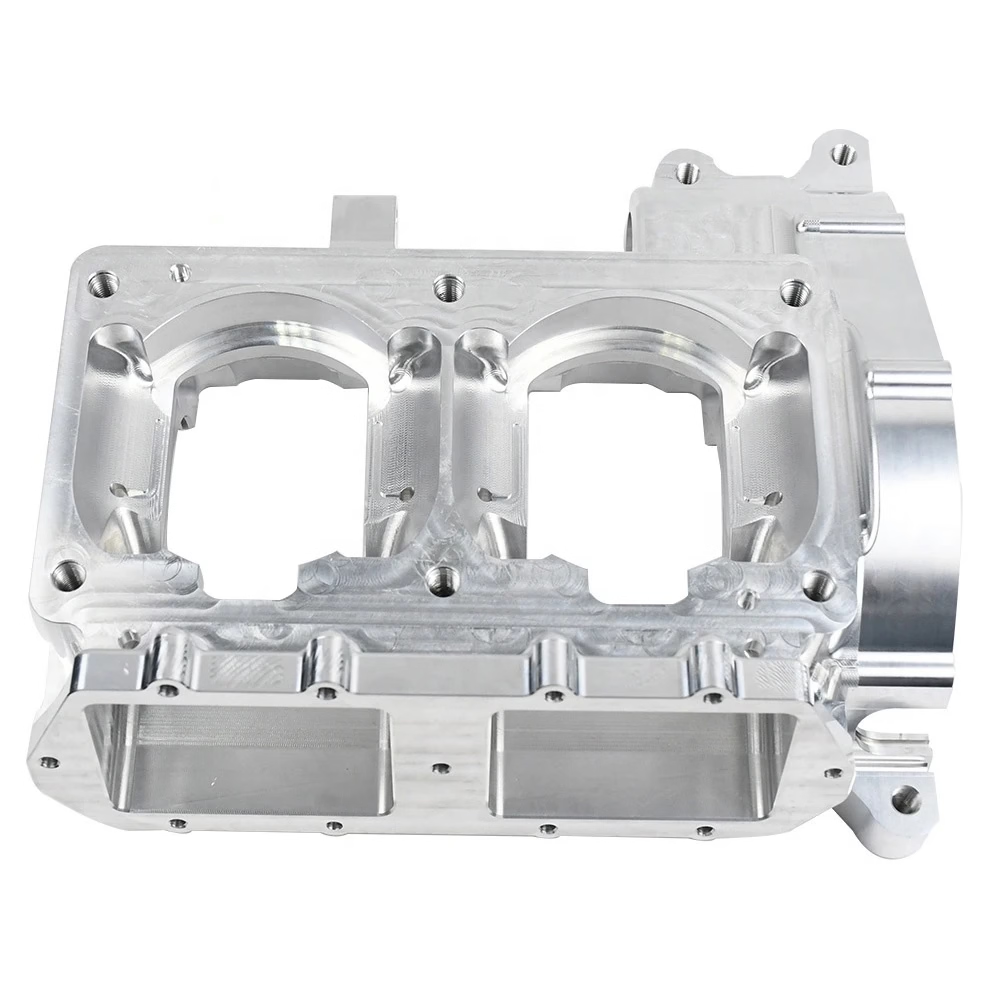
A CNC processing China service is not one machine. It is a mix, and the mix decides which of your parts fits. GreatLight runs 127 high-precision CNC machines: 16 simultaneous 5-axis machining centers, 12 four-axis mills, 27 three-axis machines and 16 mill-turn centers across three plants covering 7,600 m². That spread matters when you need a turned shaft and a milled housing from the same supplier.
Travel limits are the first filter. Large work fits the 4,000 × 400 × 150 mm envelope. Mid-size parts run on 750 × 1,150 × 550 mm or 600 × 600 × 600 mm machines. Compact parts go on 500 × 500 × 450 mm or 500 × 310 × 200 mm centers, which hold tolerance better because the structure is stiffer. Sending a 40 mm bracket to a large gantry is not wrong, but it costs more per part.
Five-axis work is where setup count drops. A part with features on five faces can be cut in one setup instead of four. Each eliminated setup removes a datum transfer and its error. For complex geometry, that is often the difference between holding ±0.005 mm and chasing it.
- 1Ask for the travel envelopeGive your bounding box. A supplier who answers in one line is telling you they checked.
- 2Match machine to batchPrototypes favor 5-axis and mill-turn. Simple volumes favor 3-axis with fixtures.
- 3Check the turning sideMill-turn centers handle shafts with cross-features without a second op.
Certifications and inspection: what an auditor will ask for
Certificates are not decoration. They tell you which industries the shop already serves and which paperwork exists before you ask. GreatLight holds ISO 9001:2015, IATF 16949:2016, ISO 13485:2016 and ISO 27001:2022. The first is the baseline for general machining. The second is what automotive and EV programs require. The third covers medical devices. The fourth covers information security, which matters when your CAD files leave your network.
Inspection is the part buyers forget to specify. A 99.99% qualification rate only means something if you know how it is measured. Ask for the inspection plan: raw material check on incoming bar and plate, in-process monitoring at defined steps, and final inspection before shipment. Every part is inspected before it ships, and dimensional reports are available on request.
For medical and automotive work, ask for lot traceability back to the heat number. If the shop cannot show which bar became which part, an audit finding is coming. Settle this during quoting, not after the first shipment.
- 1Ask for the certificate scopeA certificate with a narrow scope may not cover your process.
- 2Request a sample reportOne page of a past CMM report tells you more than a brochure.
- 3Confirm who inspectsIn-house inspection beats a subcontractor you never meet.
Lead time, MOQ and quoting: the commercial filters
Three numbers decide whether a supplier fits your program: quote turnaround, production start and shipping window. At GreatLight, quotation and free DFM analysis come back within 12 hours, production can start within 24 hours, and parts ship in 3–5 days. The historical late-delivery probability is below 2%. Treat those as the shop's stated capability and ask how they are tracked, because a date without a tracking method is a hope.
MOQ is the next filter. There is no minimum order quantity here, from one prototype to 10,000+ part runs. That matters if you are still validating a design. A supplier with a 500-piece MOQ forces you to buy inventory for a revision you may throw away. A supplier with no MOQ lets the prototype decide.
Quotingscope also varies. Some quotes list machining only and add finishing later. Ask whether the number covers material, machining, surface finishing, inspection and packing. A low quote that excludes anodizing is not a low quote.
- 1Ask what the quote includesMaterial, machining, finishing, inspection, packing. Get it in writing.
- 2Check the DFM responseFree DFM in 12 hours should include specific notes, not a generic reply.
- 3Confirm the ship date basisCalendar days or working days? Ask before you promise your customer.
Materials and finishing: where schedules quietly slip
Material choice narrows the supplier list fast. Aluminum grades 6061, 7075 and 6082 cut cleanly and hold tolerance. Stainless 303 and 316L machine well; 17-4PH needs more care. Titanium TC4 (Ti-6Al-4V) and Inconel are slow, generate heat and wear tools, so cycle time and cost rise. If your part is titanium, ask whether the shop has run it recently, not whether it can.
Plastics behave differently. POM and PEEK hold dimension better than ABS or PP, which flex under clamping. Carbon fibre needs diamond tooling and dust control. A supplier who treats plastic like aluminum will scrap your first run.
Finishing is the most common schedule risk. Anodizing, electroless nickel, zinc, silver and gold plating, powder coating, black oxide, bead blasting, tumbling, brushing and polishing all add days. Laser marking has a minimum character height of 1.5 mm, so check your label design early. Ask who runs the finishing line and who inspects the coated part.
- 1Name the grade, not just the family6061-T6 and 6061-O machine differently. Specify the temper.
- 2Plan masking before coatingThreads and mating faces often need masking. It affects the drawing.
- 3Check marking sizeBelow 1.5 mm character height, laser marking gets unreliable.
Confidentiality and file handling
Your CAD files carry your product. Before uploading, ask where they are stored, who can open them and how long they stay. GreatLight holds ISO 27001:2022 for information security, and uploads are handled as secure and confidential. An NDA is available on request if your legal team needs one on file before the first file transfer.
A practical test: ask the supplier to describe their file intake process. A shop that answers with a named system and a retention period is likely to pass your security review. A vague answer usually means files sit on a shared drive.
If your program runs under export control or a customer NDA, raise it during quoting. It changes what the shop can subcontract and how parts are labeled in the plant.
- 1Sign the NDA firstIf your legal team requires it, do it before the first upload.
- 2Ask about retentionHow long do files stay, and can they be deleted on request?
- 3Flag controlled programsExport control and customer NDAs affect subcontracting.
How to run a first order without surprises
Seven steps from drawing to shipment. Each one has a specific check.
- 1Prepare the file packageSend STEP plus a 2D PDF with GD&T, material grade and temper, finish per face, and the critical features marked. Missing datum information is the most common cause of a slow quote.
- 2Request the quote and DFMAsk for a 12-hour turnaround. Read the DFM notes, not just the price. Thin walls, deep pockets and tight corners should come back with a specific comment.
- 3Confirm tolerance and finish per featureState which dimensions carry ±0.005 mm and which run at general tolerance. Specify Ra 0.8–1.6 μm only where the function needs it.
- 4Lock the commercial termsConfirm what the quote includes: material, machining, finishing, inspection and packing. Confirm the MOQ, which can be one piece, and the ship-date basis.
- 5Approve the first articleFor tight-tolerance parts, review the first-article inspection report before the run continues. Catch a datum error at one piece, not at 500.
- 6Plan the finishing stepAnodizing, plating and powder coating add days. Confirm masking requirements and who inspects the coated surface.
- 7Inspect on arrivalCheck the shipment against the final inspection report. Every part is inspected before shipment, and reports are available on request.
Questions buyers ask before the first order
What tolerance can a CNC processing China service realistically hold?
±0.005 mm (±0.0002 in) is achievable on features that fit the machine's accuracy window, typically smaller parts on stiffer machines. On large parts up to 4,000 mm, thermal growth and workholding deflection widen the practical window.
Tell the supplier which features carry the tight callout. A drawing that marks three critical dimensions is easier to quote and inspect than one that marks all of them.
Is there a minimum order quantity for a first prototype?
At GreatLight there is no minimum order quantity. Runs range from one prototype to 10,000+ parts.
That matters during design validation. You can order one piece, check the fit, revise the model and order again without buying inventory you will not use.
Which certifications should I ask for?
ISO 9001:2015 is the baseline for general machining. IATF 16949:2016 is required for automotive and EV programs. ISO 13485:2016 covers medical devices. ISO 27001:2022 covers information security for your files.
Ask for the certificate scope as well as the certificate. A scope that excludes your process does not help you in an audit.
How fast can parts ship?
Quotation and free DFM analysis come back within 12 hours. Production can start within 24 hours, and parts ship in 3–5 days.
The historical late-delivery probability is below 2%. Ask how the schedule is tracked so the date means something on your side too.
Can the supplier handle finishing as well as machining?
Yes. Finishing options include anodizing in clear, colour, hardcoat and conductive types; electroless nickel, zinc, silver and gold plating; powder coating and black oxide; bead blasting, tumbling, brushing and polishing; and laser marking.
Laser marking has a minimum character height of 1.5 mm. Check your label artwork against that limit before the run starts.
How are my drawings protected?
Uploads are handled as secure and confidential, and an NDA is available on request. ISO 27001:2022 covers the information security side.
If your program runs under export control or a customer NDA, raise it during quoting. It affects subcontracting and plant labeling.
Send the drawing, get a reviewed quote
Upload your STEP and 2D files. We return a quote and DFM notes within 12 hours, with no minimum order quantity.
12-hour quote100% inspectionNo MOQ
More from the shop floor
We publish setup notes, tooling trials and inspection data from the factory floor.











