
China CNC Machining Prototype Service: How to Pick a Supplier Who Won't Cost You a Week
Written for design engineers and sourcing managers who need functional prototypes, not display models. You will get the checks that separate a real shop from a trading office, plus the numbers you should ask for before you release a PO.
In this article
- 1
- 2
- 3
- 4
- 5
- 6
- 7
- 8
Key takeaways
What to verify before you award a prototype order
Use this as a checklist when comparing two or three suppliers.
| Criterion | What to ask | Red flag |
|---|---|---|
| Tolerance | What do you hold on this Ø12 H7 bore? | Answer is only a brochure number |
| Lead time | Quote and DFM in how many hours? | Vague 'as soon as possible' |
| MOQ | Can you run one part? | Minimum of 10 or 50 pieces |
| Certifications | Which certificates cover this plant? | Certificate from a sister company |
| Material stock | Is 7075 or Ti-6Al-4V on the floor? | Two-week material lead time |
| Inspection | What is measured, and do I get a report? | No report unless I pay extra |
| Confidentiality | Will you sign our NDA? | Refuses or stalls on NDA |
| Scaling | Can you take it to 10,000 parts? | Prototype-only shop, no production line |
Pick the shop that asks questions before it quotes
Price matters, but a DFM report in 12 hours and a per-feature tolerance answer will save more schedule than a lower unit cost. Ask the eight questions in the table, get the NDA signed, and let the first article decide.
Tolerance, geometry and what a prototype shop can actually hold
Every supplier will quote ±0.005 mm. The useful question is where that number applies. On a 200 mm aluminium bracket, holding ±0.005 mm across the full length is a different job from holding it on a 20 mm bearing seat. Heat, tool deflection and fixturing all grow with part size, so ask for the tolerance per feature, not per shop.
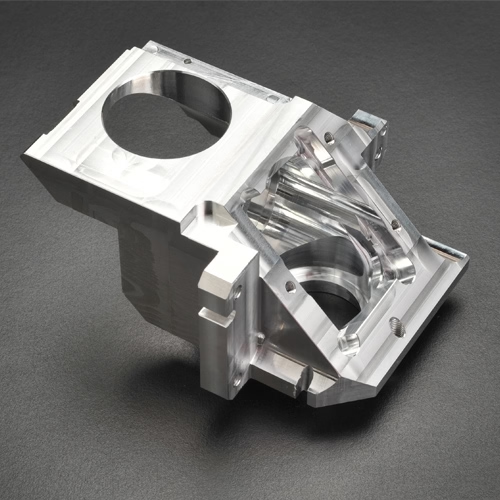
Geometry drives the machine choice. A part with undercuts, deep pockets on five faces, or compound angles needs a 5-axis center, and the setup count changes the price. GreatLight runs 16 simultaneous 5-axis machining centers, 12 four-axis mills and 27 three-axis machines, so the shop can route your part to the machine that fits rather than forcing it onto whatever is free.
Size sets the ceiling too. The largest travel here is 4,000 × 400 × 150 mm, with medium envelopes of 750 × 1,150 × 550 mm and 600 × 600 × 600 mm. If your prototype is a full frame rail or a long extrusion, confirm the envelope before you send the file. Otherwise you will get a quote that quietly splits the part into two pieces.
Surface finish follows the same logic. Ra 0.8–1.6 μm is a normal machined finish for sealing faces and bearing bores. Ra 0.2–0.8 μm means slower passes, finer tools and more inspection time, so it should be reserved for the features that need it. Ra 1.6–3.2 μm is fine for brackets, housings and anything that gets painted or anodized.
- 1Tight tolerance on small featuresBores, spigots, bearing seats. Achievable and worth paying for.
- 2Tight tolerance across long spansNeeds temperature control and careful fixturing. Ask how they plan to hold it.
- 3Thin walls under 1 mmChatter risk. Expect to discuss wall thickness before quoting.
Lead time, quoting and the 12-hour DFM window
A prototype schedule usually breaks in the first two days, before any metal is cut. Files bounce back with questions, the DFM report arrives late, and the buyer is left guessing. A supplier worth using turns the quote and a free DFM analysis around within 12 hours, so you can fix the model while the schedule is still intact.
Then production can start within 24 hours of an approved file. That number assumes material is in stock and the drawing is settled. If your part needs 7075 aluminium or Ti-6Al-4V that is not on the floor, add material lead time on top. Ask directly which grades are stocked and which are ordered in. GreatLight keeps 6061, 6061-T6, 2024, 5052, 5083, 6063, 6082, 7075 and ADC12 on the aluminium side, plus 303, 304, 316, 316L, 420, 430, 431, 440C and 17-4PH stainless.
Finished parts ship in 3–5 days. That is the window after machining, and it includes the inspection step. Treat it as a planning figure, not a guaranteed delivery date, and build a buffer for your own assembly and test. Historical late-delivery probability is below 2%, which is a useful number to ask any supplier for in writing.
Watch for quotes that arrive in an hour with no questions. A fast quote with no DFM comments usually means nobody opened the model. The value of a China CNC machining prototype service is the engineering feedback, not the speed of the reply.
- 1Quote plus DFM in 12 hoursLets you fix the model before tooling and material are committed.
- 2Production start in 24 hoursApplies after file approval and material availability.
- 3Shipping in 3–5 daysIncludes final inspection. Keep your own buffer.
MOQ, unit cost and how prototype pricing really works
Prototype pricing is dominated by setup, programming and fixturing, not by material. On a single part, the aluminium might cost a few dollars while the CAM programming costs far more. That is why a supplier with no minimum order quantity can still be competitive on one piece: the cost is already there, and adding parts 2 through 10 only adds machine time.
Ask how the shop prices a one-off versus a run of 10,000. A supplier set up for production will show a clear cost curve as volume rises. GreatLight runs from one prototype to 10,000+ part runs, so the same process and inspection standard carries from the first article into the production order. That continuity matters more than a few percent on the first invoice.
Beware of quotes that hide tooling or programming in a line item called 'engineering'. It is not dishonest, but you should know what you are paying for and whether it is reusable on the next revision. If you plan three design iterations, ask whether the fixture and program can be reused and what the second run costs.
Material choice moves cost more than most buyers expect. Titanium and Inconel cut slowly and wear tools, so a Ti-6Al-4V bracket can cost several times the same part in 6061. If the prototype is for fit and function only, 6061 or 7075 will usually answer the question at a fraction of the cost. Save the exotic alloy for the validation build.
- 1Setup dominates the first partProgramming and fixturing are the real cost, not the billet.
- 2Ask about reuse across revisionsA reusable fixture lowers the cost of iteration 2 and 3.
- 3Match alloy to the questionUse 6061 for fit checks, titanium for final validation.
Certifications, inspection and protecting your design
Certifications tell you what systems are in place, not what the shop can machine. ISO 9001:2015 covers general quality management. IATF 16949:2016 is the one automotive buyers look for on a PPAP path. ISO 13485:2016 applies to medical device work. ISO 27001:2022 covers information security, which is the certificate that matters if your drawings are valuable.
Inspection is where prototypes often go wrong. A shop that measures only the features that are easy to reach will miss the one dimension that matters. Ask what is measured, with what equipment, and whether a report comes with the parts. GreatLight inspects 100% before shipment and can supply raw material checks, in-process monitoring and final inspection reports on request.
The qualification rate here is 99.99%, which is a shop-level figure across inspected features. Read it as a sign of process control, not as a promise that your first article will be perfect. The first article exists precisely to surface the features that need a tolerance conversation.
On IP, get the NDA signed before you upload anything. Uploads are handled as secure and confidential, and a non-disclosure agreement is available on request. If a supplier hesitates on an NDA for a prototype, that tells you how they will behave when the part is in production.
- 1ISO 9001:2015Baseline quality system. Expect this from any serious shop.
- 2IATF 16949:2016Automotive. Ask whether it covers the plant doing your part.
- 3ISO 13485:2016Medical devices. Relevant for validated processes.
- 4ISO 27001:2022Information security. Important for sensitive CAD data.
When CNC machining is the right prototype process, and when it is not
CNC machining wins when the prototype has to behave like the production part. If the final part will be machined, a machined prototype gives you the same material, the same grain direction and the same surface. You can test thread strength, press fits and fatigue behaviour with reasonable confidence.
It also wins on accuracy. A machined housing can hold a bearing bore and a sealing face that a printed part cannot match without post-machining. If your test involves pressure, vibration or thermal cycling, machining is usually the only prototype route that survives the test.
CNC loses on hollow, lattice or organic shapes. A part with internal channels or a topology-optimized structure is expensive to machine and cheap to print. The same goes for very thin walls and large flat panels, where sheet metal or vacuum casting will be faster and cheaper.
The practical answer is often a mix. Machine the interfaces, the bores and the load-bearing features. Print or cast the covers and the non-critical geometry. A supplier who offers both routes can tell you where the split should be, instead of selling you the process they happen to run.
- 1Choose CNCFunctional testing, tight bores, threads, press fits, production-matched material.
- 2Choose another processInternal channels, lattices, large thin panels, cosmetic shells.
- 3Split the buildMachine the critical features, print or cast the rest.
Seven steps from CAD file to first article
Follow this order to keep a prototype on schedule.
- 1Send a STEP file plus a 2D drawingSTEP carries the geometry; the 2D drawing carries tolerances, datums and finish callouts. A model alone leaves critical dimensions open to interpretation.
- 2Ask for DFM feedback before the quoteRequest the DFM analysis with the price. Look for comments on wall thickness, tool reach, thread depth and datum strategy. No comments means no one reviewed it.
- 3Confirm material and stock statusState the alloy and temper. Ask whether it is on the floor. 6061-T6 and 7075 are common; Ti-6Al-4V and Inconel usually add material lead time.
- 4Fix the inspection plan with the POName the features that must be measured and the report format. Add first-article inspection for anything that interfaces with an existing assembly.
- 5Approve the file in writingProduction can start within 24 hours of written approval. Verbal approval plus a phone call is how schedules slip. Send a dated email.
- 6Review the first article against the drawingCheck the critical dimensions first, then fit. If a feature is out, decide whether it is a tolerance issue or a design issue before asking for a re-cut.
- 7Plan the bridge to productionIf the design is close, ask what changes when volume moves to production tooling or a production machine. Keep the same supplier if the process carries over.
Questions buyers ask before the first order
Can I order a single prototype part from a China CNC machining prototype service?
Yes. There is no minimum order quantity, and the range runs from one prototype to 10,000+ part runs. On a single part, most of the cost is programming and fixturing rather than material.
Expect the unit price of part one to be much higher than part ten. That is normal, and it is not a sign of an inflated quote.
How fast can I get a quote and a DFM report?
Quotation and a free DFM analysis come back within 12 hours. Production can start within 24 hours of an approved file, and finished parts ship in 3–5 days.
If your alloy is not in stock, add material lead time. Ask which grades are held on the floor before you set a build date.
What tolerance can I expect on a prototype?
Shop capability is ±0.005 mm, which is ±0.0002 in. Whether that applies to your part depends on feature size, material and fixturing.
Send the drawing and ask for a per-feature answer. A supplier who discusses this before quoting is the one to keep.
Do you sign an NDA before I share CAD files?
Yes. A non-disclosure agreement is available on request, and uploads are treated as secure and confidential.
Sign it before the first upload. If your design is the product, the NDA is not paperwork, it is the first engineering control.
Which materials are available for prototypes?
Aluminium grades include 6061, 6061-T6, 2024, 5052, 5083, 6063, 6082, 7075 and ADC12. Stainless includes 303, 304, 316, 316L, 420, 430, 431, 440C and 17-4PH.
Steel, copper, brass, titanium, Inconel, magnesium and engineering plastics such as POM, PEEK and PC are also available. Finish options run from anodizing and plating to bead blasting and laser marking.
Can the same supplier take the part into production?
That is the point of choosing a supplier with production capacity. The shop runs 127 high-precision CNC machines across three plants, including 16 simultaneous 5-axis centers and 16 mill-turn centers.
Keeping the same process and inspection standard from first article to production removes a re-qualification step later.
Send your CAD file and get a quote with DFM notes
Upload the STEP file and 2D drawing. You get a price and a free DFM analysis within 12 hours, with no minimum order quantity.
12-hour quoteNo MOQ100% inspectionNDA on request
More from the shop floor
We publish setup notes, tooling trials and inspection data from the factory floor.











