
China CNC News: Alibaba vs Amazon Sales for Custom CNC Parts
Both platforms list machined parts. They serve different buyers. This page compares how each handles RFQs, tolerances, sampling and fees, so a design engineer or sourcing lead can pick the right channel before sending a drawing.
What this comparison covers
A buying guide for engineers, not a marketplace ranking.
Catalog listings and RFQ threads are not the same purchase
Amazon is built around a fixed SKU. A buyer finds a listing, pays a listed price, and receives a standard item. That model fits drill bits, tool inserts, fasteners, stock bar and MRO spares. The listing already exists, so nobody has to read a drawing.
Custom CNC work starts from a 2D print or a STEP file. Someone has to check datums, thread callouts, surface finishes and inspection requirements before a price means anything. On Alibaba this happens in a supplier RFQ thread. On Amazon it usually does not happen at all.
This is the first split to understand. One platform sells finished goods. The other is a channel where a supplier reads your geometry, quotes it, and then cuts metal. A catalog page cannot answer a tolerance question. A supplier engineer can.
- 1Catalog channelsBest for standard, repeat-buy hardware with a known part number.
- 2RFQ channelsBest for one-off or low-volume parts built to your drawing.
- 3Mixed useMany teams buy tooling on one platform and custom parts on the other.
Where each channel breaks down on complex geometry
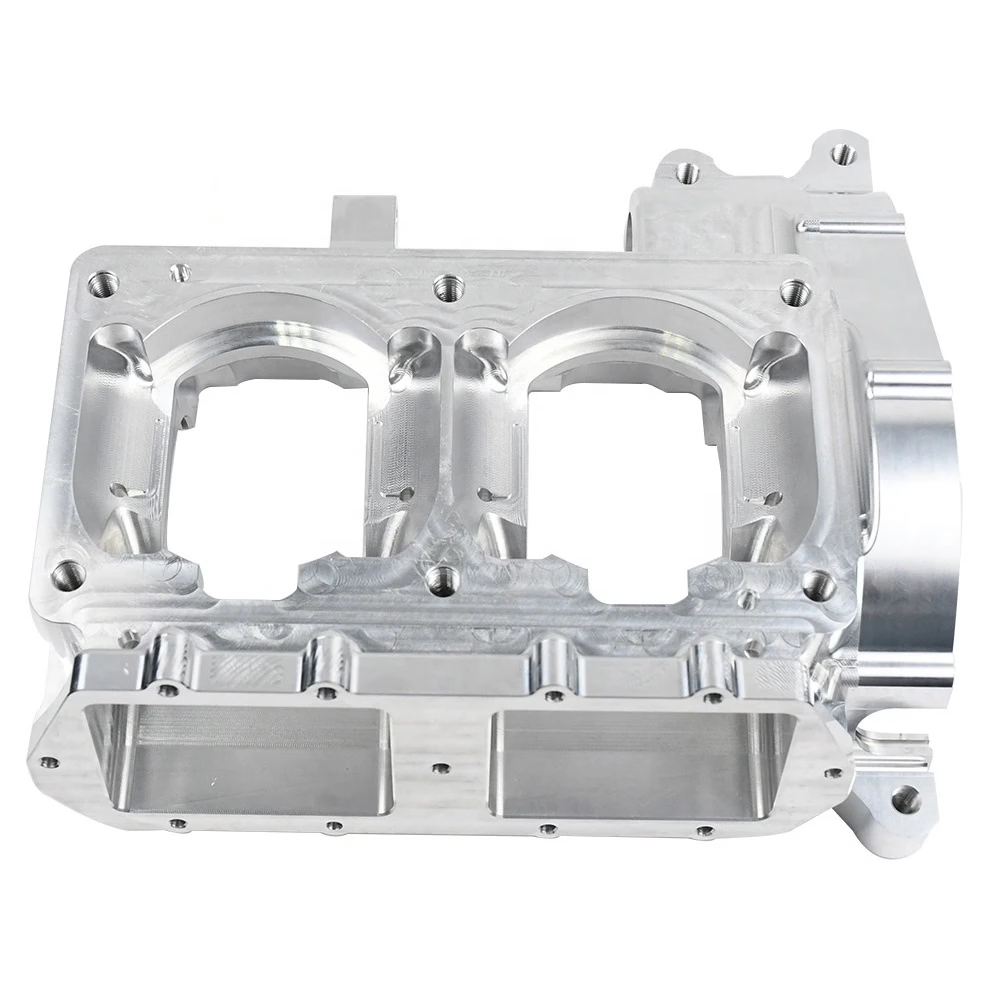
Complex parts punish a fixed listing. Take a 5-axis bracket with undercut pockets, a 0.8 μm sealing face, and a true-position callout on six holes. No catalog entry can price that. It needs a setup plan, a workholding decision, and a probe routine.
Suppliers on Alibaba can show portfolios of titanium, aerospace alloy and medical-grade plastic work, and the RFQ thread lets both sides discuss a specific feature. Amazon has no native tool for that conversation. Its strength is off-the-shelf MRO items.
So the geometry decides the channel. Simple prismatic parts with loose tolerances can move through either. Once you add curved surfaces, thin walls, or a callout tighter than ±0.05 mm, the RFQ route is the only one that returns a usable answer.
One more thing matters: who owns the risk when a feature is hard to hold. A catalog seller ships what is in the box. A machining supplier quotes a process and carries the inspection record. Those are different obligations.
- 1Fits a catalogFlat plates, spacers, bushings, standard hardware, simple turned parts.
- 2Needs an RFQContoured surfaces, deep pockets, tight true position, thin walls.
- 3Needs a partnerPrototype-to-production transitions, engineering change loops, PPAP-style files.
Alibaba and Amazon compared for custom CNC sourcing
Cells describe the typical channel behavior, not a guarantee from either platform.
| Factor | Alibaba (RFQ) | Amazon (catalog) |
|---|---|---|
| Typical purchase | Custom parts to print | Standard SKUs and MRO |
| Quoting | Supplier reads drawing, quotes process | Fixed listed price |
| Tolerance talk | Feature-level discussion | Usually none |
| Fees | Negotiated per supplier | Platform commission on the sale |
| Sampling | Sample or first article common | Buy the listed unit |
| Lead time | Engineering plus machining time | Fast if the item is stocked |
| Best fit | Prototypes to 10,000+ runs | Simple, repeat hardware |
| Main risk | Supplier quality varies | Listing may not match the print |
Platform fees, payment protection and sample checks
Amazon charges a commission on most industrial sales, and that percentage sits inside the price you pay. For a high-tolerance part with several machining hours, the fee is a smaller share of the total, but on low-value hardware it can be a real markup.
Alibaba works on negotiated terms. Payment protection covers basic order disputes, but technical judgment stays with the buyer. Check machining capability claims, certificates, and whether the shop can actually inspect what it cuts. A supplier profile is marketing, not evidence.
Samples settle most arguments. Order one piece, measure the critical dimensions, and compare the finish to the drawing. If the first article holds ±0.005 mm on the features that matter, the process is under control. If it does not, the price was never the real issue.
Ratings help on standard goods. They help far less on custom work, because two buyers of the same bracket may have different prints. A five-star score on a simple part says little about a five-axis aerospace housing.
- 1Verify capabilityAsk which machines and which inspection equipment will run your part.
- 2Verify paperworkRequest material certs and a dimensional report with the shipment.
- 3Verify with a sampleMeasure the first article before releasing a production run.
A short procurement path that avoids rework
Match the channel to the part, not to habit. Standard hardware and tooling go through a catalog. Anything built to your drawing goes through an RFQ with a supplier you have checked. Mixing the two is where most sourcing mistakes start.
Send complete data with the RFQ: STEP file, 2D print with GD&T, material, finish, quantity and any inspection requirement. A supplier who receives all of that can quote in hours. A supplier who has to guess will quote low and clarify later, which costs more.
At GreatLight we run 127 high-precision CNC machines across three wholly-owned plants in Dongguan and Singapore, including 16 simultaneous 5-axis machining centers and a Ø400 mm rotary table. That capacity supports one prototype or a 10,000+ part run with no minimum order quantity.
Before production, we check raw material, monitor in-process, and inspect 100% of parts before shipment, with reports on request. Uploads stay confidential and an NDA is available. That is the part a marketplace listing cannot offer.
- 1Use RFQ forCustom geometry, tight tolerance, documented inspection.
- 2Use catalog forStandard consumables, spares, low-risk hardware.
- 3Always doFirst article check before the full run.
Frequently asked questions
Can I buy a custom CNC part on Amazon?
You can find sellers who list machined parts, but the listing is built for a fixed item. There is no standard field for GD&T, surface finish or material certification.
If your part needs a print-based quote, use an RFQ channel instead. Amazon works better for standard hardware you already know.
Does Alibaba verify that a supplier can hold ±0.005 mm?
No. The platform verifies business identity and some credentials, not machining capability. Tolerance capability is something you check yourself.
Look at the machine list, the inspection equipment, and a first article report. A sample order is the fastest test.
How much do platform fees add to a machined part?
On catalog platforms a commission is applied to the sale, and it is already inside the price shown. On high-value custom parts the fee is a small share of the total.
On cheap hardware the same percentage is a larger markup. Compare the landed price, not the listed price.
Should I send a STEP file or a 2D drawing?
Send both when you have them. The STEP file defines geometry and the 2D print defines tolerance, datum structure, threads and finish.
For a part with a tight true-position callout, the print is the controlling document. Geometry alone cannot express it.
What should a first article inspection cover?
Cover the features that carry function: mating surfaces, bore diameters, hole positions, and any callout tighter than the general tolerance block.
Check surface finish on sealing or sliding faces too. A dimension can pass while the finish fails the application.
Is a smaller order still economic?
Yes, when the quote is built from setup time plus cycle time. Low volume means the setup is spread over fewer parts, so unit cost is higher.
A single prototype is still worth quoting. It is the cheapest way to confirm a process before a production run.
Send the drawing and get a real answer
Quotation and free DFM analysis within 12 hours. No minimum order quantity, from one prototype to 10,000+ parts.
12-hour quote100% inspectionNDA on request









