
Georgias CNC Rise: Alibaba Meets Amazon
What actually drove the Georgias CNC rise, and what it means for engineers sourcing machined parts. We break the boom into forces you can check, not slogans. Read this and you can tell which supplier claims hold up.
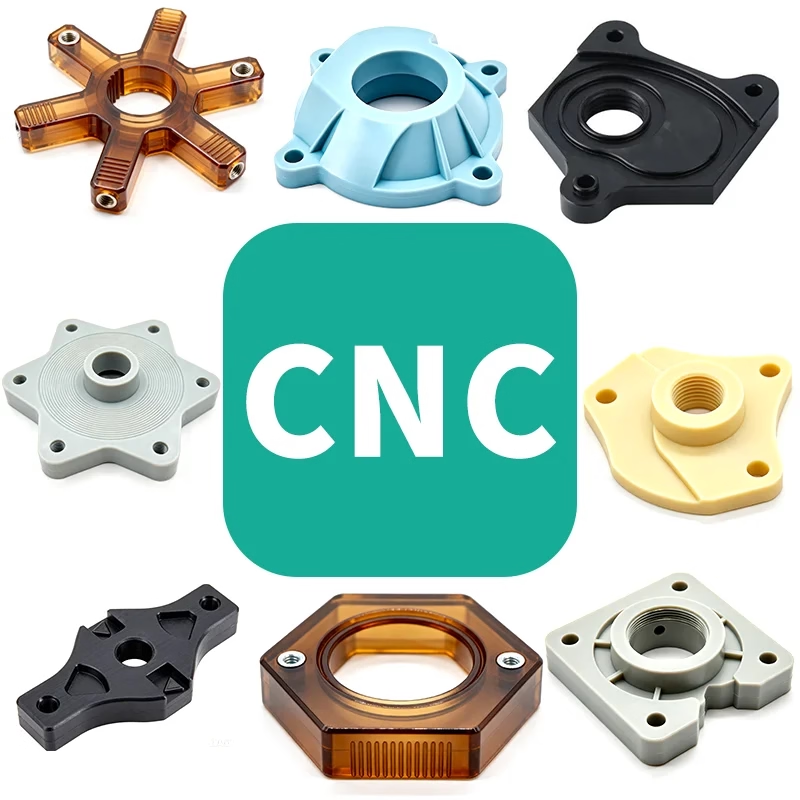
What the Georgias CNC rise actually rests on
The Georgias CNC rise is often described as a meeting of two e-commerce giants. That framing is loose but not wrong. What changed is not the cutting tools. What changed is how fast a buyer in Ohio or Stuttgart can find, vet, and order a machined part from a shop in Tbilisi or Batumi. The machine is the same 3-axis mill either way.
Three things moved together. Freight and customs links through Poti and Batumi opened a shorter path between the Black Sea and Central Asia. STEM graduates entered the workforce in numbers. And online platforms turned a local job shop into a listing that a US engineer can compare against ten others in an afternoon.
None of that makes a Georgian shop automatically better than a Dongguan shop. It changes the search cost. When search cost drops, lead time and price get squeezed, and the shop that wins is the one that documents its process. That is the part engineers should care about.
- 1Search cost drops firstBuyers compare more shops, so quotes tighten before capability improves.
- 2Documentation decidesA shop that publishes tolerance and inspection data wins the repeat order.
- 3Geography is secondaryFreight lanes help, but process control closes the deal.
How online marketplaces changed CNC sourcing
A CNC order used to start with a phone call and a faxed drawing. Now it starts with an upload. The buyer sends a STEP file, gets a DFM note back, and compares unit price at 100 and 1,000 pieces. That flow is what the Alibaba-meets-Amazon comparison is really pointing at: discovery like a marketplace, fulfillment like a storefront.
The engineering consequence is blunt. When ten shops quote the same part, the differentiator stops being the spindle and becomes the feedback loop. Can the shop flag a 0.5 mm wall before it machines it? Can it hold ±0.005 mm on a 200 mm aluminum frame without a second op? Those answers are what separate a listing from a partner.
It also raises the cost of hiding problems. A buyer who receives a bad batch now posts about it. Reputation moves faster than a shipping container. For a shop, that means in-process monitoring is not overhead. It is the product.
- 1Upload replaces the phone callSTEP plus a tolerance callout is enough to start a quote.
- 2DFM becomes the first filterShops that return manufacturability notes early win more work.
- 3Reputation travels fastOne bad batch can outrun a container of good ones.
Where the marketplace model breaks down
Marketplaces are good at simple parts. A bracket, a spacer, a cover plate. One setup, one material, loose tolerance. The listing model handles those well because the risk is low and the drawing is self-explanatory.
It breaks on parts where the drawing is not the whole story. A housing with a 0.4 mm floor, a valve body with cross-drilled ports, a heat sink with thin fins. Those need a conversation about stock, workholding, and thermal drift before a price means anything. A web form cannot hold that conversation.
There is also a materials limit. If your part needs Ti-6Al-4V or Inconel, the quote depends on tool wear and spindle load, not on a catalog price. A platform that treats titanium like 6061 will give you a number that changes later. Ask how the shop handles the hard stuff before you trust the easy number.
- 1Simple parts travel wellOne setup, loose tolerance, low risk: marketplaces work.
- 2Complex parts need a callThin walls and cross-ports need workholding review first.
- 3Hard alloys change the mathTool wear on Inconel and Ti-6Al-4V is not a catalog line item.
What this means if you are sourcing parts
The rise of a new machining region is good news for buyers. More shops competing means more quotes and shorter lead times. But a longer supplier list is not the same as a better supplier list. You still need a way to sort them.
Start with the tolerance the part actually needs. A fixture plate at ±0.05 mm does not need a 5-axis shop. A medical manifold at ±0.005 mm does. Matching the shop to the callout saves money and avoids over-specifying.
Then check the inspection story. Ask what gets measured, on what equipment, and whether a report ships with the parts. A shop that answers that in one email is usually the one that answers a problem in one email too.
- 1Match shop to calloutDo not pay for 5-axis on a part that needs 3-axis.
- 2Ask about inspectionWhat is measured, on what, and does a report ship?
- 3Test with one partA single prototype reveals more than a page of claims.
Which sourcing route fits your part
Match the route to part complexity and tolerance, not to country.
| Part type | Best route | Why |
|---|---|---|
| Simple bracket, ±0.1 mm | Marketplace listing | Low risk, drawing is self-explanatory |
| Prototype housing, ±0.02 mm | Shop with DFM feedback | Thin walls need review before quoting |
| Medical manifold, ±0.005 mm | Certified contract shop | IATF or ISO 13485 trail required |
| Large frame, 2,000 mm | Shop with 4,000 mm travel | Workholding and travel decide feasibility |
| Titanium valve body | Shop with 5-axis and tooling data | Tool wear drives the real price |
| Cosmetic panel, anodized | Shop with in-house finishing | Color match needs one vendor |
The short verdict
If your part is simple and tolerance is loose, a marketplace listing is fine. If it has thin walls, tight tolerance, or a hard alloy, pick a shop that returns DFM notes and inspection data before the first chip.
Questions engineers ask next
Does a rising machining region mean lower prices?
Usually on simple parts, yes. Competition on brackets and spacers pushes unit price down because the work is easy to compare.
On complex parts the price depends on setup, tooling, and inspection, so a new region does not automatically undercut an established shop. Compare the DFM notes, not just the number.
How tight a tolerance can a 5-axis shop hold?
GreatLight holds ±0.005 mm (±0.0002 in) on qualified features, with surface finish down to Ra 0.2–0.8 μm when the part calls for it.
The limit is usually the part, not the machine. Thin walls, long overhangs, and heat buildup move the feature more than the spindle does.
When should I skip a marketplace and go direct?
When the drawing needs interpretation. Cross-drilled ports, 0.4 mm floors, and cosmetic surfaces all need a conversation before quoting.
Also go direct when you need a certification trail. IATF 16949, ISO 13485, and ISO 9001 audits require documents a listing rarely carries.
What is the fastest way to test a new shop?
Send one prototype with a tight but realistic callout. Watch how fast you get DFM feedback and whether the first article matches the drawing.
A shop that flags a problem before machining is worth more than one that hits the number by luck.
Do I need to worry about confidentiality with online sourcing?
Yes, especially for unreleased products. Ask whether uploads are encrypted and whether an NDA can be signed before you send files.
GreatLight offers an NDA on request and keeps uploads secure and confidential.
How long should a quote take?
For a clear drawing, a day is reasonable. GreatLight returns a quotation and free DFM analysis within 12 hours, and production can start within 24 hours.
If a shop takes a week to price a simple part, that is a signal about how it will handle a change order.
Send a drawing, get a manufacturability answer
Upload your STEP file and we return a quote with DFM notes within 12 hours. No minimum order quantity, from one prototype to 10,000+ parts.
12-hour quote100% inspectionNo MOQ
Follow our shop floor
We publish setup notes, tooling trials and inspection data from the factory floor.











