
China CNC Titanium Processing Guide
This guide is for design and manufacturing engineers who need titanium parts cut to tight tolerances and want to know how the work is actually done. It covers alloy selection, cutting behavior, five-axis setup choices, inspection, and the trade-offs of placing titanium CNC work with a Chinese supplier.
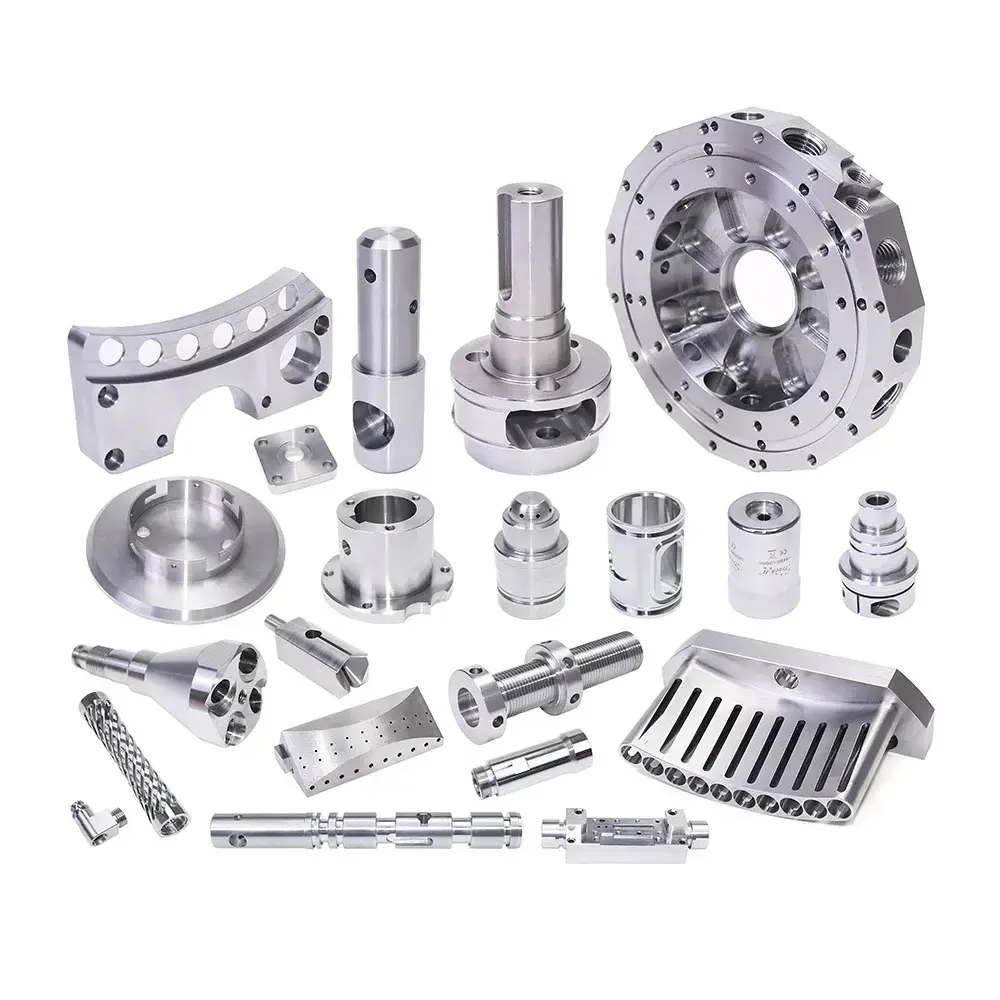
What This Guide Covers
Read the alloy and geometry first, then match the machine and the coolant to the part.
Why Titanium Punishes the Wrong Setup
Titanium sits in an awkward place for machining. It holds roughly 60% of the stiffness of steel but carries loads at half the density, so thin ribs and long slender features deflect before the cutter is even loaded. Thermal conductivity is low, around 7 W/m·K for Ti-6Al-4V. Heat generated at the cutting edge has nowhere to go except into the tool and the part surface.
That heat concentration is what kills tools. Carbide edges reach 1,000 °C in a cut that would run cool in 6061 aluminum. Above roughly 600 °C titanium starts absorbing oxygen and nitrogen from the air, and the resulting alpha case is hard and brittle. Cut through it and the surface layer cracks under fatigue.
There is also the chemical side. Titanium welds itself to cutting tool materials under pressure, so a dull edge grabs instead of shears. Built-up edge grows fast, then breaks off and takes a chip of the workpiece with it. Rubbing, not cutting, is the usual failure mode on a badly programmed titanium job.
None of this makes titanium unmachinable. It makes the process window narrow. Feed per tooth, radial engagement, coolant pressure and tool coating all have to line up. Get them right and TC4 cuts predictably at 40–60 m/min surface speed.
Grades You Will See in a Quote Request
Most titanium work that lands on a Chinese CNC floor is one of three grades. Commercially pure TA1 and TA2 are soft, weld easily and go into chemical and marine parts. TC4, known in the West as Ti-6Al-4V or Grade 5, is the workhorse for aerospace brackets, medical instruments and motorsport components.
Grade 5 responds to heat treatment and reaches about 950 MPa tensile. That strength is the reason it is specified, and also the reason it is slow to cut. Grades 2 and 5 together cover the large majority of drawings we quote.
Grade 23, the ELI version of Ti-6Al-4V, turns up in implants where fracture toughness and low interstitial content matter. It machines much like Grade 5 but costs more and needs tighter material traceability. Ask for the mill certificate before the first cut, not after.
If your part only needs corrosion resistance and not high strength, say so on the drawing. Substituting TA2 for TC4 can cut cycle time by a third and reduce tool wear sharply. We flag this during DFM review when the load case allows it.
- 1TA1 / TA2Commercially pure. Easy to cut, good corrosion resistance, lower strength.
- 2TC4 (Grade 5)Ti-6Al-4V. Heat treatable to about 950 MPa. The default structural grade.
- 3TC4 ELI (Grade 23)Lower interstitials, higher toughness. Medical implants, traceability required.
Titanium Grade Comparison for CNC Planning
Typical values for planning only; confirm against the mill certificate for your lot.
| Grade | Tensile strength | Relative machinability | Typical parts |
|---|---|---|---|
| TA1 | ~240 MPa | Good | Chemical vessels, marine fittings |
| TA2 | ~345 MPa | Good | Heat exchangers, process piping |
| TC4 (Grade 5) | ~950 MPa | Poor | Aerospace brackets, motorsport |
| TC4 ELI (Grade 23) | ~860 MPa | Poor | Implants, surgical instruments |
| Ti-6Al-4V annealed | ~900 MPa | Poor | General structural hardware |
Where Five-Axis Changes the Titanium Job
A three-axis titanium job usually means several setups. Every setup is a chance to lose position and a chance to load the part onto a fixture that flexes. Five-axis work cuts most of that away. On a simultaneous five-axis center, the tool reaches the back side of a bracket without the operator unclamping it.
The bigger gain is chip evacuation and tool engagement. Tilting the tool axis lets the cutter exit the cut cleanly instead of rubbing at the bottom of a pocket. On titanium, that single change can double tool life. Contouring a curved surface with the tool tip also spreads wear across the full flute length.
GreatLight runs 16 simultaneous five-axis machining centers, alongside 12 four-axis mills and 27 three-axis machines. Five-axis travel reaches 4,000 × 400 × 150 mm for long parts, with 750 × 1,150 × 550 mm and 600 × 600 × 600 mm envelopes for mid-size work. Compact cells cover 500 × 500 × 450 mm. A Ø400 mm rotary table handles round parts that need indexed features on several faces.
Not every titanium part belongs on a five-axis machine. A simple plate with drilled holes is cheaper on a three-axis mill, and moving it to a five-axis cell only adds hourly rate. The decision should follow geometry, not the machine list.
Coolant, Tools and Parameters That Hold Tolerance
High-pressure through-spindle coolant is not optional on titanium. Delivering 70 bar or more at the cutting edge breaks the chip, clears heat and stops the recut that dulls edges. Flood coolant alone works on shallow cuts but loses control once a tool goes deeper than two diameters.
Tooling follows the same logic. Uncoated fine-grain carbide with a sharp edge is a common choice for finishing. For roughing, AlTiN or AlCrN coatings resist the heat, but the edge geometry has to stay sharp. Avoid the same high-helix geometry you would use on aluminum; it pulls the part into the cutter.
Parameters vary with the rigidity of the setup. Roughing a solid TC4 block at 40–50 m/min with 0.1–0.15 mm feed per tooth is a workable starting point. Finishing runs faster, 60–80 m/min, with light radial engagement. Climb milling is standard.
Tolerance is where the plan gets tested. GreatLight holds ±0.005 mm (±0.0002 in) on titanium features, with a 99.99% qualification rate across inspected parts. That number only holds when the fixture is stiff and the stock has been stress-relieved before the final pass.
What China CNC Titanium Processing Actually Offers
Titanium stock is expensive, and so is the machine time. A Chinese supplier working from Dongguan or Singapore can spread tooling and programming cost across a wider machine base, which matters on low-volume runs that still need five-axis capability. That is the practical reason buyers move titanium work here.
The second reason is turnaround. GreatLight quotes and returns a free DFM analysis within 12 hours, and production can start within 24 hours of approval. Titanium parts typically ship in 3–5 days. Historical late-delivery probability sits below 2%, which is the number that matters when an aerospace bracket is holding up an assembly.
Certification coverage matters more than price on regulated parts. The plants hold ISO 9001:2015, IATF 16949:2016, ISO 13485:2016 and ISO 27001:2022. Medical and automotive titanium work can be routed through the relevant system without a separate supplier audit.
There is no minimum order quantity. One prototype and a 10,000-part run go through the same quoting path. For engineers still validating a design, that removes the usual penalty for small titanium batches.
- 1Three plants7,600 m² in total, Dongguan and Singapore, 150 technicians.
- 2127 CNC machines16 five-axis, 12 four-axis, 27 three-axis, 16 mill-turn centers.
- 3InspectionRaw material check, in-process monitoring, final inspection, 100% before shipment.
- 4ConfidentialitySecure uploads; NDA available on request before drawings are shared.
Titanium Machining Questions Engineers Ask
Can you machine titanium parts from a single prototype up?
Yes. There is no minimum order quantity. A single prototype and a 10,000+ part run use the same quotation and DFM path, so validating a titanium design does not carry a small-batch penalty.
What surface finish can titanium parts reach?
As-machined titanium typically lands at Ra 1.6–3.2 μm. Careful finishing reaches Ra 0.8–1.6 μm, and fine finishing can reach Ra 0.2–0.8 μm on the right geometry.
Deep pockets and long slender features are harder to finish because tool deflection rises with reach. Tell us the functional surface and the cosmetic surface separately on the drawing.
How do you keep titanium from warping during machining?
The main levers are stress-relieved stock, light finishing passes and a fixture that supports the part instead of clamping it hard. Roughing removes most of the stock, then the part is allowed to settle before finishing.
Thin walls below 1.5 mm need extra care. We often leave a sacrificial web and cut it last so the part stays rigid until the final operation.
Which titanium grades do you stock or source?
TA1, TA2 and TC4 (Ti-6Al-4V) are the common grades. TC4 ELI and other special grades are sourced against the drawing, and we ask for the mill certificate with each lot.
If a part can run in TA2 instead of TC4, we will say so during DFM review. It usually cuts cycle time and tool cost.
How is titanium work inspected before shipment?
Every part goes through raw material verification, in-process monitoring and final inspection, with 100% inspection before shipment. Inspection reports are available on request.
For tolerances at ±0.005 mm, we plan the measurement method before the first cut rather than after, because some features cannot be verified once the part is off the fixture.
Do you sign an NDA for titanium drawings?
Yes. An NDA is available on request, and uploads are handled as secure and confidential. Drawings, models and process notes stay with the project team.
Send a Titanium Drawing and Get a Process Plan
Upload the model and we return a quotation with DFM feedback within 12 hours, plus a machining route for the grade you specified.
12-hour quoteFree DFM analysis100% inspectionNDA on request









