
China Copper CNC Processing Guide for Engineers
Sourcing copper parts from Chinese shops raises a specific set of questions: how the alloy behaves on the machine, which grade fits the part, and what to verify before you commit to a batch. This guide answers those for design and sourcing engineers.
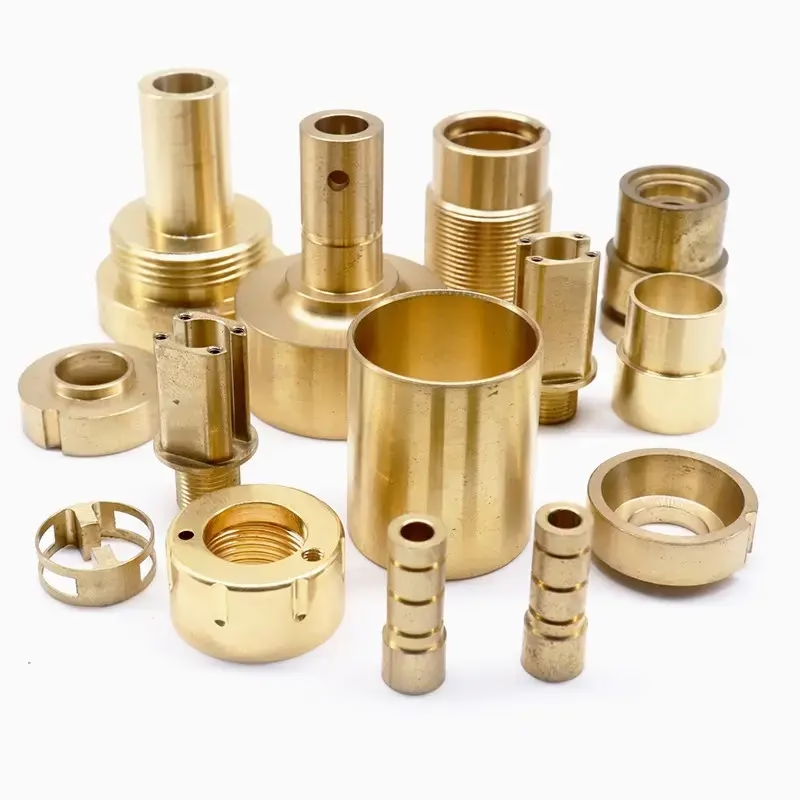
What This Guide Covers
Alloy choice, cutting behavior, achievable tolerance, and the questions worth asking a supplier.
Picking the Right Copper Alloy Before You Cut Metal
Copper is not one material. The alloy you choose decides whether the part machines cleanly or fights you for every millimeter. Pure copper C101 and C110 conduct heat and electricity better than anything else on the shop floor, and they also gum up tools faster than anything else. Brass C36000 machines like a dream and conducts roughly a quarter as well. Beryllium copper sits in the middle and adds hardness after heat treatment.
Start from the function. If the part carries current or pulls heat away from a device, stay with C101, C103 or C110 and accept the chip control work that follows. If the part is a bushing, a fitting, a valve body or a connector shell, C27400, C28000 or C36000 will cut faster and hold a better surface. Beryllium copper earns its higher cost on spring contacts and wear plates where hardness matters more than conductivity.
Thin walls change the answer. A 0.8 mm wall in pure copper will deflect under light clamping pressure and chatter at the end of a long tool. If the drawing allows it, move the thin-wall section to a brass alloy or thicken the wall before quoting. A small geometry change often removes the need for a second operation entirely.
- 1C101 / C110Best conductivity, worst chip control. Plan for pecking and high-pressure coolant.
- 2C36000 brassFree-machining. Short chips, good finish, about 27% IACS conductivity.
- 3C27400 / C28000Stronger than C36000, still machines well. Fittings and valve bodies.
- 4Beryllium copperHardens after aging. Spring contacts and wear surfaces.
Why Copper Chips Are the Real Problem
On aluminum or steel, a wrong feed rate costs you time. On pure copper, it costs you the part. Copper is soft and ductile, so the chip stretches instead of breaking. It wraps around the tool, gets dragged back into the cut, and tears the finished surface. A wrapped chip also traps heat at the cutting edge, and copper conducts that heat straight into the tool rather than into the chip.
The fix is chip breaking, not more speed. Increase feed per tooth until the chip forms a tight curl, and use a sharp, high-rake carbide tool with a polished flute. Keep depth of cut heavy enough that the tool cuts instead of rubbing. Rubbing work-hardens copper on the surface, and the next pass cuts through a harder skin than the one before.
Brass behaves differently. Free-machining brass C36000 breaks into small chips on its own, which is why it is the default for high-volume turned parts. If a job has long cycle times and a tight finish callout, brass is usually the cheaper answer even though the material costs more per kilogram.
- 1Feed per toothRaise it until the chip curls. Light feeds produce stringy chips and chatter.
- 2Tool geometrySharp edge, high rake, polished flutes. Avoid worn tools.
- 3CoolantHigh pressure through the tool. Copper moves heat into the tool fast.
- 4Depth of cutToo shallow rubs and work-hardens the surface layer.
Copper Alloy Selection at a Glance
Machinability and conductivity figures are typical values, not guaranteed minimums.
| Alloy | Machinability | Conductivity | Typical parts |
|---|---|---|---|
| C101 / C110 | Poor | ~100% IACS | Busbars, heat sinks, RF cavities |
| C103 | Poor | ~100% IACS | High-purity electrical contacts |
| C27400 | Good | ~27% IACS | Fittings, fasteners, hardware |
| C28000 | Good | ~27% IACS | Valve bodies, pipe fittings |
| C36000 | Excellent | ~27% IACS | Connectors, bushings, turned parts |
| Beryllium copper | Fair | ~20–50% IACS | Spring contacts, wear plates |
Fixturing and Thermal Control on Copper Parts
Copper moves. A 200 mm copper bar can grow 0.3 mm or more from a 40 °C temperature swing, which is several times the tolerance we hold on a bearing bore. If a drawing calls for ±0.005 mm and the shop measures a part straight off the machine, the number is unreliable. Let the part settle to room temperature on a granite plate before final inspection.
Clamping is the other source of error. Soft jaws machined to the part profile spread the load and avoid the jaw marks that show up on polished copper surfaces. For thin discs and rings, vacuum chucks or a light glue-fixture hold the part flat without crushing it. A three-jaw chuck tightened by feel will ovalize a thin copper ring every time.
For features on five sides or more, a simultaneous 5-axis setup removes the part from one operation and avoids the re-clamping error that comes with moving between fixtures. Our shop runs 16 simultaneous 5-axis centers, so a complex copper housing that once needed four setups can often be cut in two.
- 1Soft jawsMachined to the part profile. Prevents jaw marks on soft copper.
- 2Vacuum or glue fixturesFor thin discs and rings that a chuck would ovalize.
- 3Thermal soakLet parts reach room temperature before final measurement.
What Tolerance Is Realistic on Copper
Copper cuts softer than steel, so the tool deflects more and the surface finishes finer. That trade works in your favor on finish and against you on size. We hold ±0.005 mm (±0.0002 in) on copper features when the geometry supports it: rigid setups, short tool overhangs, and walls thick enough to resist cutting force.
Fine surface finishes come easier on copper than on most metals. Ra 0.2–0.8 μm is reachable on a turned copper face with a sharp insert and a clean coolant flow. Ra 0.8–1.6 μm is the practical target for most milled copper surfaces, and Ra 1.6–3.2 μm is what you get when the priority is cycle time rather than appearance.
Where copper gets difficult is aspect ratio. A Ø3 mm bore 30 mm deep in pure copper is a chip evacuation problem before it is a tolerance problem. Deep small holes in soft, gummy material are where quotes stretch and scrap rates climb. If the design allows a larger bore or a shallower depth, both the price and the risk drop.
- 1±0.005 mmAchievable on rigid setups with short tool overhangs and stable temperature.
- 2Ra 0.2–0.8 μmTurned copper faces with a sharp insert and steady coolant.
- 3Deep small holesChip evacuation, not tolerance, is usually the limiting factor.
What to Verify Before Ordering Copper Parts From China
Material certificates matter more on copper than on aluminum. C101 and C110 look identical on the shelf and differ in oxygen content, which changes conductivity and how the part brazes. Ask for the mill certificate with the heat number, and confirm the grade matches the drawing before the first chip is cut. A shop that cannot produce a certificate on request is not a shop to send copper work to.
Ask how the shop handles first-article inspection. On copper, the first article is where you find out whether the process controls chips or fights them. We inspect 100% of parts before shipment and run raw material checks, in-process monitoring and final inspection, with reports available on request. For copper jobs we also photograph the chip form from the first article, because it tells you more about the process than a dimensional report alone.
Confidentiality is a normal request, not a special one. Uploads are handled as confidential and an NDA is available on request. If your copper part is a connector or a heat sink for an unreleased product, put the NDA in place before you send the STEP file, not after.
A note on cost structure. Copper raw material is a large share of the part price and it moves with the LME, so a quote that is valid for 30 days is normal and a quote that is valid for a year is not. Ask what the material surcharge policy is before you compare two suppliers on unit price alone.
- 1Mill certificateConfirm C101 vs C110 by heat number, not by appearance.
- 2First articleReview the chip form alongside the dimensional report.
- 3NDASign before sending STEP files for unreleased products.
- 4Material surchargeCopper price tracks the LME. Ask how it is applied.
Copper Machining Capability at a Glance
| Item | Specification |
|---|---|
| Tolerance | ±0.005 mm (±0.0002 in) |
| Surface finish | Ra 0.2–0.8 μm fine, Ra 0.8–1.6 μm standard |
| Maximum part size | 4,000 mm |
| Machine count | 127 high-precision CNC machines |
| Simultaneous 5-axis | 16 machining centers |
| Materials | C101, C103, C110, beryllium copper, C27400, C28000, C36000 |
| Order quantity | One prototype to 10,000+ parts |
| Inspection | 100% before shipment, reports on request |
Common Questions
Can you machine pure copper without the chips wrapping the tool?
Yes, but it is a process decision rather than a machine setting. We raise feed per tooth until the chip curls, use sharp high-rake carbide with polished flutes, and run high-pressure coolant through the tool.
If a geometry cannot break the chip no matter the parameters, we say so at the DFM stage and suggest a change rather than quoting a job we expect to scrap.
Which copper alloy should I specify for an electrical contact?
For maximum conductivity, C101 or C110. For a spring contact that must hold shape, beryllium copper, which gains hardness after aging.
C36000 brass is the wrong choice for a contact even though it machines best, because its conductivity is roughly a quarter of pure copper.
How does copper compare to aluminum for heat sinks?
Copper conducts heat better and weighs about three times as much. For a small, high-flux device, copper wins. For a large enclosure where weight matters, aluminum 6061 or 6063 usually wins.
Copper is also harder to machine, so a copper heat sink costs more per part than the same geometry in aluminum.
What surface finishes work well on copper parts?
Bead blasting, tumbling, brushing and polishing all work on copper. Electroless nickel, silver and gold plating are common where conductivity or solderability matters.
Bare polished copper tarnishes in air. If appearance matters, specify a plating or a clear coating at the design stage.
What is the lead time for a copper order?
We return a quotation and a free DFM analysis within 12 hours, and production can start within 24 hours of approval. Parts typically ship in 3–5 days.
The main variable is material availability. Some copper grades are not stocked in every thickness, so confirm the grade and stock form early.
Do you require a minimum order quantity?
No. We run from a single prototype to 10,000+ part runs on the same equipment and process.
For copper, small quantities often make sense first, because the first article tells you whether the chip control plan actually works before you commit to a batch.
Send a Copper Drawing and Get a Real Answer
Upload your STEP file and drawing. We return a quote and a free DFM analysis within 12 hours, and we tell you if the alloy or the geometry is working against you.
12-hour quote100% inspectionNDA on request









