
China Precision Stainless Steel CNC Processing
This page explains how stainless steel parts are machined to tight tolerances, which alloys suit which features, and where the process runs into trouble. It is written for design engineers and sourcing engineers who need to judge a shop, not just read a capability list.
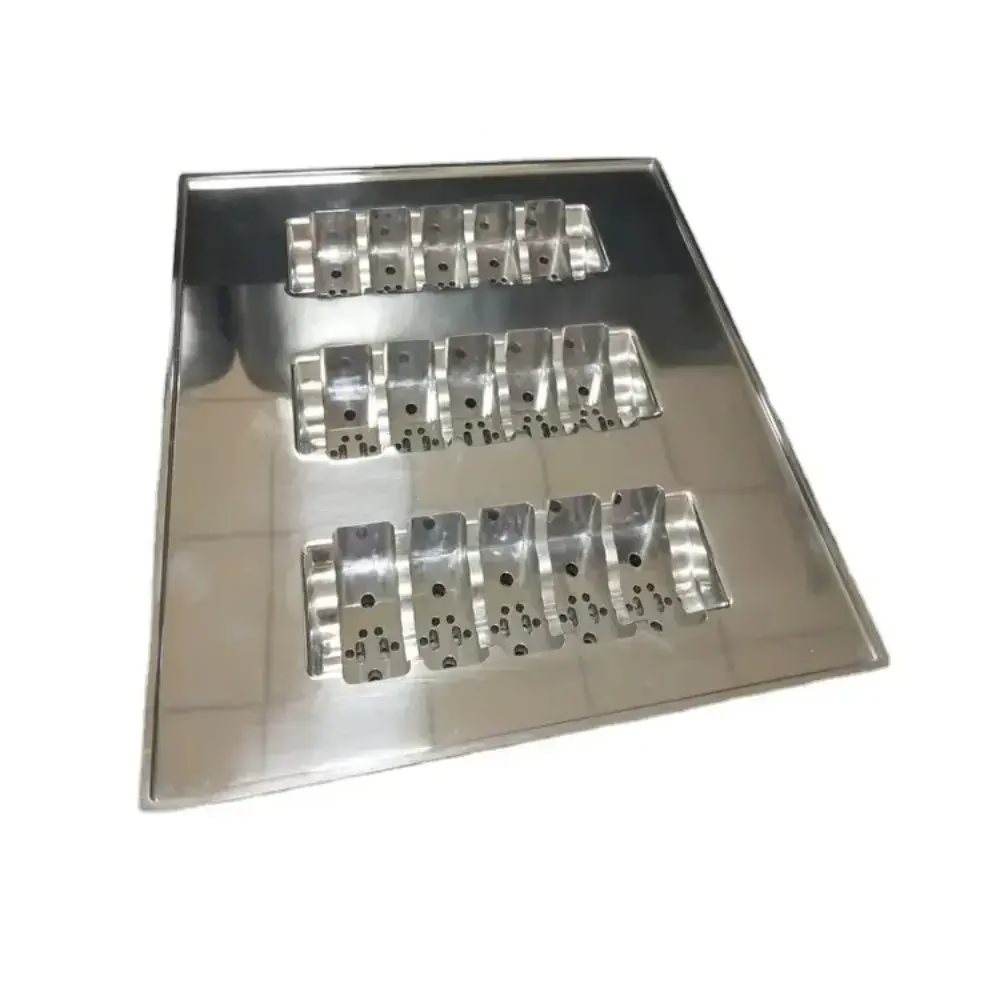
What Stainless Steel Does to a CNC Program
Stainless is not a single material. Grade choice changes tool life, finish and cost more than machine choice does.
Picking the Grade Before the Geometry
Most stainless parts that arrive for quoting fall into four families: austenitic (303, 304, 316, 316L), martensitic (420, 430, 431, 440C), precipitation hardening (17-4PH / SUS630), and duplex. Each one behaves differently at the cutting edge. Austenitic grades work-harden fast, so a light pass with a dull insert will harden the surface instead of cutting it. Martensitic grades cut more freely but move when you heat them. 17-4PH gives high strength after aging, and it holds that strength at temperatures where aluminum would already be soft.
Grade selection is usually decided by the environment, not by the drawing. A pump housing in chlorinated water wants 316L. A shaft that needs wear resistance and moderate corrosion resistance is often 440C or 17-4PH. A bracket that only needs to resist humidity can be 304 and nothing more. Choosing 316 for a dry indoor bracket adds cost and machining time for no benefit.
303 is the free-machining grade and the easiest to turn at volume. It contains sulfur, which breaks chips and improves tool life, but it also lowers corrosion resistance and weldability. If a part will be welded later, 303 is usually the wrong call. For a turned fitting with no welding and a clean finish requirement, it is often the cheapest path.
We machine all of these in the same shop, so the grade decision is made against the feature list, not against what happens to be on the shelf. A deep pocket in 316 needs different tool paths than the same pocket in 303, and the quote should reflect that.
- 1Austenitic303, 304, 316, 316L. Work-hardens; keep the tool engaged and the feed up.
- 2Martensitic420, 430, 440C. Free cutting, but watch heat and distortion.
- 3Precipitation hardening17-4PH (SUS630). Machines in the annealed state, then ages to high strength.
- 4DuplexHigher strength and chloride resistance, heavier tool wear.
Why 5-Axis Helps With Stainless
Stainless rewards fewer setups. Every time a part is unclamped and re-fixtured, the accumulated position error grows, and stainless is not forgiving about re-cutting a hardened skin. Five-axis machining lets us reach the side of a part, an angled port, or an undercut in one setup instead of three. The 16 simultaneous 5-axis machining centers in our Dongguan plant cover most of this work, with a Ø400 mm rotary table for parts that need rotation around a bore.
For long parts, the work envelope matters more than the axis count. Our largest travel is 4,000 × 400 × 150 mm, which covers shafts, rails, and long manifolds. Medium frames at 750 × 1,150 × 550 mm and 600 × 600 × 600 mm handle typical housings and plates. Small frames at 500 × 500 × 450 mm and 500 × 310 × 200 mm are used for compact medical and electronic components where the fixture is often bigger than the part.
Turning stainless is a separate problem. The material galls and welds to the insert, so we run mill-turn centers for parts that combine a turned diameter with milled flats or cross-holes. Doing the milling on the same machine that turned the diameter removes a concentricity stack-up that is hard to hold across two operations.
Fixturing is where a stainless job is won or lost. Thin walls deflect, and stainless deflects more than aluminum under the same cutting force. Soft jaws, tailstocks, and where needed sacrificial webs keep the part supported until the last pass.
- 1Fewer setupsAngled ports and undercuts cut without re-clamping.
- 2Long parts4,000 mm travel for shafts, rails and manifolds.
- 3Mill-turnTurned diameter plus milled features in one operation.
Stainless Grades: Machinability, Corrosion and Typical Use
Use this as a starting point for the drawing review, not as a final material call.
| Grade | Machinability | Corrosion | Typical parts |
|---|---|---|---|
| 303 | Excellent | Moderate | Turned fittings, bushings, nuts |
| 304 | Good | Good | Brackets, housings, food equipment |
| 316 / 316L | Fair | Very good | Marine, medical, chemical contact |
| 420 | Good | Moderate | Shafts, cutlery, wear parts |
| 440C | Fair | Moderate | Bearings, valves, high-wear pins |
| 17-4PH | Fair | Good | Aerospace, pump shafts, high-strength fittings |
Holding ±0.005 mm in a Work-Hardening Material
Our standard tolerance band is ±0.005 mm (±0.0002 in) on critical features. That number is achievable in stainless, but not everywhere on the part. It belongs on diameters, bores, and locating faces. Applying it to a 300 mm long unsupported wall invites scrap, because the part will move as material is removed. We flag those features during the free DFM analysis and either propose a relaxed callout or a fixture change.
Surface finish drives the last passes. As-machined stainless usually lands at Ra 1.6–3.2 μm. A high-quality finish is Ra 0.8–1.6 μm, and fine finishing reaches Ra 0.2–0.8 μm where a seal or a sliding fit needs it. Finer finish costs time in two ways: slower feed rates, and more frequent insert changes because stainless dulls edges quickly.
Work-hardening is the main reason a stainless program goes wrong. If the tool rubs instead of cuts, the surface layer gets harder, and the next pass cuts a harder material than the first. The fix is a deeper cut with a higher feed, which sounds counterintuitive on a finishing pass. Constant tool engagement and a rigid setup matter more than a conservative feed.
Inspection is not a final step, it is a thread through the job. We check raw material certificates on arrival, monitor dimensions during machining, and run a final inspection on 100% of parts before shipment. Reports are available on request. The measured qualification rate across production is 99.99%.
- 1Where it appliesBores, diameters, locating faces, mating surfaces.
- 2Where it does notLong unsupported walls, thin webs, free-form surfaces.
- 3Finish bandsRa 1.6–3.2 μm as-machined; Ra 0.2–0.8 μm fine.
Finishing Stainless Without Losing the Dimensions
Stainless is often left as-machined because it looks acceptable and resists corrosion on its own. When a finish is specified, it is usually for wear, friction, or appearance. Passivation removes free iron from the surface and is common on 316L medical and food-contact parts. Electropolishing smooths the microscopic peaks and can bring a bore closer to a Ra 0.2 μm band than a cutter alone can reach.
Bead blasting, tumbling, brushing, and polishing change the surface without removing meaningful material, so tight dimensions survive. Plating is different: electroless nickel, zinc, silver, and gold all add a layer. That layer is thin, but on a ±0.005 mm bore it can consume a real share of the tolerance. We plan the pre-plate dimension so the coated part lands in band, rather than plating first and measuring after.
Laser marking and engraving are used for part numbers, lot codes, and UDI. Minimum character height is 1.5 mm, which keeps the mark legible after blasting or polishing. Deep engraving on a thin-wall part is avoided because it creates a stress riser in a material that is already notch-sensitive.
For parts that will be welded or placed in a chloride environment, be careful with 303 and with any free-machining additive. The sulfur that makes the chips break also leaves inclusions that become corrosion initiation sites. If the part needs both easy machining and chloride resistance, we usually recommend 316L and accept the slower cycle.
- 1No dimension changePassivation, blasting, tumbling, brushing, polishing.
- 2Adds thicknessElectroless nickel, zinc, silver, gold plating.
- 3MarkingLaser marking, minimum character height 1.5 mm.
What to Send for an Accurate Quote
A STEP file and a 2D drawing with the tolerance block does most of the work. The drawing is where we learn which features are critical and which are reference. If only a 3D model is available, note the fits and the mating surfaces in the RFQ. A model tells us the shape; it does not tell us that a bore is a bearing seat.
Add the grade, the finish, and the quantity range. Quantity changes the process. One prototype in 316 may be machined from bar with a simple vise setup. A 10,000-piece run of the same part may move to a dedicated fixture, a different blank strategy, or a mill-turn cycle. There is no minimum order quantity here, so the same part can start as a single prototype and scale later without a re-quote for a new process.
Tell us the environment too. Salt water, sterilization cycles, high temperature, and food contact all push the grade and the finish in different directions. That context costs nothing to include and often saves a re-quote.
Uploads are handled as confidential, and an NDA is available on request. We return a quotation and a free DFM analysis within 12 hours, production can start within 24 hours, and parts typically ship in 3–5 days. Our historical late-delivery probability is below 2%.
- 1FilesSTEP plus a 2D drawing with the tolerance block.
- 2CalloutsGrade, finish, quantity, and which features are critical.
- 3ContextService environment, sterilization, temperature, food contact.
Stainless Steel CNC Questions
Can you hold ±0.005 mm on a long stainless shaft?
On a supported diameter, yes. On an unsupported length, the part moves as the material is removed and the tolerance is not realistic over the whole span.
We review this in the DFM step and either propose support, a stepped machining sequence, or a relaxed callout on the non-critical length.
Which stainless grade machines most easily?
303. It contains sulfur, which breaks chips and extends tool life, so turned parts run faster and cheaper.
The trade-off is lower corrosion resistance and poor weldability. If the part will be welded or exposed to chlorides, 304 or 316L is usually the better call even at a higher cycle time.
Is 316 worth the extra cost over 304?
Only when the service environment needs it. 316 and 316L carry molybdenum, which improves resistance to chlorides and some acids.
For dry indoor parts, brackets, and general housings, 304 performs well and machines faster. The right answer comes from the environment, not from the grade name.
How do you stop stainless from work-hardening during machining?
Keep the tool engaged and the feed high enough to cut under the hardened layer. A light rubbing pass hardens the surface instead of removing it.
Rigid fixturing and sharp, correctly coated inserts do the rest. Dull tooling is the most common cause of a hardened, shiny surface that measures out of tolerance.
Does plating affect the tolerance?
Yes. Electroless nickel, zinc, silver, and gold all add a layer, and on a ±0.005 mm bore that layer is a real share of the band.
We set the pre-plate dimension so the finished part lands inside tolerance, rather than plating to size and measuring afterwards.
What finishes can be applied after machining?
Passivation, bead blasting, tumbling, brushing, polishing, electroless nickel, zinc, silver, and gold plating, plus laser marking and engraving.
Passivation, blasting, tumbling, brushing, and polishing do not change meaningful dimensions. Plating does, so it is planned into the machining dimensions.
Send a Stainless Drawing and Get a Process Answer
Upload a STEP file and drawing for a quotation plus a free DFM analysis within 12 hours. An engineer reviews the grade, the critical features, and the setup before the price is set.
12-hour quote±0.005 mm100% inspectionNDA on request









