
China's Accurate 5 Axis CNC Machining: What Engineers Should Check
This page explains how simultaneous 5-axis work is set up in China, which part features justify it, and where it stops being the right call. Written for design engineers and sourcing engineers who need to judge a quote, not read a brochure.
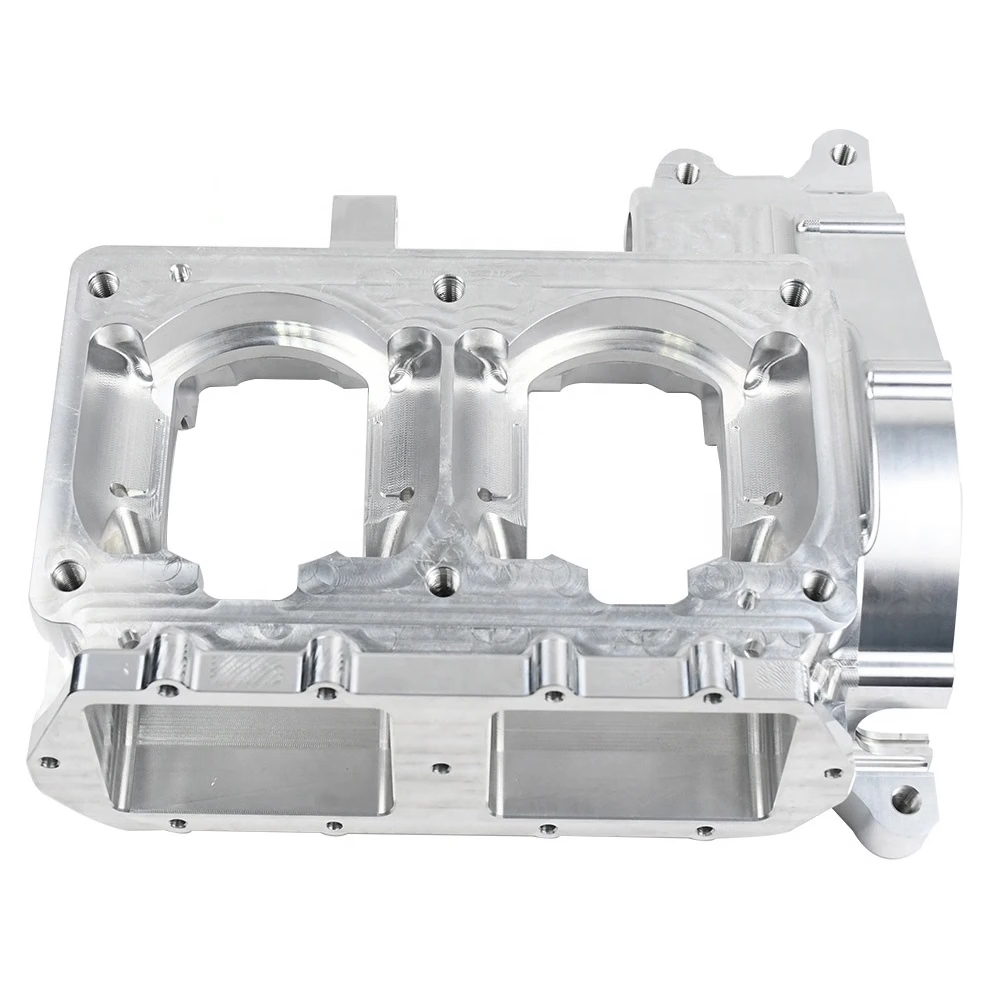
What accurate 5-axis work actually means in a Chinese shop
Two rotary axes change the setup, the tool access, and the inspection plan. Here is how to read all three.
How the two rotary axes change the cut
A 3-axis mill holds the part flat and moves the tool in X, Y and Z. Undercuts, side-wall ports and compound angles need a second or third setup, and each setup adds a re-clamp error. A simultaneous 5-axis center tilts the tool or the table while cutting, so a single program reaches five faces. That is the whole point: fewer setups, tighter position between features.
The trade-off is stiffness. When the table tilts, gravity and cutting force act on the part from a new direction. Deep pockets in hard steel still cut better on a rigid 3-axis machine with a short tool. Five axes help most on parts with many features at different angles and moderate depth, not on one deep bore.
GreatLight runs 16 simultaneous 5-axis machining centers alongside 12 four-axis mills, 27 three-axis machines and 16 mill-turn centers. That mix matters when you quote. Not every feature on your part should be cut on the 5-axis machine. The roughing may run on a 3-axis machine and the angled features finish on a 5-axis center, which keeps the hourly rate down.
- 1Good fitUndercuts, compound angles, ports on curved surfaces
- 2Poor fitOne deep bore in hard steel, flat plates, simple turned parts
- 3WatchThin walls deflect more when the table tilts
Which features justify five axes
Start with the drawing, not the machine list. Count the number of distinct tool approach directions. If a part has features reachable from three or more sides, five axes usually win. Impellers, turbine housings, medical bone plates with curved slots, and manifold blocks with angled ports all fall in this group.
Now check the tolerance callout. A 5-axis setup holds position between features better than a chain of re-clamped setups, because the datum never moves. When a hole pattern and a milled face must stay within ±0.005 mm of each other, that relationship is easier to hold in one setup. The tolerance itself is not the reason to go 5-axis. The relationship is.
Some parts look complex but do not need simultaneous motion. A part with five flat faces and one hole per face can be cut on a 3+2 setup, where the table indexes to a position and locks. Indexed work is faster and cheaper than continuous 5-axis motion. If your part allows it, say so on the RFQ. It changes the price.
When each setup type makes sense
Use this to decide what to ask for on the quote.
| Part feature | Better setup | Why |
|---|---|---|
| Angled ports on a curved wall | Simultaneous 5-axis | Tool stays normal to surface |
| Five flat faces, one hole each | 3+2 indexed | Faster, no continuous motion |
| Deep bore in 4140 steel | 3-axis or mill-turn | Higher rigidity, short tool |
| Impeller blades and hubs | Simultaneous 5-axis | Continuous contoured path |
| Thin-wall housings | 5-axis, light passes | Fewer re-clamps, less distortion |
| Simple turned shaft | Mill-turn center | Turning and milling in one setup |
Material choice changes the cutting plan
Aluminum 6061 and 7075 cut fast on a 5-axis center, and the light cutting force lets the machine use its full tilt range. Titanium TC4 (Ti-6Al-4V) and Inconel behave differently. Heat stays at the edge, so tool life drops and the shop slows the feed. Expect more passes and a longer cycle on the same geometry.
Stainless 17-4PH and 316L sit in the middle. They hold a good finish at Ra 0.8–1.6 μm with the right cutter and coolant, but they work-harden if the tool rubs. On a tilted table, a rubbing tool is harder to spot, so the shop may run a test cut and check the surface before the full run.
We machine 6061, 2024, 5052, 5083, 6063, 6082, 7075 and ADC12 aluminum; 303, 304, 316, 316L, 420, 430, 431, 440C and 17-4PH stainless; 1018, 1045, 4130, 4140, 4340 and A36 steel; C101, C110, C27400, C28000 and C36000 copper alloys; TA1, TA2, TC4, Inconel and magnesium AZ31B or AZ91D; and ABS, PC, POM, PEEK, PA, PP and carbon fibre. The material list is long. The cutting plan is not the same for each one.
Tolerance, finish and how they get checked
GreatLight works to ±0.005 mm (±0.0002 in) on 5-axis parts, with finishes from Ra 0.2–0.8 μm on fine work up to Ra 1.6–3.2 μm as machined. Those numbers are the shop's capability, not a promise for every feature. A thin wall 300 mm long will move more than a compact bracket, no matter which machine cuts it.
Thermal drift is the quiet problem. Five axes generate heat in the rotary drives, and a long cycle can shift the part a few microns. Shops that care about this run warm-up cycles, keep the spindle running between parts, and check the first article before releasing the run. Ask whether your shop does this. It is a fair question.
Inspection follows the same logic as the setup. A part cut in one 5-axis setup should be checked in one setup too, on a CMM with the same datum. GreatLight inspects 100% of parts before shipment, with raw material check, in-process monitoring and final inspection. Reports go out on request. The qualification rate on record is 99.99%.
Reading a quote from a Chinese 5-axis shop
A quote should tell you the setup count, the machine class, and the inspection method. If it only gives a price and a lead time, ask for the rest. Setup count drives cost more than machine hours on small runs, and it tells you whether the shop understood the part.
Lead times in China are short when the shop plans ahead. GreatLight returns a quotation and free DFM analysis within 12 hours, can start production within 24 hours, and ships parts in 3–5 days. Historical late-delivery probability is under 2%. Those numbers come from the shop's own record. Treat them as a starting point and confirm on your order.
Order size is flexible. There is no minimum order quantity, from one prototype to 10,000+ part runs. For a first article, send the drawing and the critical callouts, and mark the datums. That one step saves a round of questions. Uploads are secure and confidential, and an NDA is available on request.
Questions engineers ask before ordering
Does every complex part need simultaneous 5-axis motion?
No. Many parts with angled features can be cut on a 3+2 indexed setup, where the table locks before each cut. Indexed work is faster and the hourly rate is lower.
Simultaneous motion pays off when the tool must stay normal to a curved surface, or when the path is a continuous contour that cannot be broken into indexed positions.
How tight a tolerance can a 5-axis machine hold?
GreatLight works to ±0.005 mm (±0.0002 in) on 5-axis parts. That figure applies to well-supported features with a clear datum.
Long thin walls, deep small bores and hard alloys will open up the band. Send the critical callouts and the shop can tell you what is realistic before you commit.
Which materials are hardest on a 5-axis setup?
Inconel and titanium TC4 give the most trouble. Heat concentrates at the cutting edge, so tool life drops and the shop reduces feed and speed.
Aluminum 6061 and 7075 are the easiest. Stainless 17-4PH and 316L sit in the middle and need sharp tools to avoid work-hardening.
Can you start from one prototype?
Yes. There is no minimum order quantity. Runs go from a single prototype up to 10,000+ parts.
For a first article, include the drawing, the critical dimensions and the datums. A free DFM analysis comes back with the quote within 12 hours.
What surface finishes are available after 5-axis cutting?
As machined, the range is Ra 1.6–3.2 μm. Fine work reaches Ra 0.2–0.8 μm, and a common target band is Ra 0.8–1.6 μm.
Finishing options include anodizing, electroless nickel, zinc, silver and gold plating, powder coating, black oxide, bead blasting, brushing and polishing.
How is confidentiality handled on uploaded files?
Uploads are secure and confidential. An NDA is available on request before any file is shared.
If your program needs a signed agreement first, say so in the first message and the shop will send one before the review starts.
Send the drawing, get a setup plan
We review your part, tell you which features need 5-axis motion, and quote in 12 hours.
12-hour quote100% inspectionNo minimum order









