
China's 4 Axis CNC Machining Service: A Buyer's Guide
A 4th axis adds one rotary motion to a 3-axis mill. That single axis decides whether a part needs two setups or one, and whether hole positions stay true across four faces. This guide is for engineers and buyers comparing quotes: what a 4 axis cnc machining service in China can hold, when it is the wrong choice, and which supplier details actually change the outcome.
Key takeaways
4-axis vs 3-axis vs 5-axis: which one fits your part
Pick the lowest axis count that still holds your tolerance in one setup.
| Part feature | 3-axis | 4-axis | 5-axis |
|---|---|---|---|
| Features on one face | Best fit | Overkill | Overkill |
| Holes on 3-4 side faces | Two or three setups | One setup | One setup |
| Cylindrical slots and cams | Hard to fixture | Good fit | Good fit |
| Deep cavities, undercuts | Poor access | Limited access | Best fit |
| Long shafts, 4,000 mm | Not practical | Rotary table work | Rarely needed |
| Tight true position, ±0.005 mm | Setup stack-up risk | Achievable | Achievable |
| Cost per part, small batch | Lowest | Middle | Highest |
Pick the axis count your part needs, not the highest one on the list
If features sit on three or four faces and position matters, a 4 axis cnc machining service removes setups and holds tolerance. If everything is on one face, a 3-axis mill is cheaper and just as accurate. Send the print and we will tell you which one, in writing, within 12 hours.
What the A axis actually changes
A 4-axis mill keeps the usual X, Y and Z travels and adds one rotary axis, almost always the A axis turning about X. The workpiece is held in a chuck, a 3-jaw, a collet block or a tombstone fixture, and the table indexes to a new angle while the tool stays in the cut. On our 12 four-axis mills the standard rotary table is Ø400 mm, which covers most housings, manifolds and shaft-type parts.
The practical gain is not spindle speed. It is setup count. A part with bores on four sides machined on a 3-axis machine needs three or four re-clamps, and every re-clamp adds a datum error. Each move can drift 0.02–0.05 mm on a good vise setup. On a 4-axis machine those bores come from one datum, so true position holds at ±0.005 mm without chasing the operator.
You also get continuous rotary cutting. A cam profile, a spiral oil groove or an impeller fillet can be cut with the A axis turning while X and Z interpolate. That removes the faceting you get from indexing in 5° steps, and it keeps the surface finish at Ra 0.8–1.6 μm without a second polishing step.
It is not a 5-axis machine. The tool axis stays normal to the rotary centerline, so steep walls and deep undercuts still need long reach or a different process. If your part has compound angles on five faces, 4-axis will force a second op.
- 1A axis about XThe usual 4th axis. Indexing or continuous rotation, depending on the part.
- 2One datum, four facesRemoves the re-clamp stack-up that drives position errors on 3-axis work.
- 3Ø400 mm rotary tableOur standard capacity for four-axis work; larger parts go to mill-turn.
Which parts belong on a 4-axis mill
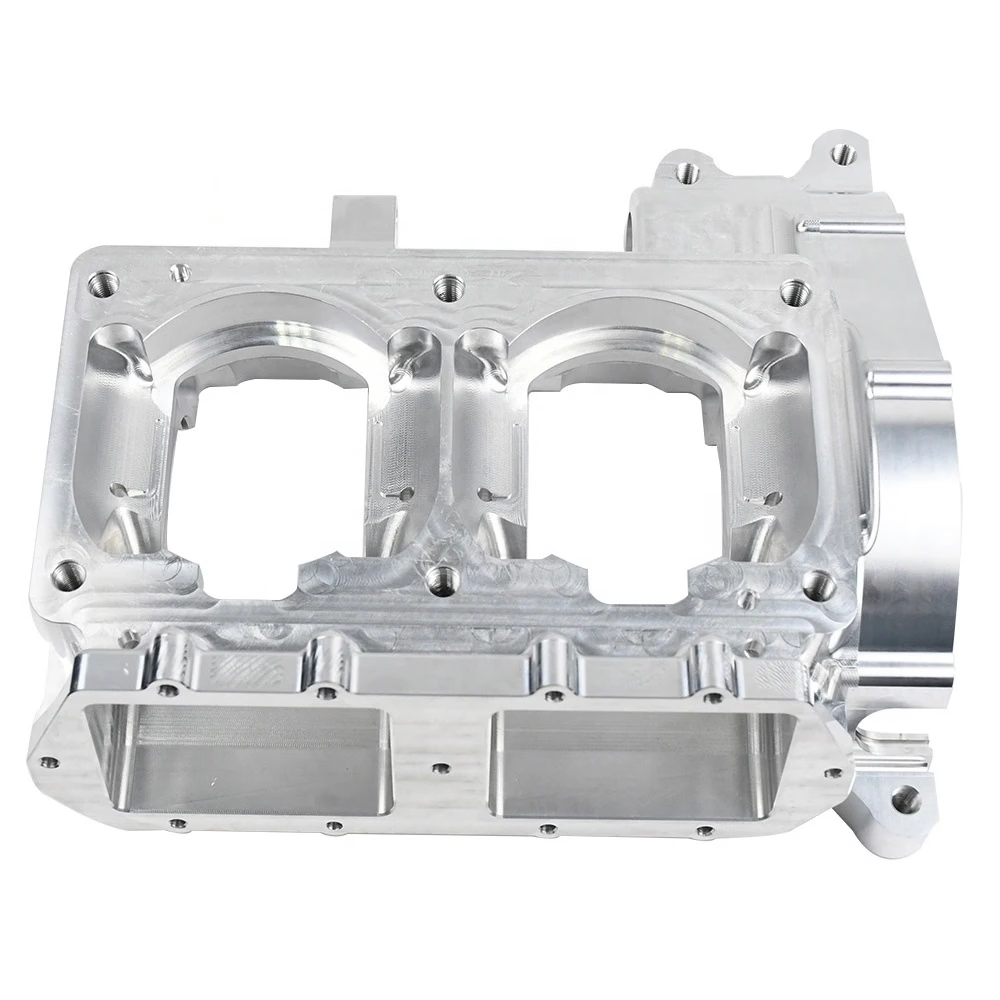
Good candidates share a shape: a body that can be gripped by one end while the tool reaches the other faces. Valve bodies, pump housings, gearbox covers, sensor mounts, surgical instrument handles and robot joint brackets all fit this pattern. So do long parts up to 4,000 mm where a rotary table indexes between flats and slots.
Bad candidates are flat plates with all features on one side, and simple turned shafts with no cross holes. A 3-axis mill or a lathe does those faster and cheaper. Paying for a rotary setup on a part that never rotates is money spent for nothing.
There is a middle group where the answer depends on quantity. A part needing two side holes can be done on a 3-axis machine with a right-angle head or a second op, and that is fine for 5 pieces. At 500 pieces the extra handling dominates, and 4-axis becomes the cheaper route even after the higher hourly rate.
Material matters less than you might expect. Aluminum 6061, 7075, 304 stainless, 17-4PH and Ti-6Al-4V all run on these machines. Titanium and Inconel need slower feeds and more coolant, which affects cycle time and price, not feasibility.
What to check in a China 4 axis cnc machining service
Ask for the machine list, not a brochure. A supplier claiming four-axis capability should be able to name the rotary table size and the number of machines. Ours is 12 four-axis mills inside a fleet of 127 high-precision CNC machines, with 16 simultaneous 5-axis centers and 16 mill-turn centers for parts that outgrow the A axis.
Check the tolerance statement against the drawing. A shop that quotes ±0.005 mm on every feature is not reading your print. Tolerance should be tied to the critical dimensions, with general tolerances looser. If the quote does not separate them, the inspection report will not either.
Confirm the certification path. ISO 9001:2015 covers general machining. Automotive work usually needs IATF 16949:2016, medical devices ISO 13485:2016, and any customer sending proprietary CAD should ask about ISO 27001:2022 for information security. Certificates that do not match your industry are decoration.
Finally, ask who reviews the drawing. A DFM reply in 12 hours means an engineer looked at wall thickness, tool reach and fixturing before the price was set. A price with no comments means nobody opened the file.
- 1Machine listRotary table size, machine count, and what happens when the part outgrows them.
- 2Tolerance by featureCritical dimensions called out separately from general tolerances.
- 3Right certificateISO 9001 for general work, IATF 16949 for auto, ISO 13485 for medical.
- 4Engineering feedbackComments on the drawing, not just a number.
Cost, lead time and order size
Four-axis work is priced above 3-axis because the machine hour is higher and the fixture takes longer to build. The trade is fewer operations. For a part with four machined faces, the 4-axis route often lands within 10–20 percent of the 3-axis price while cutting two setups and the scrap risk that comes with them.
Order size is not a barrier with the right partner. We run from one prototype to 10,000+ part runs with no minimum order quantity, so a single housing for fit testing costs the same setup as the first article of a production batch. Production can start within 24 hours of a released PO, and parts ship in 3–5 days for standard work.
Volume changes the method, not just the price. At low quantity, a 4-axis mill with a soft jaw is correct. Past a few thousand pieces, a tombstone fixture holding four or eight parts per cycle brings the per-part time down, and the same machine does the work. Ask what fixture the shop plans before you compare numbers.
Watch the freight and finish steps. Anodizing, electroless nickel, black oxide and laser marking all add days, and laser marking has a minimum character height of 1.5 mm. If your schedule is tight, confirm which finishing steps sit inside the quoted lead time.
How to qualify a supplier in 6 steps
Run these in order. Each step can end the conversation early, which saves time.
- 1Send the STEP file and the 2D printBoth matter. The 3D model defines geometry, the print defines datums and tolerances. Ask for a DFM note back within 12 hours.
- 2State the axis count you think you needSay which faces carry features and whether any surface is cylindrical. Let the supplier confirm or push back with a lower axis count.
- 3Ask for the setup and fixturing planOne page is enough: datum faces, workholding, number of ops. If the answer is vague, the tolerance claim is vague too.
- 4Match certificates to your industryISO 9001:2015 as the floor. Add IATF 16949:2016 for automotive, ISO 13485:2016 for medical, ISO 27001:2022 for confidential data.
- 5Order one piece firstWith no minimum order quantity, a single part is a cheap test. Check the critical dimensions and the surface finish before releasing a batch.
- 6Confirm lead time in writingQuote in 12 hours, production start in 24 hours, parts shipped in 3–5 days for standard work. Get finishing steps listed separately.
Questions buyers ask before ordering
Can a 4-axis machine hold ±0.005 mm on a long part?
Yes, within the machine envelope. Our largest travel is 4,000 × 400 × 150 mm, and tolerance of ±0.005 mm is achievable on critical features when the part is supported correctly.
Long parts deflect. If a 2,000 mm shaft is gripped at one end only, the free end will move under cutting force. The fix is a tailstock or a steady rest, and that has to be in the setup plan.
Is 4-axis ever more expensive than 5-axis?
Not usually, but the gap narrows on parts with many faces. If a part needs five-sided access, forcing it onto a 4-axis machine adds a second setup and a second fixture, which can cost more than the 5-axis hourly rate.
Send both options. The right answer depends on quantity and how many features sit outside the A axis reach.
What file formats do you need for a quote?
STEP or IGES for the solid, plus a PDF drawing with datums and tolerances. Native CAD helps for complex surfacing but is not required.
Uploads are secure and confidential, and an NDA can be signed before any file moves.
How do you inspect a 4-axis part?
Raw material check on arrival, in-process monitoring during the run, and final inspection before shipment. We inspect 100 percent of parts before they leave, with reports available on request.
For position-critical features, CMM reports on the rotated datums are the useful document. Ask for them by name.
Can I order a single prototype?
Yes. There is no minimum order quantity, so one part and a 10,000-part run go through the same quoting and setup process.
Prototypes often reveal a fixturing problem that is cheap to fix at one piece and expensive at one thousand.
Which materials are available?
Aluminum 6061, 7075, 2024 and 6082; stainless 303, 304, 316L, 17-4PH; steels 1018, 1045, 4140, 4340; titanium TC4; and plastics including POM, PEEK and PC.
Titanium and Inconel are machinable but slower. Expect cycle time, not a refusal, to change.
Send your drawing, get a setup plan with the price
DFM analysis and quotation within 12 hours. No minimum order quantity, from one prototype to 10,000+ parts.
12-hour quoteNo MOQ100% inspectionNDA on request
More from the shop floor
We publish setup notes, tooling trials and inspection data from the factory floor.











