
China's CNC Machine Builder: What to Check Before You Commit
This page is for engineers and sourcing leads who are comparing machine shops in China and need a way to separate real capability from brochure claims. It covers machine mix, tolerance and finish limits, inspection workflow, certifications, and the part profiles that do not fit a China CNC machine builder well.
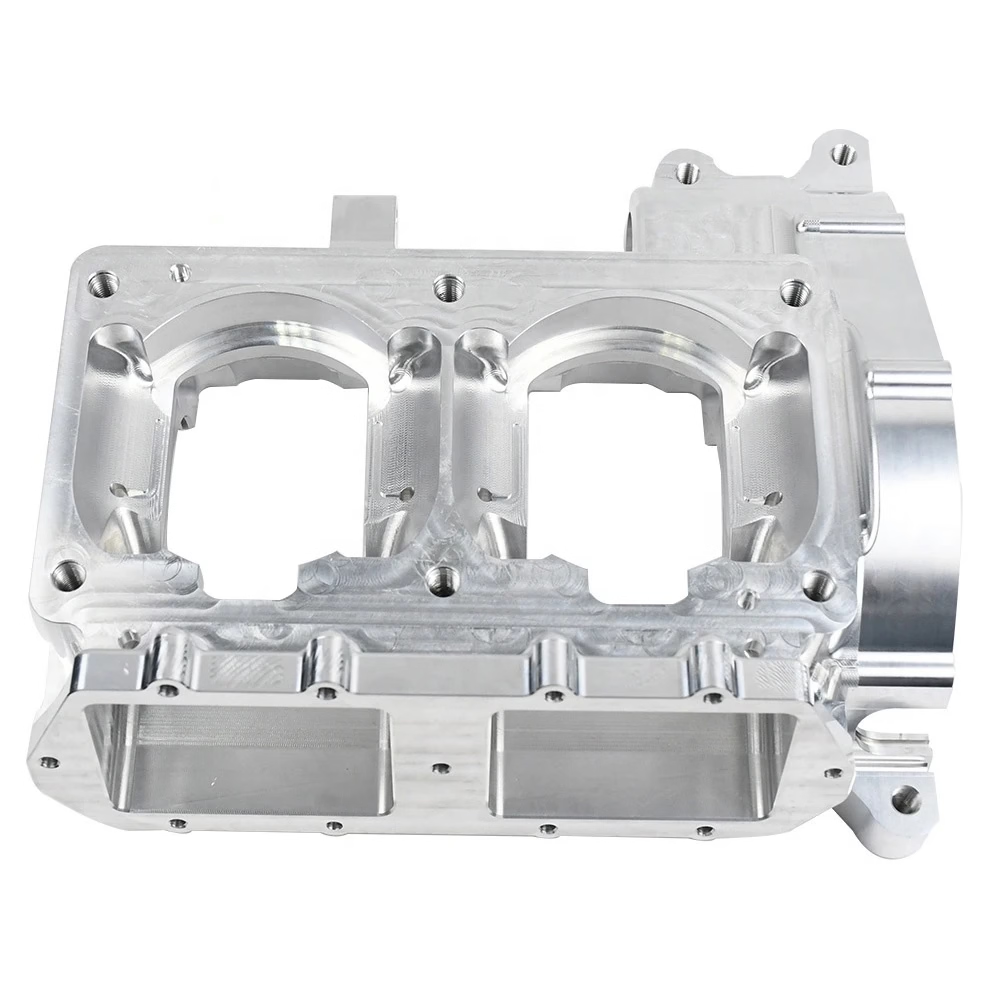
What actually decides whether a build goes well
Machine counts matter less than whether the right machine, the right fixture, and the right inspection step are assigned to your part.
What a China CNC machine builder can and cannot do
The question is rarely whether a shop in China owns CNC machines. It is whether the machine assigned to your part matches the geometry. A builder with 127 high-precision CNC machines may still quote your part on a 3-axis mill because the schedule is open there, and that choice shows up later as a second setup, a tolerance stack, or a hand-finished blend that never quite repeats.
GreatLight runs 16 simultaneous 5-axis machining centers, 12 four-axis mills, 27 three-axis machines, and 16 mill-turn centers across three wholly-owned plants in Dongguan and Singapore, covering 7,600 m². That mix is the useful part of the number. Five-axis work suits impellers, angled ports, medical housings, and any part where two setups would introduce a datum shift you cannot inspect away.
Size sets the ceiling. Maximum processing size reaches 4,000 mm, with travels of 4,000 × 400 × 150 mm for long parts, 750 × 1,150 × 550 mm and 600 × 600 × 600 mm for mid-size frames, and 500 × 500 × 450 mm or 500 × 310 × 200 mm for compact work. A Ø400 mm rotary table handles parts that need continuous rotation rather than indexing.
Where a machine builder struggles is not geometry but volume economics. A shop tooled for prototypes and low-volume runs will not beat a dedicated production line on 500,000 identical stamped or die-cast parts. If your annual volume is that high, machining is usually the wrong process, not the wrong supplier.
Tolerance, finish, and which parts fit
Tolerance is a system result, not a machine spec. A builder can hold ±0.005 mm (±0.0002 in) on a part when the material is stable, the fixture is rigid, and the feature is reachable in one setup. The same builder will quote ±0.05 mm on a thin-wall aluminum bracket and be right to do so, because the part moves after clamping regardless of who machines it.
Surface finish follows the same logic. As-machined surfaces land around Ra 1.6–3.2 μm. A controlled high finish sits at Ra 0.8–1.6 μm, and fine finishing reaches Ra 0.2–0.8 μm, usually on sealing faces, bearing bores, or optical mounts. Asking for Ra 0.2 μm on a non-functional cosmetic face adds cost and inspection time for nothing.
Part profile matters more than industry label. Good fits are complex 3D contours, tight-tolerance bores and bores with intersecting cross-holes, thin ribs that need light finishing passes, and parts machined from bar or plate in aluminium, stainless, steel, copper alloys, titanium, Inconel, magnesium, or engineering plastics such as POM, PEEK, and PC.
Poor fits are parts with no functional tolerance, big flat plates that a laser would cut in minutes, and single-sided features that never need a second operation. Send those to a fabricator. It saves money and keeps the machining supplier focused on what it does well.
Matching part profile to machine and process
Use this as a first filter before you request quotes.
| Part profile | Machine assigned | Practical tolerance | Watch out for |
|---|---|---|---|
| Angled ports, impellers, blades | 5-axis simultaneous | ±0.005 mm | Fixture access and tool reach |
| Box housings, multi-face bores | 4-axis with rotary table | ±0.01 mm | Datum shift between faces |
| Shafts, bushings, fittings | Mill-turn centers | ±0.005 mm | Bar stock runout |
| Long extrusions, rails | 3-axis, 4,000 mm travel | ±0.02 mm | Thermal drift over length |
| Thin-wall brackets, lids | 3-axis, light passes | ±0.05 mm | Clamping distortion |
| Prototype enclosures | 3-axis plus finishing | ±0.1 mm | Cosmetic finish consistency |
Inspection and paperwork that hold up in an audit
Ask how the part is measured, not just how it is cut. A builder that inspects only after the last operation finds problems too late to fix cheaply. The workflow worth paying for is raw material check on arrival, in-process monitoring at setup and between operations, and a final inspection before shipment, with reports available on request.
Inspection coverage is the number to pin down. At GreatLight every part is inspected before shipment against the drawing, and the historical qualification rate is 99.99%. If a supplier cannot state a coverage figure, assume it is sampling by eye on a bench, which is fine for a bracket and unacceptable for a medical implant housing.
Certifications tell you whether the quality system is documented and audited. Four matter in this market: ISO 9001:2015 for general quality management, IATF 16949:2016 for automotive and EV work, ISO 13485:2016 for medical devices, and ISO 27001:2022 for information security. The last one is often overlooked and matters if your CAD files are controlled intellectual property.
Confidentiality should be handled at the file level, not by a clause in a quote. Uploads are secure and confidential, and an NDA is available on request, which is standard practice for aerospace and medical programs where the drawing itself is the sensitive asset.
Lead time, materials, and finishing in one loop
Schedule risk usually comes from the steps around machining, not the cut itself. Quotation and a free DFM analysis come back within 12 hours, production can start within 24 hours, and parts ship in 3–5 days. The historical late-delivery probability is below 2%. Those numbers assume the drawing is released and the material is in stock, so confirm both before you commit to a build date.
Material availability drives more delay than machine time. Common grades are held or sourced quickly: aluminium 6061, 6061-T6, 2024, 5052, 5083, 6063, 6082, 7075, and ADC12; stainless 303, 304, 316, 316L, 420, 430, 431, 440C, and 17-4PH; steel 1018, 1045, 4130, 4140, 4340, A36, and tool steel; copper and brass C101, C103, C110, beryllium copper, C27400, C28000, and C36000; titanium TA1, TA2, TC4 (Ti-6Al-4V), Inconel, and magnesium AZ31B or AZ91D; plus ABS, PC, PMMA, POM, PA, PEEK, PP, HDPE, and carbon fibre.
Finishing is where quotes quietly diverge. Anodizing in clear, colour, hardcoat, or conductive; electroless nickel, zinc, silver, and gold plating; powder coating and black oxide; bead blasting, tumbling, brushing, and polishing; laser marking and engraving with a minimum character height of 1.5 mm. Each step adds a handling cycle, so grouping finishes on one drawing reduces both cost and the chance of a mixed-up batch.
Volume flexibility removes a common blocker. There is no minimum order quantity, so a single prototype and a 10,000+ part run can sit on the same process sheet. That continuity matters at the transition from validation build to production, when re-qualifying a new supplier costs more than the parts.
Questions engineers ask before awarding a build
How do I verify tolerance claims before sending a production order?
Send a part with features that are hard to measure and hard to hold: an intersecting cross-hole, a thin wall next to a tight bore, or a face that needs two setups. Ask for the inspection report with the first article.
If the supplier quotes ±0.005 mm but cannot show the measurement method, treat the number as a marketing target rather than a capability.
Which certifications should a China CNC machine builder hold for my industry?
Automotive and EV programs generally require IATF 16949:2016. Medical device work needs ISO 13485:2016. General industrial and electronics work is usually covered by ISO 9001:2015.
ISO 27001:2022 applies to how your design files are stored and transmitted, which matters when the drawing itself is confidential.
When is 5-axis machining the wrong choice?
When the part is prismatic, has features on two or three faces, and those faces can be reached in two well-fixtured setups. Five-axis time costs more per hour and does not improve a tolerance you already hold.
It is also the wrong choice for large flat panels and simple profiles that a laser or waterjet cuts faster and flatter.
What size parts can be machined in one setup?
Travels run from 500 × 310 × 200 mm on compact machines up to 4,000 × 400 × 150 mm for long parts, with mid-size frames at 750 × 1,150 × 550 mm and 600 × 600 × 600 mm.
A Ø400 mm rotary table supports parts that need continuous rotation. Anything beyond those envelopes becomes a multi-setup job and should be planned as one.
How is a prototype run different from a 10,000-part run?
Prototype work is driven by setups, programming, and inspection time. Production work is driven by cycle time, tool life, and fixture repeatability.
Keeping both on the same supplier avoids re-validating tolerances, finishes, and inspection methods when you scale up. There is no minimum order quantity, so a single unit and a large run are both viable.
What should be in the RFQ to get an accurate quote?
Send the 3D model, a 2D drawing with datums and tolerances, the material grade, the surface finish for each functional face, and the quantity. Note any cosmetic requirement separately from functional ones.
If a feature is hard to inspect, say so. It is cheaper to discuss the measurement approach before cutting metal than after.
Send a drawing and get a DFM review with the quote
Upload your files and an engineer reviews the part for setup count, tolerance, and finish before pricing. Quotation and free DFM analysis within 12 hours.
12-hour quote100% inspectionNDA on requestNo minimum order quantity









