
Chinese Rapid Prototyping Fabrication Guide
This guide is for design engineers and sourcing managers who need functional prototype parts from China and want to know what the process can actually hold. It covers process selection, tolerance and finish limits, DFM checks, and the questions that separate a capable shop from a broker.
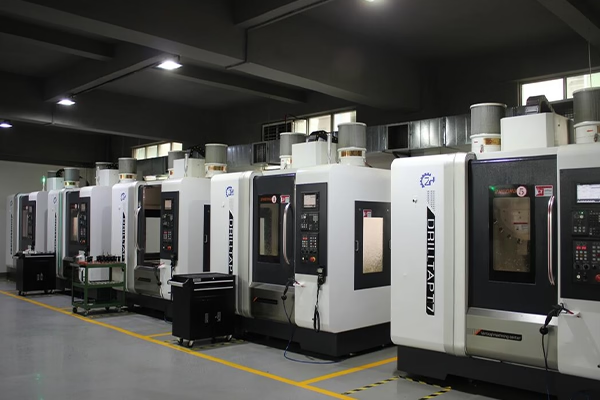
What Chinese rapid prototyping fabrication really covers
Machining, printing, casting and sheet metal sit under one label. They are not interchangeable.
Pick the process before you pick the country
The label covers a category, not a single process. A Dongguan or Shenzhen supplier may quote you CNC milling, vacuum casting, 3D printing and sheet metal on the same RFQ. Each one produces a different part. CNC machined from solid stock behaves like the production part. A printed part does not.
Start with the validation goal. If you need to test fit, function and assembly under real load, machined metal or engineering plastic is the safer route. If you need a form check on a housing next week, printing or vacuum casting will get you there for less money. Mixing the two on one assembly is common and usually a mistake.
Material choice follows the process, not the other way around. A 7075 aluminium bracket, a 316L stainless manifold and a PEEK insulator each drive different tooling, feeds and inspection plans. Send the drawing with the material and finish already specified. It saves a round of emails.
Tolerances, finishes and sizes that hold up
A capable shop holds ±0.005 mm on critical features, not on every surface. That distinction matters. Datum-referenced bores and fits get the tight callout. Cosmetic faces and clearance holes do not, and asking for them wastes cycle time and money.
Surface finish is quoted in Ra. As-machined aluminium lands around Ra 1.6–3.2 μm. Fine turning and milling reach Ra 0.8–1.6 μm. Polishing, lapping or specialty processes get you to Ra 0.2–0.8 μm where a seal or bearing surface needs it.
Size matters too. A 4,000 mm maximum processing size covers most frame and fixture work. For compact parts, 500 × 500 × 450 mm travels are plenty. If your part sits near the edge of a machine envelope, say so in the RFQ. Setup strategy changes the price.
- 15-axisOrganic shapes, undercuts, fewer setups on multi-face parts.
- 24-axisCylindrical and prismatic parts with features on four sides.
- 3Mill-turnShafts and housings where turning and milling meet.
- 43-axisFlat plates, simple brackets, high-volume runs.
Process comparison for prototype parts
Use this to narrow the RFQ before you send drawings.
| Process | Best for | Typical tolerance | When it is wrong |
|---|---|---|---|
| CNC milling | Functional metal and plastic parts | ±0.005 mm | Thin-wall hollow shapes |
| CNC turning | Shafts, bushings, threaded parts | ±0.005 mm | Large flat plates |
| 5-axis machining | Complex geometry, undercuts | ±0.005 mm | Simple 2.5D parts |
| Vacuum casting | Small batches of urethane parts | ±0.1 mm | High-load structural parts |
| 3D printing | Form, fit, early concept checks | ±0.1 mm | Tight metal fits |
| Sheet metal | Enclosures, brackets, panels | ±0.1 mm | Thick solid blocks |
How to vet a supplier in seven questions
Ask who owns the machines. A shop with its own 5-axis centers, mill-turn cells and inspection equipment controls its schedule. A broker does not. Request the machine list and the plant address. A video call through the floor tells you more than a PDF.
Ask about inspection. 100% inspection before shipment, with raw material checks, in-process monitoring and a final report on request, is the baseline for anything functional. If the answer is 'we check the important dimensions', push further. Which ones, measured how, recorded where?
Ask about certificates. ISO 9001:2015 covers general quality. IATF 16949:2016 matters for automotive. ISO 13485:2016 for medical. ISO 27001:2022 for data security. A shop that holds all four is rare, but the ones that do tend to run tighter documentation.
Ask about DFM feedback. A useful supplier flags a 0.5 mm wall, an unreachable corner or a thread that will chatter before the job starts. Quotation and free DFM analysis within 12 hours is a reasonable benchmark. If feedback arrives after the parts ship, it is not feedback.
Ask about confidentiality. Uploads should be secure, and an NDA should be available on request without a fight. For medical and defense-adjacent work, this is not optional.
Lead time, MOQ and the one-stop question
Prototype schedules slip at the handoffs, not at the machine. When milling, finishing, laser marking and inspection happen under one roof, there is no shipping delay between steps and no argument about who scratched the part. That is the real argument for a full-process shop.
MOQ is another filter. Some suppliers will not quote a single part. Others quote one piece and a 10,000-piece run from the same drawing. For prototype work, no minimum order quantity means you can iterate without a purchasing conversation every time.
On timing, ask for the sequence rather than a single number. Quotation and DFM analysis within 12 hours, production start within 24 hours, and parts shipping in 3–5 days is a working rhythm for standard prototype jobs. Complex finishing adds days. Get that noted in writing.
Questions engineers ask before the first order
Can a Chinese supplier match Western tolerances?
Yes, on features that are called out and measurable. ±0.005 mm is achievable on datum-referenced bores, fits and ground surfaces with the right machine and inspection plan.
The failure mode is not capability, it is ambiguity. If a drawing has no datums, no critical dimensions and a blanket tolerance note, the shop will hold what it can and you will argue about the rest.
What file formats should I send?
STEP or STP for the solid model, plus a 2D PDF with the critical dimensions, datums, thread callouts and finish requirements. Native CAD files help but are not required.
Mark the critical-to-function dimensions clearly. Everything else can run to general tolerance.
How do I protect my design?
Ask for an NDA before you upload. A supplier that hesitates on a standard mutual NDA is telling you something. Secure upload channels and access control on the shop floor matter as much as the paperwork.
Is 3D printing or CNC better for a prototype?
Printing is faster and cheaper for form and fit checks on non-structural parts. It will not give you the same material properties as the production part.
If the prototype has to survive load, heat or a real assembly torque, machine it from the production material. The data you get back is worth the extra cost.
What finishes can be done in-house?
Anodizing, plating, powder coating, black oxide, bead blasting, tumbling, brushing, polishing and laser marking are common in-house operations. Keeping them under one roof avoids shipping parts between vendors.
Laser marking needs a minimum character height of 1.5 mm to stay legible.
How do I handle a part that changes after the prototype?
Send the revision with a clear change list. A supplier running the same drawing through to serial production will flag any tooling or fixture impact early.
Prototype-to-production continuity on one drawing is the simplest way to avoid a second qualification cycle.
Send the drawing, get a real answer
Upload your STEP file and we will return a quotation with DFM notes within 12 hours. No minimum order quantity, from one prototype to a 10,000-piece run.
12-hour quote100% inspectionNDA on request









