
CNC 3018 Pro M: 7 Must-Know Upgrades to Avoid Costly Beginner Mistakes
This page explains what actually limits the CNC 3018 Pro M and which seven upgrades fix those limits. It is written for hobbyists, educators and hardware engineers who cut wood, plastic or light aluminum on a desktop router. After reading it you can tell which upgrades are worth the money and when a part belongs on an industrial machine instead.
What the stock machine can and cannot do
Know the starting point before you spend on parts.
Spindle swap: from toy motor to real cutting power
The stock spindle on a CNC 3018 Pro M is usually a 775-class brushed motor running on 12–24 V DC. Spindle speed lands somewhere between 7,000 and 10,000 rpm, and runout is the real problem. On a new machine it is often 0.05 mm or worse, and a tired one can reach 0.1 mm. Runout shows up twice: the wall of your slot is not parallel, and the cutter edge chips out early. Beginners then blame the end mill.
A 24 V 400 W or 500 W brushless spindle kit with an ER11 collet changes the picture. Torque rises, runout typically drops below 0.02 mm, and the smaller collet lets you run 3.175 mm and 4 mm tooling without an adapter sleeve that adds its own error. Brushless motors also run cooler and quieter, which matters when the machine sits in a classroom.
Skip the tempting higher-speed 775 replacement. Same plain bearings, same weak collet nut, same runout. The money is better spent on a spindle you can indicate with a dial test indicator, because runout is the single number that separates a toy from a machine that produces usable parts.
Cutting aluminum every day is a different job. A 1.5 kW air-cooled or water-cooled VFD spindle gives the rigidity and speed range you need, but the 3018 frame and plastic wheels cannot absorb that torque. Upgrade the spindle and frame together, or not at all.
- 1Measure firstIndicate the shank at 10 mm from the collet nut. Over 0.03 mm means replace.
- 2Keep the collet cleanA chip under the collet adds 0.02 mm of runout instantly.
- 3Match toolingER11 covers 1–7 mm shanks; buy cutters in that range only.
Frame reinforcement: stiffness is not a luxury
The 3018 extrusions handle light loads, but the gantry uprights and the Z-axis plate flex under any real cutting force. The result is chatter, inconsistent depth of cut, and snapped 1 mm end mills. Many beginners assume the stepper skipped steps. Usually the machine is bending, and the stepper is doing exactly what it was told.
Triangular gusset plates at the gantry uprights and at the base connections are the cheapest stiffness you can buy. A thicker Z-axis carriage plate, 3–4 mm heavier than the stock part, removes most of the nodding motion at the tool tip. Braces between the rear uprights and the bed frame close the loop and stop the gantry from walking.
Long term, replace the X-axis extrusion with a C-beam or a dual-extrusion setup. Those profiles resist twisting far better than a single square tube. Do this before you chase a bigger spindle, because a stiff frame on a weak spindle still cuts, while a strong spindle on a flexing frame just breaks tools.
- 1Push testPush the tool tip by hand with the machine powered. Visible movement means flex, not backlash.
- 2Torque evenlyTighten gusset bolts in a cross pattern so the extrusion does not bow.
Bed and workholding: from clamps to a real wasteboard
The stock bed is a thin aluminum plate with a few threaded holes. It is not flat, and it is not sacrificial. Clamping a part on top of it lifts the work above the machine's usable Z travel, and a 3 mm cut into the plate ends the session early.
Fit a 12–18 mm MDF or HDPE wasteboard, faced flat with a 6 mm surfacing bit after it is bolted down. Now you can cut through the part without touching metal, and you can screw small parts down anywhere on the bed. A grid of M5 or M6 threaded inserts gives you repeatable fixture positions for batch work.
Low-profile step clamps and a small machinist vise cover most jobs. Double-sided tape works for thin plates and acrylic, but degrease both surfaces first and use tape rated for the load. For anything taller than 40 mm, add a support block so the part cannot tilt into the cutter.
- 1Face the board in placeSkipping this step leaves the board 0.2–0.5 mm out of flat.
- 2Mark the tool pathsSpray the board with layout dye so you can see where you have cut.
Upgrade priority by material and part type
Spend in this order for the work you actually do.
| Material | First upgrade | Second upgrade | Realistic limit |
|---|---|---|---|
| Balsa, foam, MDF | Wasteboard and clamps | Dust shoe | Fine detail, no tight tolerance |
| Hardwood, plywood | Frame gussets | 400 W brushless spindle | Steady feeds, ±0.1 mm practical |
| Acrylic, POM | Spindle with ER11 | Electronics and drivers | Clean edges, light finishing passes |
| Thin aluminum 6061 | Frame and Z plate | 1.5 kW VFD spindle | Slow, shallow passes only |
| Steel, titanium | Not on this platform | Outsource the part | No practical path on a 3018 |
Electronics and linear motion: smooth motion starts here
The stock GRBL board and its integrated drivers are the weakest link in the motion chain. Mid-band resonance makes the motors howl and lose steps at exactly the feed rates you want to use. A board with socketed step drivers, better heat sinking and a proper 24 V supply removes most of that noise. Add a relay or PWM output for spindle control and you stop reaching for the power switch on every tool change.
Plastic V-wheels are the second source of slop. They deform under load, flat-spot when the machine sits still, and need constant eccentric nut adjustment. Steel or polycarbonate wheels on the same V-slot rail hold preload far longer. The bigger step is linear rails on the X and Z axes, which remove wheel adjustment from your routine entirely.
Do the electronics and the wheels before you chase speed. A machine that holds position at 400 mm/min finishes parts faster than one that loses steps at 900 mm/min and ruins the second half of the job.
- 1Set driver currentStart at 70% of the motor rating and raise only if you hear skipping.
- 2Check preloadWith power off, the gantry should move with light drag, not free play.
Dust control, cooling, and the setup work that saves parts
Dry cutting fills the slot with chips, and recutting those chips is what dulls a 2 mm end mill in ten minutes. A dust shoe with a shop vacuum keeps the cut line visible and the tool cool. On plastics, a small air blast aimed at the cutter does more for edge quality than any feed change.
Calibration is where most beginners lose accuracy without noticing. Square the gantry to the bed, then tram the spindle so a dial indicator sweeps within 0.02 mm across a 100 mm circle. Steps per millimeter need to be measured on your machine, not copied from a forum, because pulley and lead screw batches differ.
Limit switches are worth fitting on all three axes. Homing at the start of every job gives you a repeatable zero, which is the only way to run a second operation on the same part. In your CAM software, set the safe Z height above the tallest clamp, use ramp or helical entry instead of plunging straight down, and keep depth of cut under half the cutter diameter in aluminum.
One more habit: cut a test part in scrap before you commit the real stock. Ten minutes of scrap proves the zero, the tool length and the workholding all at once.
- 1Tram in two directionsCheck front to back and left to right; correct with shims.
- 2Log your settingsWrite down steps per mm and backlash per axis for the next setup.
When upgrades are not enough
A fully upgraded 3018 is still a light machine with a small work envelope and a moving gantry. Parts that need ±0.005 mm, a 4,000 mm envelope, or a documented inspection report do not belong on it, no matter how much you spend on parts.
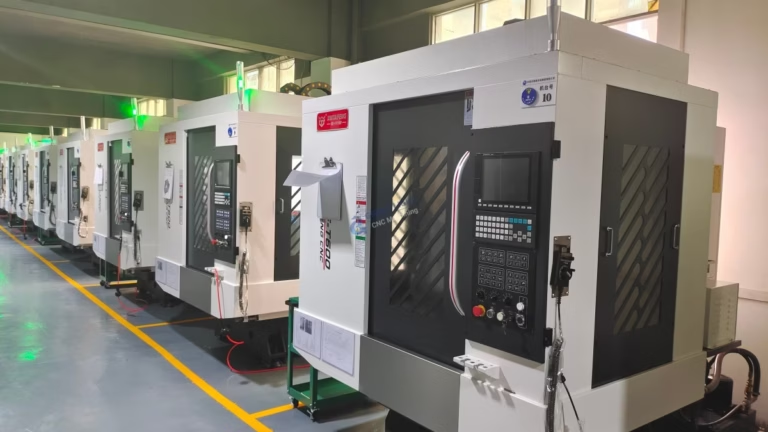
That is the point where the job moves to a machining shop. GreatLight runs 127 high-precision CNC machines across three plants, including 16 simultaneous 5-axis machining centers and 12 four-axis mills, with a maximum processing size of 4,000 mm. We hold ±0.005 mm and finish to Ra 0.8–1.6 μm on aluminum, stainless, titanium and engineering plastics.
Send a model and we return a quotation plus a free DFM analysis within 12 hours. Production can start within 24 hours, and there is no minimum order quantity, so a single prototype and a 10,000-part run go through the same process. Uploads stay confidential and an NDA is available on request.
- 1Good fit for a 3018Enclosures, jigs, signage, teaching models, one-off brackets.
- 2Good fit for a machine shopTight tolerance, hard metal, large envelope, traceable inspection.
Questions engineers ask next
How much runout is acceptable on a desktop spindle?
Below 0.02 mm at 10 mm from the collet nut is a workable target for wood and plastic.
For aluminum finishing passes, keep it under 0.01 mm or the wall finish will show every cutter mark.
Can a CNC 3018 Pro M cut 6061 aluminum?
Yes, with shallow passes, a stiffened frame and a spindle that holds low runout. Expect 0.2–0.5 mm depth of cut with a 3 mm single-flute cutter and air blast.
It will not hold production tolerances. Treat it as a way to prove a design before you order machined parts.
Do I need limit switches and homing?
They are optional for a single one-off cut, but almost mandatory for repeat work.
Homing gives a fixed machine zero, so a second operation lines up with the first without re-probing every time.
Why does my machine lose steps at higher feed rates?
Usually driver current is set too low, the supply sags, or the plastic wheels are too loose.
Fix the mechanics first. Raising current on a flexing frame just turns lost steps into broken cutters.
What should I check on a new part before cutting the real stock?
Zero, tool length, workholding and safe Z height, in that order.
Run the first operation in scrap material and measure it. A 0.3 mm error found on scrap is free.
When should I outsource a part instead of upgrading the router?
When the drawing calls for tolerances tighter than ±0.05 mm, hard metals, or a documented inspection report.
At that point the upgrade cost exceeds the price of having the part machined properly.
Send the part the desktop router cannot hold
Upload your model and get a quotation with free DFM analysis within 12 hours.
12-hour quote100% inspectionNo minimum order quantity









