
CNC Aluminum Machining Parts Services: What to Check Before You Place an Order
We wrote this for engineers and sourcing teams comparing aluminum machine shops. It lists the checks that actually separate a capable factory from a sales office, and the points where a quote starts to fall apart after the PO is signed. Read it before you send drawings.
In this article
- 1
- 2
- 3
- 4
- 5
- 6
- 7
Key takeaways
What to compare across aluminum machine shops
Judge a supplier on these five axes. Weakness in any one of them shows up after the first shipment, not before.
| Criterion | What good looks like | What to avoid |
|---|---|---|
| Tolerance | ±0.005 mm stated with the alloy and feature size | A single number quoted for every part |
| Alloy range | 6061-T6, 7075, 2024, 5083 in stock | One grade, ordered per job, with delays |
| Lead time | Quote in 12 hours; parts in 3–5 days | Vague dates that move after deposit |
| MOQ | One prototype accepted, scaling to 10,000+ | Setup fees that kill small runs |
| Certifications | ISO 9001, IATF 16949, ISO 13485, ISO 27001 | A logo on the site with no scope |
| Inspection | 100% before shipment, reports on request | Sample-only checks with no records |
| Finishing | Anodizing, hardcoat, plating, blasting in one chain | Outsourced steps with no traceability |
The verdict
Pick a shop that ties tolerance to features, quotes with a DFM note, and inspects 100% before shipment. If a supplier cannot answer those three, volume will not fix it.
Tolerance and alloy: the two numbers that decide feasibility
Every quote should tie tolerance to a feature, not to the whole part. A ±0.005 mm bore on a 40 mm aluminum bracket is routine on a 5-axis center with a temperature-stable setup. The same tolerance across a 400 mm frame with 2 mm walls is a different job, and any shop that quotes it the same way is guessing.
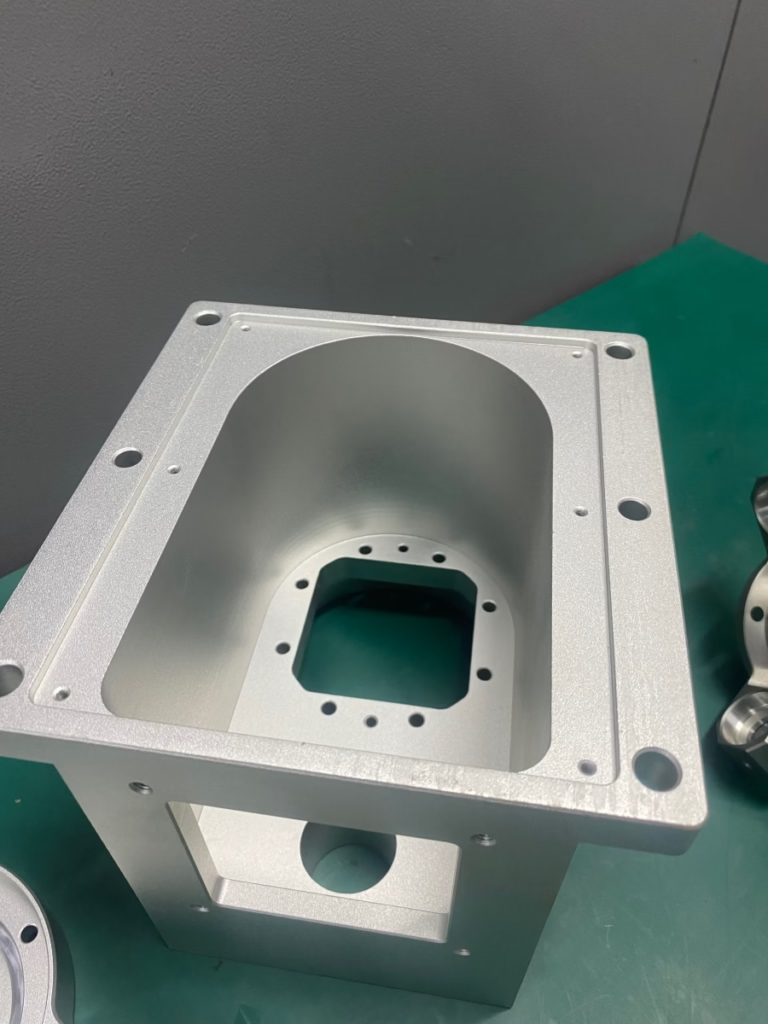
Ask which machine will run your part. GreatLight keeps 16 simultaneous 5-axis centers, 12 four-axis mills, 27 three-axis machines and 16 mill-turn centers. A turned aluminum housing with cross-drilled ports belongs on a mill-turn, not on a 3-axis mill with four re-fixturings. Fewer setups means fewer stacked errors.
Alloy choice moves the numbers too. 6061-T6 is the default for structural brackets and heatsink plates. 7075 gives higher yield strength for aerospace ribs but cuts slower and is less weldable. 2024 holds fatigue loads well and needs corrosion protection. 5083 and 6082 are common in marine and EV housings, and ADC12 shows up in die-cast housings that get machined afterward.
When a drawing calls for Ra 0.2–0.8 μm on aluminum, the shop has to plan the last pass, not just the geometry. Fine finishes on soft alloys attract built-up edge, so the finishing tool, coolant and spindle speed all matter. An as-machined Ra 1.6–3.2 μm surface is often enough for internal parts and costs less.
- 16061-T6General purpose. Good strength, easy to anodize, best value for brackets and plates.
- 27075High strength for aerospace and racing parts. Slower feeds, watch tool wear.
- 32024Fatigue resistant. Needs anodizing or plating for corrosion.
- 45083 / 6082Marine and EV housings. Gumminess needs sharp tools and steady coolant.
Lead time, quoting and what a real CNC aluminum machining parts services quote contains
A useful quote arrives with a DFM note. If the shop only returns a price, nobody has checked whether the 1.5 mm floor on your pocket will chatter or whether the tapped hole sits 0.3 mm from a wall. At GreatLight we send the quotation and a free DFM analysis within 12 hours, and production can start within 24 hours of approval.
Delivery promises are easy to make. Ask what the historical late-delivery rate is. Our figure is below 2%, and parts typically ship in 3–5 days once material is in. That number only means something if the shop also tells you how many jobs run in parallel and whether finishing is in-house.
Watch how the quote handles finishing. Anodizing, electroless nickel, zinc plating, powder coating, black oxide, bead blasting and laser marking each add a step and a queue. If any of those steps leave the building, the promised date belongs to a third party, not to the shop you signed with.
Ask about marking detail early. Laser engraving needs a minimum character height of 1.5 mm to stay legible after anodizing. Part numbers below that size will fill in, and you will find out at incoming inspection.
Certifications, inspection and data handling
Certificates describe a management system, not your shipment. ISO 9001:2015 covers quality process. IATF 16949:2016 matters if the part ends up in a vehicle program. ISO 13485:2016 applies to medical hardware. ISO 27001:2022 covers information security, which is what protects your CAD files.
The paperwork that actually follows your parts is the inspection record. We run raw material checks, in-process monitoring and a final inspection, with 100% inspection before shipment and reports on request. Our qualified-rate figure is 99.99%, and it comes from that routine rather than from a claim.
For prototypes and low-volume runs, data handling matters as much as machining. Uploads are treated as secure and confidential, and an NDA is available on request. If your drawings carry export-controlled geometry, settle the NDA before the RFQ, not after.
One more practical point. Ask who signs the first article report and what happens when a dimension sits at the edge of tolerance. A shop that flags a marginal feature before shipping saves you a rejection cycle.
Batch size, materials and the limits of aluminum machining
Batch size should not change how the part is made. A factory set up to move from one prototype to a 10,000+ part run on the same floor keeps the process stable. There is no minimum order quantity here, which means a single bracket and a full production lot go through the same first-article logic.
Know the boundaries. Aluminum is fast to cut and light, but it is not the answer for every part. Wear surfaces, high-temperature zones and parts that need extreme stiffness usually belong in steel, stainless or titanium. We machine 303, 304, 316L, 17-4PH, 4130, 4140, Ti-6Al-4V and Inconel when aluminum will not hold up.
Size limits matter too. Our maximum processing size is 4,000 mm, with travel envelopes of 4,000 × 400 × 150 mm, 750 × 1,150 × 550 mm, 600 × 600 × 600 mm and compact 500 × 500 × 450 mm cells. A part outside those envelopes needs a different plan, not a longer quote.
Thin walls, deep pockets and tight corner radii are the three features that push aluminum parts toward the edge. A 0.5 mm wall on a 100 mm long rib will deflect under normal cutting force. If the design needs it, expect the shop to propose a support strategy or a two-stage cut.
Step by step: qualifying a supplier in one week
These steps work whether you are comparing three shops or one.
- 1Send a real part, not a simple onePick the drawing with the tightest tolerance and the most setups. A cube tells you nothing about a shop.
- 2Ask for the DFM note with the priceIf the reply is only a number, the model was not reviewed. Expect feedback within 12 hours from a capable shop.
- 3Ask which machine will run itA 5-axis or mill-turn answer is better than a 3-axis answer for a part with angled features or cross ports.
- 4Confirm the alloy and temper in writing6061-T6 is not the same as 6061-T4. Temper changes strength and anodizing response.
- 5Check the inspection planAsk what is measured, on how many pieces, and whether the report ships with the parts.
- 6Settle confidentiality before releaseSign the NDA first if the drawing is sensitive. Uploads should stay secure and confidential.
- 7Run one small order, then scaleApprove the first article on a low quantity, then release the 10,000+ run against that same process.
Common questions
What tolerance can you hold on aluminum parts?
We hold ±0.005 mm (±0.0002 in) on features that support it, with the setup matched to the alloy and geometry.
On long thin walls or large frames, the achievable number depends on fixturing and thermal stability. Send the drawing and the DFM note will state what is realistic per feature.
Do you accept very small orders?
Yes. There is no minimum order quantity, so a single prototype is fine, and the same floor handles 10,000+ part runs.
Prototypes and production parts go through the same first-article check, which is what keeps the process from drifting when volume changes.
How fast can I get a quote and parts?
Quotation and free DFM analysis come back within 12 hours. Production can start within 24 hours of approval.
Parts typically ship in 3–5 days. Finishing steps such as anodizing or plating add their own queue time, so plan those into the schedule.
Which aluminum alloys do you machine most?
6061, 6061-T6, 2024, 5052, 5083, 6063, 6082, 7075 and ADC12 are all in regular use.
The choice usually follows the load case and the finish. 7075 for strength, 2024 for fatigue, 5083 for marine and welded housings.
What finishes can be applied to aluminum parts?
Anodizing in clear, color, hardcoat and conductive versions, plus electroless nickel, zinc, silver and gold plating, powder coating, black oxide, bead blasting, tumbling, brushing and polishing.
Laser marking and engraving are available with a minimum character height of 1.5 mm.
How is my design data protected?
Uploads are secure and confidential, and an NDA is available on request before you release drawings.
Information security is covered by our ISO 27001:2022 certification.
Send your aluminum drawings and get a usable answer
We return a quotation and a free DFM analysis within 12 hours, and we tell you which features will be hard before you order.
12-hour quote100% inspectionFrom one part to 10,000+
More from the shop floor
We publish setup notes, tooling trials and inspection data from the factory floor.











