
CNC jewelry production technology
How 5-axis milling turns a CAD file into a finished ring, pendant or clasp — and where the process stops being economical. Written for engineers and product managers who need to judge geometry, tolerance and material before they send a model out for quote.
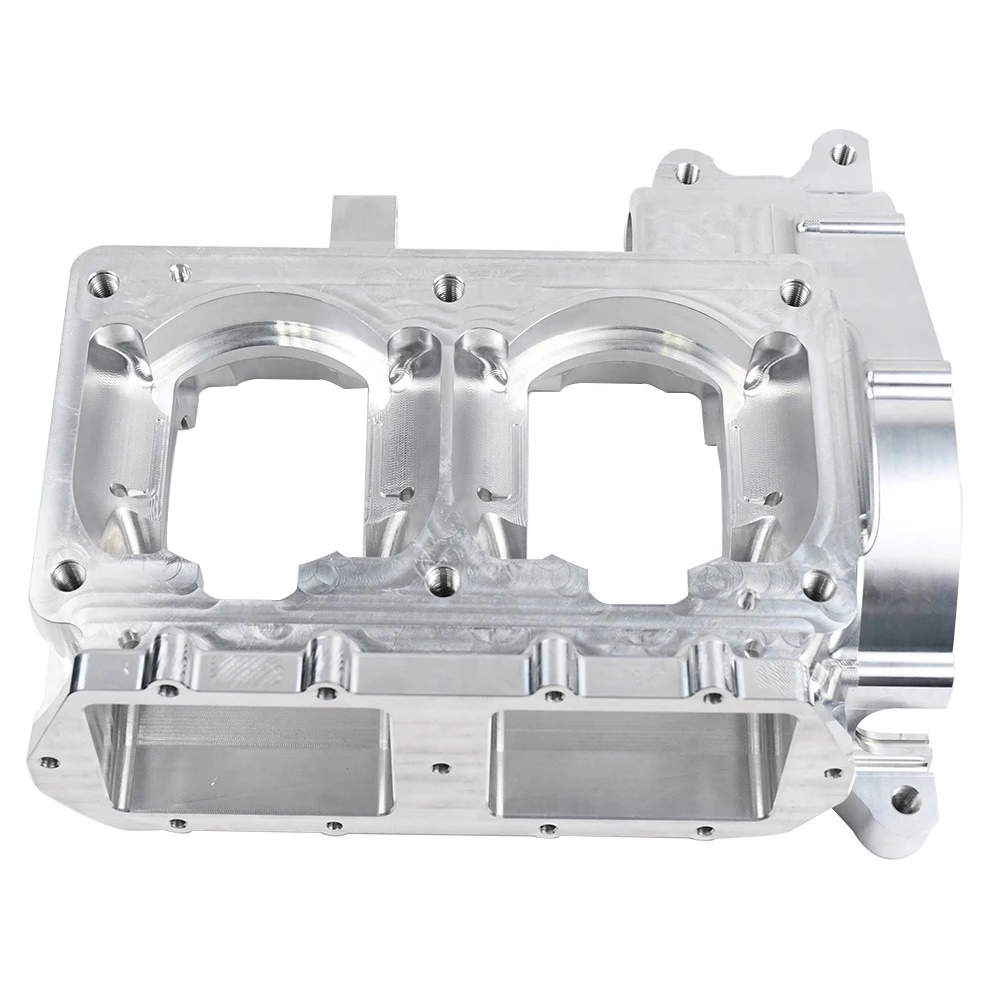
How CNC jewelry production technology removes metal
The process is subtractive. A solid block of wax, brass, silver, gold or titanium is clamped in a machine, and a rotating cutter removes everything that is not the part. Geometry comes from a CAD model, not from a mold, so the first physical piece can match the final drawing. That single fact changes how a collection is planned.
Cutters run from Ø0.5 mm down to Ø0.2 mm for prong gaps and bead seats. A 0.2 mm tool spinning at 40,000 rpm leaves a floor around Ra 0.4 μm, which usually means only a light polish before setting. Deeper cavities need longer reach, and long thin tools deflect. That deflection is what sets the practical depth-to-diameter limit.
Toolpath strategy matters more than spindle speed on small parts. Constant-engagement paths keep radial load steady, so a 0.3 mm cutter survives a full roughing pass. Trochoidal moves clear a pocket without burying the flute. Skip these and the tool snaps on the second pass.
Every feature must be reachable. A stone seat facing the inside of a closed shank cannot be cut unless the part is flipped or the shank is split. This is the first thing to check in CAD, not the last.
Why 5-axis motion matters for jewelry geometry
A simultaneous five-axis center tilts the tool and rotates the workpiece at the same time. The cutter stays normal to the surface across a curved shank, so scallop height stays even. On a three-axis machine the same surface needs several setups, and each setup adds a re-clamp error.
For a ring with an asymmetric taper, five-axis motion cuts the outer profile, the seat and the inner bore in one grip. There is no mismatch where two setups meet. Positional tolerance stays inside ±0.005 mm across the whole part.
The gain is not only accuracy. It is reach. A 30° tilt lets a short, stiff cutter enter an undercut that a straight tool cannot touch. Short tools deflect less, so finish improves at the same feed rate.
Five-axis programming costs more hours upfront. On a one-off piece that cost is real. On a 200-piece run it spreads thin, and the per-part time usually beats a three-axis route with four setups.
Materials that behave well on the machine
Wax machines fast and cheap. It is the right choice when the part will be cast afterward, because the milled wax pattern is more accurate than an injected one and holds fine detail like 0.3 mm filigree. Wax also lets you test a design before spending on precious metal.
Brass C36000 and copper alloys cut cleanly and take a mirror polish. They suit prototype rings, clasps and findings where the final material is not critical. Silver 925 and gold alloys machine well too, but chip recovery matters, so we keep precious swarf separated by alloy.
Titanium Ti-6Al-4V, stainless 316L and 17-4PH are harder to cut. They work for men's bands, watch cases and clasps that need wear resistance. Use sharp carbide, low cutting speed and plenty of coolant. Heat buildup is the main risk.
Precious-metal weight is a design decision, not a machining one. A hollowed shank weighs less but has thinner walls. Below 0.6 mm wall thickness, chatter becomes visible on the inner surface.
Where the process stops paying off
CNC milling is not the answer for a 5,000-piece chain of identical simple bands. Casting wins on unit cost once the mold is amortized. The crossover sits somewhere around a few hundred pieces for simple shapes, and much lower for complex ones.
Very thin, springy features are also a poor fit. A 0.3 mm wire loop or a fine mesh will deflect under cutting force. If the design needs that, casting or 3D printing is the better route.
Hardened tool steel and some ceramics cut poorly without a grinder. We can machine them in the annealed state, but post-hardening distortion is a separate problem that milling cannot solve.
Finally, consider total lead time. Complex five-axis programming can take a day or two. If a client needs a single piece tomorrow, a simpler 3-axis setup on wax may deliver faster even if the finish is rougher.
CNC milling compared with lost-wax casting
Pick the route that matches geometry, volume and material
| Factor | CNC milling | Lost-wax casting |
|---|---|---|
| Best volume | 1 to 10,000+ parts | 50+ parts per mold |
| Setup cost | CAD and toolpath time | Mold and rubber tooling |
| Wall thickness | Down to 0.6 mm | Down to 0.8 mm typical |
| Surface as cut | Ra 0.4–1.6 μm | Requires filing and polish |
| Undercuts | Reachable with 5-axis tilt | Limited by draft angle |
| Hollow interiors | Machined directly | Needs cores or split mold |
| Precious scrap | Recoverable swarf | Sprue and button reuse |
| Tolerance | ±0.005 mm | ±0.05 mm typical |
When to choose which route
Choose CNC milling when the geometry has undercuts, tight tolerance or precious-metal detail and the run is under a few hundred pieces. Choose casting when the shape is simple, the volume is high and unit cost dominates. For one-off design validation, mill in wax first.
Questions engineers ask before quoting
Can you machine a ring with a closed shank and set stones in it?
Yes, but the stone seats must be reachable. On a closed shank the inner surface and the seat facing inward cannot be cut in one grip. We usually machine the outer profile and seats first, then flip and bore the inner diameter.
If a seat points inward with no clearance, the design needs a split shank or a two-piece build that is later assembled. We flag this in the DFM review within 12 hours of upload.
What is the smallest cutter you run, and what detail does it hold?
We run down to Ø0.2 mm on suitable geometry. That holds a groove or filigree around 0.3 mm wide with a clean floor.
The limit is depth. A 0.2 mm cutter should not go deeper than about 1 mm without a special long-reach tool and reduced feed. Deeper than that, deflection shows as taper in the slot.
Do you machine precious metals directly, or only wax patterns?
Both. We machine silver 925, gold alloys, brass and copper directly. We also mill wax patterns for clients who want to cast afterward.
Precious swarf is collected and separated by alloy so the value is not lost. Uploads and files stay confidential, and an NDA is available on request.
How tight can the tolerance be on a small curved surface?
We hold ±0.005 mm on critical features like bores, seat diameters and mating faces. On free-form curved surfaces the practical limit is set by cutter deflection, not by the machine.
Reported inspection data comes from the final check. Raw material, in-process and final inspection all run, and reports are available on request.
What finish can I expect straight off the machine?
As-machined surfaces sit around Ra 1.6–3.2 μm. With a finishing pass and a small cutter, Ra 0.4 μm is realistic on flat and gently curved faces.
For a mirror polish we send parts to bead blasting, tumbling or hand polishing. Laser marking and engraving are also available, with a minimum character height of 1.5 mm.
Is there a minimum order quantity?
No minimum. We run from one prototype to 10,000+ part runs on the same process.
Quotation and free DFM analysis come back within 12 hours. Production can start within 24 hours of approval, and parts typically ship in 3–5 days.
Send a model and get a manufacturability read
Upload your CAD file and we will return a quote plus a DFM note on reach, wall thickness and tool access within 12 hours.
12-hour quote100% inspectionNo minimum orderNDA on request
More from GreatLight
We publish setup notes, tooling trials and inspection data from the factory floor.











