
CNC Machine Service NJ: What to Check Before You Send a PO
A sourcing guide for engineers and buyers in New Jersey who are choosing an outside machine shop. It covers tolerance, inspection, certifications, lead time and MOQ, and it tells you when a partner outside the state makes more sense than a local one.
In this article
- 1
- 2
- 3
- 4
- 5
- 6
- 7
Key takeaways
Six Criteria for Choosing a CNC Machine Service NJ Partner
Use this as a screening sheet before you request quotes.
| Criterion | What to ask | Red flag |
|---|---|---|
| Tolerance capability | Which CMM verifies the ±0.005 mm? | No metrology lab on site |
| Inspection records | FAI and material certs on request? | Reports cost extra per part |
| Certifications | ISO 9001, IATF 16949, ISO 13485? | Certificate expired or out of scope |
| Lead time | Quote in 12 hours, parts in 3–5 days? | Vague dates, no dates in writing |
| Minimum order | One prototype to 10,000+ pieces? | Setup fee added to every small lot |
| Finishing | Anodize, plating, powder coat in house? | Three vendors, three schedules |
| Confidentiality | NDA signed before you upload? | Files kept after the job ends |
| Payment terms | Deposit tied to milestones? | Full payment before first article |
The Short Version
Pick the shop that shows you its inspection method and its certificate scope. Local matters for big, heavy, or fast-changing parts. Everything else is a machine, a program, and a report.
Tolerance Is a Measurement Claim, Not a Marketing Number
Every shop page lists a tolerance. Few list how they prove it. When a drawing calls for ±0.005 mm, the shop needs a controlled temperature room, a calibrated CMM, and a datum scheme that matches your drawing. Ask which of the three they have. If the answer is a caliper and a granite plate, the number on the website is decoration.
Material behavior matters as much as the machine. Aluminum 6061-T6 moves less after roughing than 7075, but it still moves. A shop that roughs, stress-relieves, then finishes will hold a thin wall better than one that cuts to size in a single pass. We rough to 0.5 mm stock, let the part rest, then finish.
Surface finish travels with tolerance. Ra 0.8–1.6 μm is a normal machined finish. Ra 0.2–0.8 μm needs a finer step-over, a sharper tool, and often a second setup. If your drawing asks for both a tight bore and a mirror finish, expect the shop to quote two operations, not one.
The practical test: send one part with a feature only your CMM can check. Read the inspection report they return. The report tells you more about the shop than the website does.
Certifications Must Match the Industry You Sell Into
ISO 9001:2015 is the baseline. It means the shop has a documented quality system and audits it. That is enough for brackets, housings, fixtures, and most industrial machinery work. It is not enough for a brake component or a surgical instrument.
Automotive and EV parts usually need IATF 16949:2016. That standard adds traceability, PPAP-style documentation, and tighter change control. If your customer is a Tier 1 supplier, they will ask for it before they ask for a price. Medical device work moves to ISO 13485:2016, which is about process validation and device history records.
ISO 27001:2022 covers information security. It matters when you upload CAD for a defense-adjacent or unannounced product. Combined with a signed NDA, it is the reason a shop can hold your files and your geometry without leaking them.
A certificate is only useful if the scope covers the process you are buying. A shop can hold ISO 9001 for assembly and still outsource its machining. Ask which processes sit inside the audit scope.
Lead Time, MOQ and What the Quote Actually Covers
Quotation speed is a proxy for how the shop is organized. If CNC programming sits in-house, DFM feedback can come back within 12 hours, and production can start within 24 hours of approval. If the shop is brokering work, the same step takes a week and you never see the DFM notes.
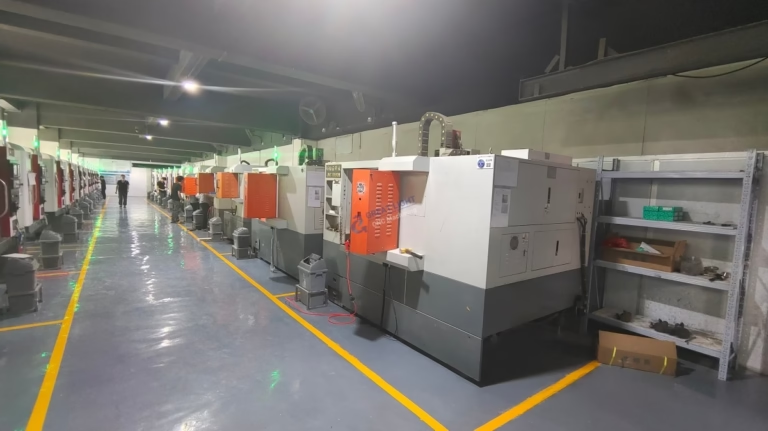
Volume flexibility is the second filter. Some shops quote one prototype and lose interest at 50 pieces. Others will not touch a job under 500. Ask for the range up front: one prototype through 10,000+ part runs is a workable span for a shop with 127 machines across three plants.
Read the quote line by line. A low unit price with tooling, programming, and fixturing billed separately is not low. Ask what happens if the first article fails: rework at whose cost, and on whose schedule. A shop that stands behind its process will say so before you ask.
Shipping is part of the lead time. Parts that ship in 3–5 days from Dongguan still need air freight to Newark. Count the transit days before you promise a build date to your own customer.
When a New Jersey Shop Wins and When It Does Not
Keep the work local when the part is large, heavy, or needs a person in the room. A 4,000 mm weldment, a fixture that must be trial-fitted on your floor, or a prototype that will be modified three times in one week all favor a shop within driving distance. Same-day pickup is a real advantage and worth paying for.
Go outside the region when the part is small, the geometry is complex, and the volume is steady. A 5-axis medical housing with 40 tapped holes and a hardcoat finish does not care where it was made. What matters is the machine, the program, and the inspection report.
The middle case is the tricky one. A part that is simple but needed fast, or complex but needed once. Price the freight both ways before you decide. Two days of transit against a 30 percent lower unit price is usually an easy call on a production run.
New Jersey has strong aerospace, biotech, and automotive supply chains, and the shops serving them are good. They are also busy. If your dates are fixed, a second source outside the state is risk reduction, not disloyalty.
How to Vet a CNC Machine Service NJ Supplier in Five Steps
Run these in order. Stop at the first step that fails.
- 1Send a drawing with one hard featurePick a part with a true position callout or a ±0.01 mm bore. See whether the quote mentions the feature at all.
- 2Ask for the inspection methodRequest the CMM model, the calibration date, and a sample first-article report from a similar part.
- 3Check the certificate scopeDownload the ISO 9001, IATF 16949, or ISO 13485 certificate and read which processes are covered.
- 4Confirm the volume rangeAsk for a price at 1, 100, and 2,000 pieces. A shop that only quotes one tier is not flexible.
- 5Request the DFM notesLook for specific changes: thinner wall, larger corner radius, different datum. Generic notes mean no one read the file.
Frequently Asked Questions
How long does a quote from a China-based shop take to reach New Jersey?
A shop with in-house programming can return a quotation and a free DFM analysis within 12 hours. That covers the time zone gap. If you send files at the end of your workday, the notes are usually waiting when you arrive in the morning.
Ask for the DFM notes in writing, not a phone summary. Written notes are what you forward to your own design team.
Can a supplier outside New Jersey hold ±0.005 mm on a production run?
Yes, if the machine, the fixture, and the inspection process are built for it. A simultaneous 5-axis center with a Ø400 mm rotary table holds position better than a 3-axis machine with four re-clampings.
The condition is temperature control and a calibrated CMM. Without those, the tolerance claim is not repeatable across a 500-piece lot.
What is a normal minimum order quantity for CNC machining?
It varies widely. Many shops set a floor at 100 or 500 pieces because setup time dominates small lots. Others quote from one prototype upward, which suits design validation and bridge production.
If you are between prototype and production, ask for a price at both ends. The gap tells you how much of the cost is setup versus cycle time.
Do I need an NDA before uploading CAD files?
If the part is unannounced, yes. A mutual NDA before the first upload is standard practice, and a shop holding ISO 27001:2022 has documented controls around file access.
Uploads should be secure and confidential by default. Ask what happens to your files after the job ships.
Which materials are common for New Jersey aerospace and medical work?
Aluminum 6061-T6 and 7075, stainless 316L and 17-4PH, titanium Ti-6Al-4V, and PEEK cover most of it. Inconel appears when the part sees heat.
Each material changes the tool path, the coolant, and the finishing step. Tell the shop the service environment, not just the alloy name.
What should the first article inspection report contain?
Nominal dimensions, actual measurements, the datum scheme, and the instrument used. If the drawing has a true position callout, the report should show the calculated value, not just the X and Y offsets.
Ask for raw material certificates in the same package. Traceability is cheaper to collect at the start than to reconstruct later.
Send a Drawing, Get DFM Notes in 12 Hours
Upload your CAD and get a quotation with free DFM analysis, no minimum order quantity, and 100% inspection before shipment.
12-hour quoteNo MOQ100% inspectionNDA on request
More from GreatLight
We publish setup notes, tooling trials and inspection data from the factory floor.











