
CNC Machine Shop Customer Service: What Engineers Should Check
This page explains what good CNC machine shop customer service looks like from an engineer's side of the desk. It covers the seven points we get asked about most: DFM feedback, quote clarity, tolerance talk, inspection evidence, NDA handling, delivery risk and change control. Read it to judge a supplier before you release a purchase order.
In this article
- 1
- 2
- 3
- 4
- 5
- 6
- 7
- 8
- 9
- 10
Key takeaways
What CNC machine shop customer service means on a real job
Most buyers judge a supplier after the parts arrive. By then it is too late to change anything. The useful part of CNC machine shop customer service happens earlier: when someone reads your STEP file, asks about function, and tells you which features will be hard to hold.
That first read is where cost is decided. A wall at 0.8 mm, a deep pocket with a 3 mm corner radius, a thread that runs into a shoulder, a flatness callout across a thin plate. Each one moves the process, the fixturing and the price. A shop that quotes without comment is quoting a guess.
Service also shows up in how questions are answered. If you ask about material substitution and get a one-line reply, the same pattern will follow when a dimension goes out of tolerance. Engineers want a named person who can talk about speeds, feeds and setup.
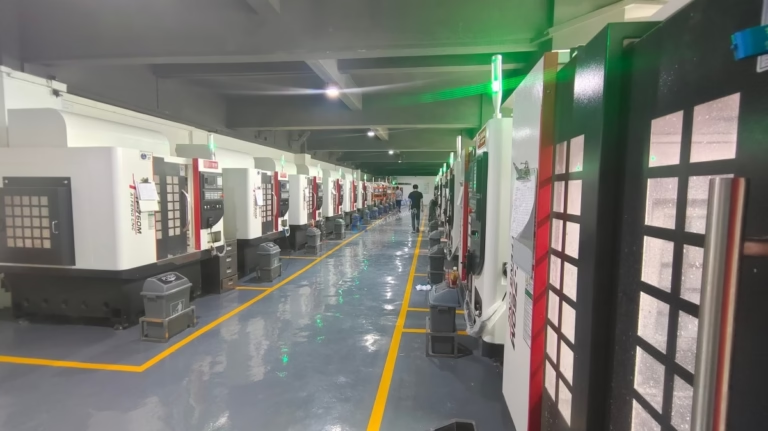
We have run 3 wholly-owned plants in Dongguan and Singapore since 2011, with 150 technicians and 127 CNC machines. None of that replaces a clear answer to a technical question. That answer is the service.
- 1Read before quoteDFM comments should arrive with the price, not after.
- 2One named contactYou should know who owns your job and who to call.
- 3Function firstTell the shop how the part works; tolerance decisions follow.
DFM feedback: the part of CNC machine shop customer contact that saves money
Design for manufacturing review is not a lecture about your drawing. It is a short list of changes that cut cost or risk. On a typical aluminium housing, moving one hole 0.5 mm off a wall can remove a second setup. On a 17-4PH shaft, switching from a ground finish to a turned finish at Ra 0.8–1.6 μm can drop a whole operation.
We return a quotation and a free DFM analysis within 12 hours. The DFM note lists the features we flagged, why they are risky, and what we suggest instead. You decide. Sometimes the answer is to keep the design and pay for the extra time.
Two questions are worth asking every time. Which feature drives the price? Which feature is most likely to fail inspection? If the shop cannot name both, the review was not a review.
A good DFM note is short. Three to eight lines, each tied to a specific face or dimension. Long generic advice about draft angles on a machined part is filler.
- 1Ask for the price driverOne feature usually controls most of the cost.
- 2Ask for the risk driverThe hardest dimension is where scrap starts.
- 3Keep it specificComments should point at faces and callouts, not general rules.
What a CNC machine shop customer quote should contain
A quote is a plan with a number at the bottom. It should state the machine class, the stock size and form, the tolerance band, the finish, the inspection level and the assumed quantity. When one of those is missing, the price is soft.
Machine class matters because it sets what is possible. A 3-axis job with four sides of work needs either multiple setups or a 4-axis mill. A part with undercut geometry or compound angles may need one of our 16 simultaneous 5-axis centers. The quote should say which, because that choice explains the price and the lead time.
Stock form is the quiet cost. Bar stock, plate and near-net forging give very different material yields and different machining time. On a 4,000 mm part, the difference between a plate and a casting is often larger than the machining rate.
If the quote lists a tolerance of ±0.005 mm with no note about which dimensions hold it, ask. The number is real for the features we control, but it does not apply to every surface on every material.
- 1Machine and setup countExplains both cost and achievable geometry.
- 2Stock form and sizeDrives material yield and cycle time.
- 3Inspection levelStandard check or report with named dimensions.
Tolerance, finish and material questions you should be able to ask
Tolerance is a conversation about features, not a brochure number. We hold ±0.005 mm ( ±0.0002 in ) on critical features when the drawing supports it. That means a clean datum scheme, enough wall thickness, and a material that does not move after cutting.
Thin aluminium plates are the common trap. A 2 mm 6061 plate with a flatness callout will move after stress relief unless the stock is pre-machined. The same callout on a 12 mm plate is routine. Surface finish follows the same logic: Ra 0.2–0.8 μm needs a finishing pass and often a different tool, while Ra 1.6–3.2 μm comes off the machine as cut.
Material choice changes the answer. 7075 aluminium machines cleanly but is less weldable and more prone to stress cracking. 316L stainless work-hardens, so light passes and rigid setups matter. Ti-6Al-4V ( TC4 ) needs slow speeds, plenty of coolant and sharp tooling. Inconel is slower again.
Ask the shop to name the material grade it will buy, not just the family. 6061 and 6061-T6 behave differently on a thin wall. 304 and 316L behave differently on a deep bore.
- 1Name the grade6061-T6 is not the same job as 6061.
- 2Flag thin wallsUnder 3 mm on aluminium needs a plan for movement.
- 3Match finish to functionSealing faces and sliding faces need different Ra.
Inspection, reports and the evidence behind CNC machine shop customer support
Every part we ship is inspected before it leaves. That covers a raw material check, in-process monitoring and a final inspection. Reports are available on request, and the report should list the dimensions that were measured, not just a pass stamp.
For a first article, ask which measuring tools were used. Calipers are fine for a 0.1 mm callout. A bore at ±0.005 mm needs a bore gauge, an air gauge or a CMM. If the report does not say, the number is decoration.
Process capability matters more than a single result. Our historical qualification rate is 99.99%, which reflects parts that met the print, not parts that were reworked into tolerance without telling anyone. Ask how nonconforming parts are handled and who signs off on a concession.
Keep the inspection plan tied to the drawing. A GD&T callout for position on a hole pattern should be checked as position, not as a simple linear distance between two holes.
- 1100% inspection before shipmentNo sampling on outgoing parts.
- 2Tool named for each calloutThe method has to match the tolerance.
- 3Concession processAsk who approves a deviation and how you hear about it.
Confidentiality, NDA and file handling
Your drawings carry your product. Secure uploads and confidential handling are baseline, not a premium option. We keep files inside the job folder, limit access to the engineers working on the part, and sign an NDA on request.
ISO 27001:2022 covers information security at our sites. That certification is about how data is stored and accessed, not about machining. It matters when your customer asks where their model lives and who can open it.
Ask a simple question during the review: who inside the shop can see my files? A clear answer names roles, not departments. If the reply is vague, treat it as a gap.
Do not send a full assembly when the job is one bracket. Trimming the data package reduces risk for both sides and speeds up the review.
- 1NDA available on requestSigned before files are shared, if you need it.
- 2Access limited by roleOnly the engineers on the job open the model.
- 3Send only what is neededA single part file beats a full assembly.
Lead time, changes and how CNC machine shop customer communication holds up under pressure
We quote and return DFM within 12 hours. Production can start within 24 hours after approval, and parts typically ship in 3–5 days. Those windows assume a released drawing, confirmed material and a clear inspection level.
Changes are where service is tested. A revision after cutting starts costs money and time. The rule we use is simple: no cutting on a new revision until the change is confirmed in writing, with the effect on price and lead time stated.
Our historical late-delivery probability is below 2%. That number comes from jobs where the inputs were complete. If material is on allocation or a finish is outsourced, the schedule changes, and we say so at the quote stage.
There is no minimum order quantity. One prototype and a 10,000-part run go through the same quoting and inspection process. The difference is in the setup plan and the fixture, not in how questions get answered.
- 1Written revision controlNo cutting until the change is confirmed.
- 2Schedule stated up frontOutsourced finishes and material risk named early.
- 3No MOQOne piece or 10,000+, same process.
Step by step: vetting a supplier in one week
Seven steps, each with something you can check.
- 1Send one representative partPick the part with the tightest tolerance or the thinnest wall, not the easiest one. Send STEP plus a PDF drawing with GD&T.
- 2Ask for DFM with the priceRequire the note in the same reply as the quote. Expect it within 12 hours for a normal part.
- 3Read the quote structureCheck for machine class, stock form, tolerance band, finish and inspection level. Missing items mean a soft price.
- 4Ask two tolerance questionsWhich features hold ±0.005 mm, and which do not. A clear answer separates a real shop from a broker.
- 5Request the inspection planAsk for the dimensions to be measured and the tools used. For a first article, a CMM report is reasonable.
- 6Settle confidentialityConfirm secure upload and, if needed, sign an NDA before sharing the full data package.
- 7Test one changeSend a small revision and see how fast you get a written response with the price and schedule effect.
Service signals to check before you place an order
Use this as a checklist during supplier review.
| Check | Weak signal | Strong signal |
|---|---|---|
| DFM feedback | Quote only, no comments | Specific notes on faces and callouts |
| Quote detail | One total price | Machine, stock, tolerance, finish listed |
| Tolerance talk | Brochure number quoted | Feature-by-feature limits explained |
| Inspection | Pass stamp only | Named dimensions and measuring tools |
| Confidentiality | Verbal assurance | Secure uploads plus NDA on request |
| Change control | Email thread only | Written revision before cutting |
| Delivery risk | No data offered | Historical late-delivery rate below 2% |
Pick the shop that answers technical questions in writing
If your part is simple and the schedule is loose, price alone is a fair way to choose. If the part has tight tolerances, thin walls or a regulated end use, choose the shop that puts DFM notes, tolerance limits and inspection methods in writing before the first cut. We do that on every job, from one prototype to a 10,000-part run.
Questions engineers ask about our service
How fast do you return a quote and DFM feedback?
Quotation and free DFM analysis come back within 12 hours for a normal part. Complex assemblies or unusual materials can take longer, and we say so rather than guess.
Production can start within 24 hours after you approve the quote and drawing. Parts typically ship in 3–5 days.
Can you hold ±0.005 mm on every dimension?
No, and no shop can honestly say yes. We hold ±0.005 mm ( ±0.0002 in ) on critical features when the drawing supports it: clean datums, adequate wall thickness and a stable material.
On long thin parts or soft plastics, the achievable band is wider. We tell you which dimensions fall outside the tight band at the quote stage.
What certifications do you hold?
ISO 9001:2015, IATF 16949:2016, ISO 13485:2016 and ISO 27001:2022. The first three cover quality and process control; ISO 27001 covers information security.
These are the certifications we hold. We do not claim others.
Is there a minimum order quantity?
No minimum order quantity. We run from one prototype to 10,000+ part runs.
The quoting and inspection process is the same at both ends. Setup and fixturing are what change.
Will you sign an NDA before I send files?
Yes. NDA is available on request, and uploads are secure and confidential.
Only the engineers working on your job open the model. If you prefer, send a trimmed data package with just the part you need quoted.
What happens if a dimension is out of tolerance?
Every part is inspected before shipment: raw material check, in-process monitoring and final inspection. Reports are available on request.
If a feature falls outside the print, we contact you with the measured values and the options before shipping. You decide whether to accept a concession, rework or remake.
Send one part and judge the service for yourself
Upload a STEP file and a drawing. You get a quote and a written DFM note within 12 hours, with the tolerance limits and inspection method stated up front.
12-hour quote + DFM100% inspectionNDA on requestNo MOQ
More from the shop floor
We publish setup notes, tooling trials and inspection data from the factory floor.











