
01
The blank bows after milling
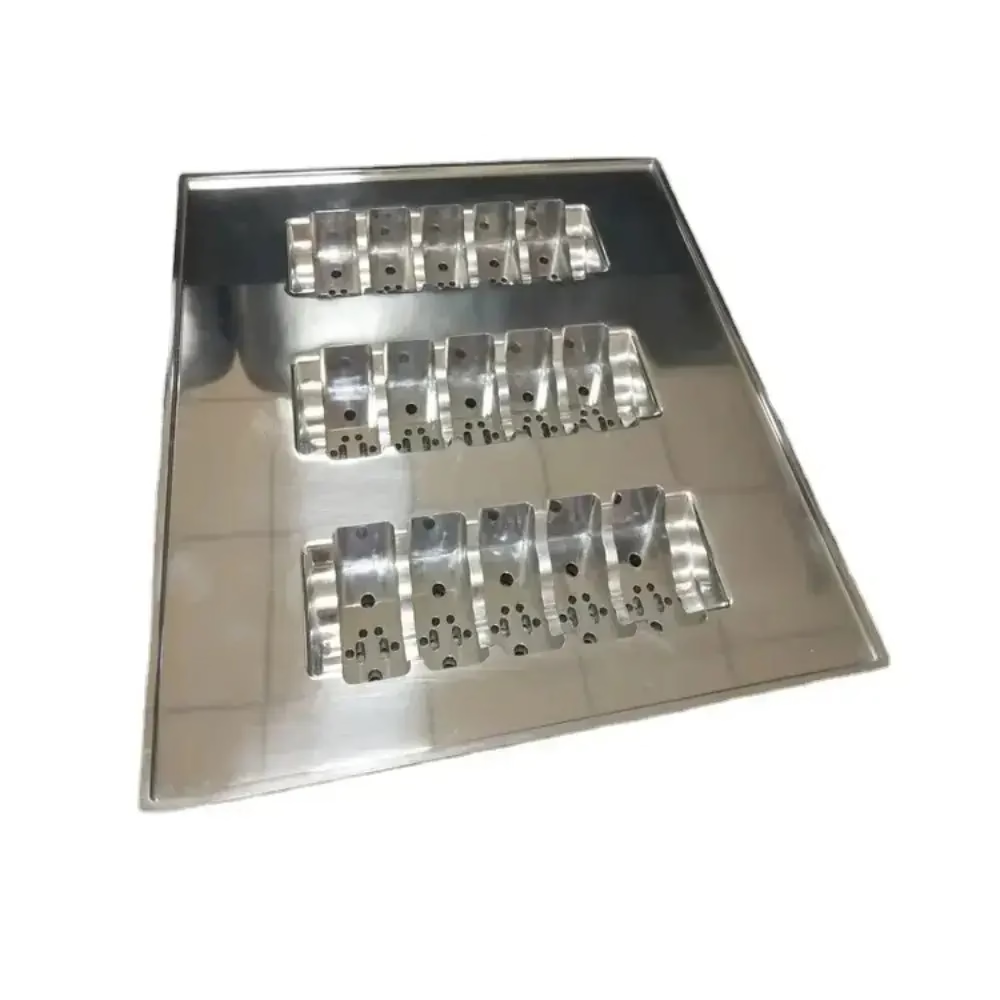
A 1.5 mm 304 panel is cut on one face only. The rolled-in stress releases and the plate bows 0.3–0.8 mm across 400 mm. Assembly gaps open up, and the fixture you built around the old part no longer fits.
We mill and turn 304 and 304L sheet into brackets, panels, enclosures and mounting plates. Flat blanks stay flat, holes stay on position, edges stay clean enough for the next process.
All four come from the same root cause: 304 work-hardens fast and moves when you cut it.
A 1.5 mm 304 panel is cut on one face only. The rolled-in stress releases and the plate bows 0.3–0.8 mm across 400 mm. Assembly gaps open up, and the fixture you built around the old part no longer fits.
Spot drilling without a rigid setup lets the drill walk in 304. A 6 mm hole comes out 6.15 mm and oval. Bolts rattle, dowel pins lose their press fit, and the whole batch gets scrapped or welded up.
Sheared 304 edges leave a rolled burr that hand deburring misses. The part passes visual check but cuts the operator, or sheds a chip into a sealed enclosure. Rework eats a week you did not plan for.
Cutting 304 dry or at the wrong feed welds chips to the tap. Threads tear, the tap snaps in the hole, and the part is now a paperweight. Tools that cut 6061 all day fail on this grade within minutes.
Rigid setups, sharp tooling, real coolant. That is the whole trick.
We remove stock from both faces instead of one. Equal depths on a 304 blank keep the stress balanced, so the part stays within 0.05 mm of flat after you unclamp it. For thin panels under 3 mm we rough, let the part sit, then finish.
Fixtures are cut for the job. Vacuum plates on thin sheet, soft jaws on brackets, and supports under unsupported spans. Clamping pressure gets checked before the first cut, not after the tenth.
A 304 bracket can hold ±0.005 mm on a bored hole and still be useless if the hole sits 0.2 mm off the datum. We control position first, then size. Datums come off your drawing, not off our convenience.
Every run gets a first-article check and a final inspection before it ships. CMM reports, material certificates and surface finish readings are available when your quality file needs them.
If your part sees food, weather or washdown, read the 304 rows.
| Grade | Pick it when | Watch out for |
|---|---|---|
| 304 / 304L | General corrosion resistance, food and washdown areas | Work-hardens fast; needs balanced cuts |
| 316 / 316L | Chlorides, salt spray, marine and medical exposure | Higher cost, slightly tougher to cut |
| 303 | You need fast turning and easy chip control | Lower corrosion resistance than 304 |
| 430 | Indoor panels where cost drives the build | Magnetic; limited corrosion resistance |
| 17-4PH | High strength plus corrosion resistance in one part | Needs heat treatment to reach full strength |
One supplier for the blank, the machining and the finish.
Flat panels, pockets, slots and contoured edges on 304 sheet. 16 simultaneous 5-axis centers handle angled faces in one setup.
Bushings, spacers, threaded inserts and fittings in 304 bar or plate stock. Live tooling cuts cross holes without a second op.
Laser cutting, forming and bending for enclosures and chassis that pair with machined 304 details.
Bead blasting, brushing, polishing, passivation and laser marking. Marked characters down to 1.5 mm tall.
One-off 304 brackets and test panels before you commit to a production run.
Hardware install, sub-assembly, protective packing and export shipping documentation.
Numbers below are the working range, not a wish list.
| Item | Range |
|---|---|
| Sheet thickness | 0.5 mm to 20 mm |
| Maximum part size | 4,000 mm envelope, 4,000 × 400 × 150 mm travel |
| General machining tolerance | ±0.005 mm (±0.0002 in) |
| Surface finish | Ra 0.8–1.6 μm standard, Ra 0.2–0.8 μm on request |
| Threads and taps | M1.6 and up, rolled or cut |
| Laser marking | Minimum character height 1.5 mm |
| Order quantity | One prototype to 10,000+ part runs |
| Lead time | Quote in 12 hours, production start in 24 hours, parts ship in 3–5 days |
Six reasons that show up on the shop floor, not in a brochure.
Three wholly-owned plants and 7,600 m² of manufacturing space in Dongguan, plus a factory in Singapore.
16 simultaneous 5-axis centers, 12 four-axis mills, 27 three-axis machines and 16 mill-turn centers. The right machine gets picked per feature.
CMM inspection and 100% check before shipment. Reports go out with the parts when your quality file asks for them.
Send a STEP file and a drawing. We come back with pricing and a manufacturability review within 12 hours, production can start inside 24 hours.
ISO 9001:2015, IATF 16949:2016, ISO 13485:2016 and ISO 27001:2022 cover the plants and the data handling.
Programmers, machinists and inspectors work the same job. When a 304 part fights back, the person who cut it talks to the person who designed it.
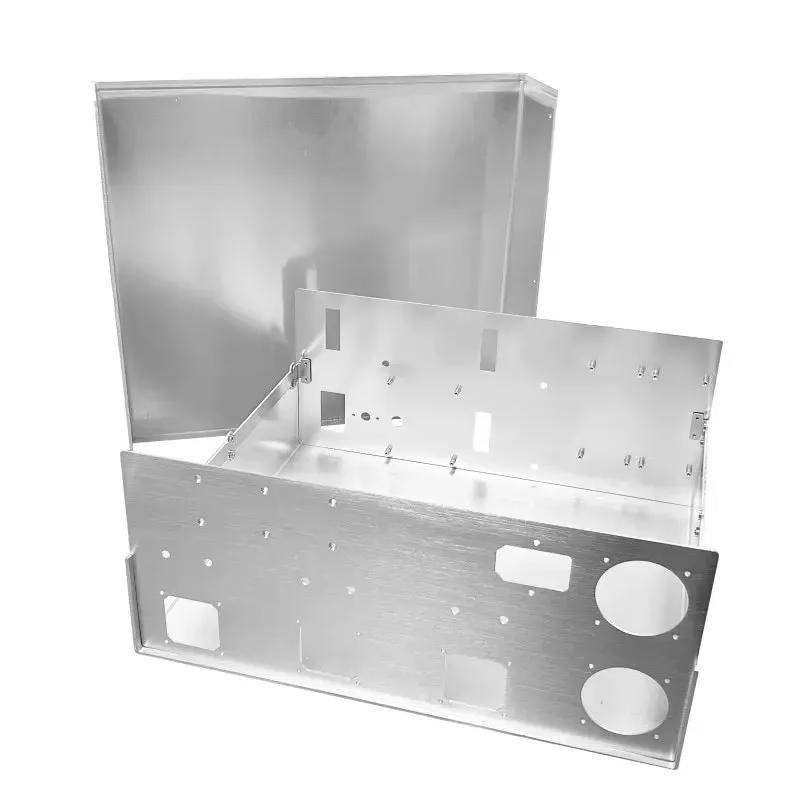
Housing panels and chassis plates where EMI gasket grooves must line up with the lid.
Mounting brackets and guard plates that take vibration without cracking at the bend line.
Panels that see daily cleaning and cannot rust at a scratch or a cut edge.
Test fixtures and battery pack plates that hold position across a production run.
Yes, if the cut is balanced. We remove stock from both faces and split roughing from finishing on thin panels. That keeps the stress in the sheet from pulling the part out of flat after unclamping.
Parts under 3 mm thick are the ones that move most. Tell us the flatness callout and we will plan the sequence around it.
We work down to 0.5 mm stock. Below roughly 1.5 mm, ±0.005 mm on every feature stops being realistic because the sheet deflects under cutting force.
On those parts we agree on which dimensions carry the tolerance and which ones can sit looser. The critical hole gets the tight number, the outline does not need it.
Pick 304 for general corrosion resistance, indoor and outdoor parts, and food-contact surfaces that are not heavily chlorinated. It machines better and costs less than 316.
Move to 316 or 316L when the part sees salt spray, chloride cleaning agents or marine air. The molybdenum content is what buys you that resistance.
Sharp tooling, proper feed per tooth, and coolant that reaches the cutting edge. Rubbing a dull tool against 304 hardens the surface and welds chips to the tap.
We also roll threads where the geometry allows. Forming the thread instead of cutting it avoids the chip problem and leaves a stronger thread.
There is no minimum order quantity. A single prototype 304 bracket can go through the same machines as a 10,000-piece run.
Unit cost drops as volume rises, so it pays to send the full annual forecast even if you start with one part.
A 3D model in STEP or IGES, plus a 2D drawing with tolerances, datums and finish callouts. If you only have a sample, we can scan it and work from the measured geometry.
Send both files and you get pricing plus a DFM review within 12 hours. An NDA is available before you upload anything.
Bead blasting, tumbling, brushing and polishing all work. Passivation is common after machining because it restores the oxide layer on cut edges.
Laser marking holds well on 304. Minimum character height is 1.5 mm, so plan your serial numbers and logos around that limit.
You get a named contact who reports progress at set points: material in, machining started, inspection done, packed for shipping.
Inspection reports and photos of the finished parts go out before the boxes leave, so you can catch a problem while it is still fixable.
Upload a STEP file and drawing. You get pricing and a manufacturability review within 12 hours, and every part is inspected before it ships.
12-hour quote100% inspectionFrom one piece
Trusted by engineers and manufacturers worldwide










Upload your 3D model or 2D drawing and get a quotation with a free DFM analysis. Maximum processing size 4,000 mm.
CNC Metals 13 grades
CNC Plastics 10 grades
Machines & processes 12 options
Surface & post-processing 10 options
Material: not selected Machine: not selected Post-process: not selected
Fill in this short form and we'll open WhatsApp with your message ready to send. We only use these details to reply to you.
Nothing is sent until you press send inside WhatsApp.