
CNC Machining Adelaide Service: What to Check Before You Order
This guide is for Adelaide engineers and buyers who need machined parts but are weighing local shops against an overseas supplier. It lists the checks that decide whether a CNC machining Adelaide service can actually hit your drawing, your quantities and your dates.
In this article
- 1
- 2
- 3
- 4
- 5
- 6
- 7
- 8
Key takeaways
Matching the part to the right Adelaide supply route
Use the row that describes your part. The right column is what to insist on before you place an order.
| Part situation | What it needs | What to ask the supplier |
|---|---|---|
| One-off jig or bracket, ±0.1 mm | 3-axis milling, fast quote | Can you start from a STEP file today? |
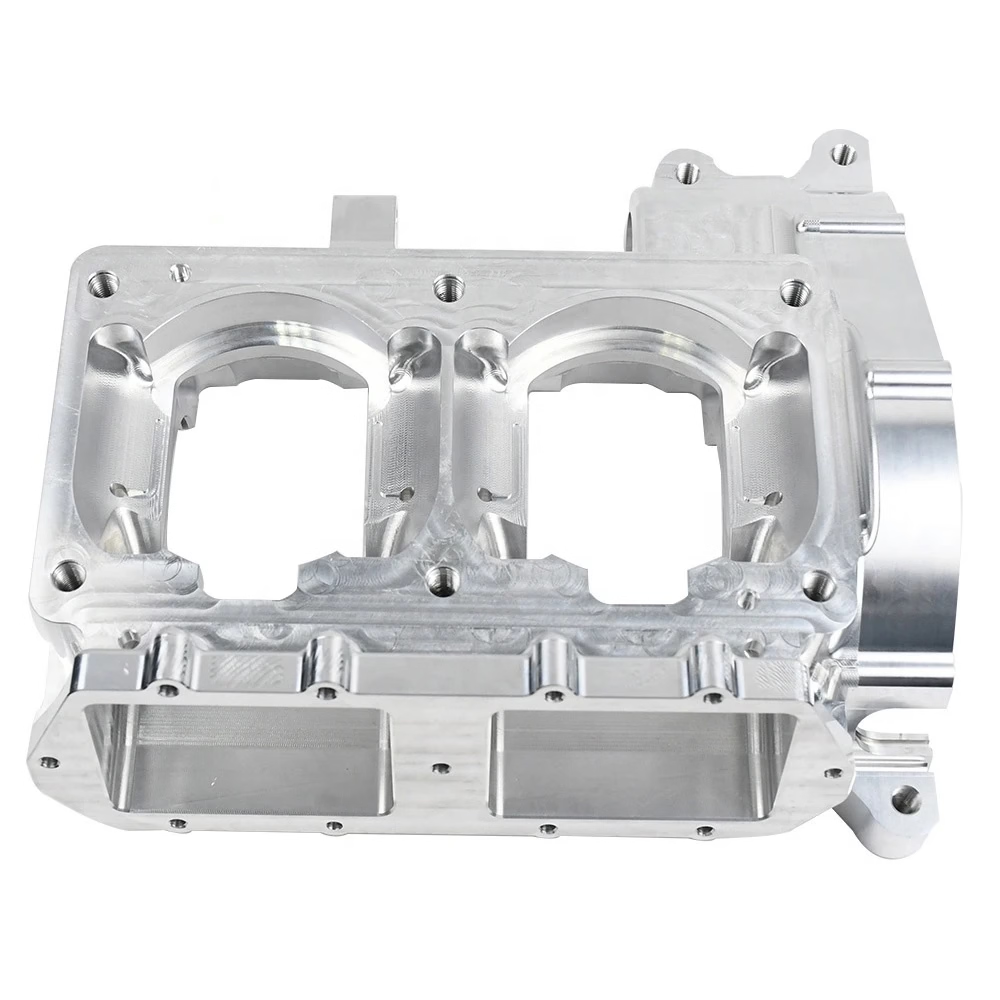
| Pocketed housing with 5 faces | 3+2 or simultaneous 5-axis | How many setups does the quote assume? |
| Thin wall under 1 mm | Low cutting force, support material | What wall thickness did you quote against? |
| Turned shaft with milled flats | Mill-turn, single chucking | Is the concentricity held in one setup? |
| Automotive bracket, 2,000 pcs | IATF 16949 process control | Which certificate covers this line? |
| Surgical instrument, 200 pcs | ISO 13485, Ra 0.8–1.6 μm | Can you supply inspection reports per batch? |
| Part longer than 1,000 mm | Large-travel machine | What is your maximum processing size? |
| Material not in stock locally | Certified mill stock | Will you send the material cert with the parts? |
Pick the supplier that answers technical questions first
A cheap quote with no setup detail, no material grade and no inspection scope will cost more once the parts arrive. Send the drawing and ask one hard manufacturing question. The reply tells you more than the price.
Tolerance is a per-feature conversation, not a headline number
Every shop advertises a tight number. The useful question is which features that number applies to. A bearing bore at Ø20 H7 needs a different setup from a mounting face that only locates a cover plate. When a supplier answers with one global tolerance, they are usually quoting the loose end of their capability and hoping the drawing does not ask for more.
At GreatLight we quote ±0.005 mm where the drawing calls for it, and we say so when a feature does not need it. That matters for cost. Chasing ±0.005 mm on a face that only needs ±0.1 mm adds inspection time, slower feed rates and sometimes a second operation, with no benefit to the assembly.
Send the drawing with GD&T intact. If the datum scheme is missing, the shop will invent one, and the invented datum may not match how the part sits in your product. A five-minute conversation about datums before cutting metal saves a scrapped batch later.
- 1Quote the tight features separatelyMark them on the drawing so the shop prices the real work.
- 2State the fit, not just the sizeH7, h6, or a clearance range tells the machinist what the number means.
- 3Ask which machine will run itA 5-axis center and a 3-axis mill have different setup limits.
How many setups the part needs drives both accuracy and price
Each time a part is unclamped and re-fixtured, position error accumulates. For a housing with pockets on four sides plus a bore, a 3-axis route can need four or five setups. A simultaneous 5-axis center can reach most of those faces in one or two. The difference shows up in the tolerance stack, not just the hourly rate.
The machine list matters here. GreatLight runs 16 simultaneous 5-axis machining centers, 16 mill-turn centers, 12 four-axis mills and 27 three-axis machines, plus a Ø400 mm rotary table. That range means we can quote the setup count honestly instead of forcing every part onto one machine type.
Some parts genuinely do not need 5-axis. A flat plate with holes is faster and cheaper on a 3-axis mill. A turned bushing with a cross-hole is a mill-turn job. When a supplier pushes 5-axis for everything, ask why. The answer is usually about their capacity, not your part.
- 1Count the setups in the quoteFewer setups usually means tighter position control.
- 2Watch thin-wall partsBelow 1 mm, clamping force can deflect the part before the cutter touches it.
- 3Long parts need the right travelWe machine up to 4,000 mm on the large-travel machines.
Material and finish choices that change the quote
Aluminium 6061-T6 is the default for prototypes because it machines fast and holds tolerance well. Switch to 7075 and the cutting forces rise; switch to 17-4PH stainless and you add heat and tool wear. Titanium TC4 (Ti-6Al-4V) and Inconel are machinable here, but they need slower parameters and more cutter changes, and that shows in the price.
Surface finish follows the same logic. As-machined at Ra 1.6–3.2 μm is fine for brackets and internal parts. Ra 0.8–1.6 μm covers most sealing faces and sliding contacts. Ra 0.2–0.8 μm is for optical, medical and fluid-handling surfaces, and it usually adds a finishing operation after machining.
Plating and coating can also change dimensions. Hardcoat anodizing builds a layer that shifts a bore by several micrometres. If a bore is anodized after machining, say so at the quoting stage so the machinist can leave material for it. The same applies to electroless nickel and powder coating.
- 1Aluminium: 6061, 7075, 2024, 6082, ADC12Fast to machine, good for prototype and production runs.
- 2Stainless: 303, 304, 316L, 17-4PH, 440C17-4PH needs slower parameters but holds strength after heat treat.
- 3Titanium and InconelTC4 and Inconel are available; expect longer cycle times.
- 4Plastics: POM, PEEK, PC, ABS, carbon fibrePEEK and carbon fibre need sharp tooling and controlled feeds.
Certifications and inspection reports: read the scope, not the logo
A certificate on a website tells you the management system was audited. It does not tell you which production line it covers. ISO 9001:2015 is the baseline for general machining. IATF 16949:2016 applies to automotive work. ISO 13485:2016 applies to medical devices. ISO 27001:2022 covers information security, which matters when you send proprietary CAD files.
Ask for the scope statement on the certificate and check that your part type falls inside it. If you are ordering automotive brackets, an ISO 9001 certificate alone does not answer the PPAP or traceability questions your customer will ask.
Inspection is the other half. We inspect 100% of parts before shipment, with raw material checks, in-process monitoring and a final inspection. Reports are available on request. If your drawing needs CMM reports or material certificates, say so in the RFQ. Adding that after the parts are made is not possible.
- 1Match the certificate to the industryAutomotive and medical have their own standards.
- 2Request reports up frontCMM and material certs are cheaper to plan than to add later.
- 3Confirm confidentiality termsUploads are secure and confidential; an NDA is available on request.
Lead time, MOQ and what a quote should actually contain
Lead time is measured from drawing release, not from the purchase order. The first useful number is how fast the supplier returns a quotation with DFM feedback. At GreatLight that is within 12 hours, and production can start within 24 hours of approval. Parts typically ship in 3–5 days, with a historical late-delivery probability below 2%.
MOQ is the other common blocker for Adelaide buyers. Small runs get pushed to the back of the queue at shops that need volume. We take no minimum order quantity, so one prototype and a 10,000-part run go through the same quoting process.
A quote that only lists a price is not enough. It should state the material grade, the finish, the tolerance assumptions, the inspection level and the shipping terms. If any of those are missing, you are comparing two different scopes and the cheaper number will move once the shop sees the drawing.
- 1Quote and DFM in 12 hoursThat is the number that sets your project schedule.
- 2No minimum order quantityOne part or 10,000+ parts, quoted the same way.
- 3Check what the price includesMaterial cert, finish and inspection are separate line items.
How to send an RFQ that gets a usable answer
Follow these steps in order. Most slow quotes come from missing information, not from a busy shop.
- 1Send native CAD plus a PDF drawingSTEP or X_T for geometry, PDF for tolerances and notes. A PDF alone forces the shop to rebuild the model and guess at features.
- 2Mark the critical featuresHighlight bores, sealing faces and any feature at ±0.005 mm. The rest can be quoted at general machining tolerance.
- 3State quantity and how it will growOne prototype now, 500 next quarter. This lets the shop choose a process that scales instead of one that only works for a single part.
- 4Name the material gradeWrite 6061-T6, not aluminium. Write 316L, not stainless. Grade changes the cutting parameters and the price.
- 5Specify the finish and where it appliesSay clear anodize on all surfaces, or bead blast only. Masking and build-up affect dimensions.
- 6List the reports you needMaterial cert, dimensional report, CMM report. Ask before the run, not after.
- 7Confirm the shipping address and termsAdelaide delivery, DDP or EXW. This affects the landed cost comparison against a local shop.
- 8Ask one technical questionA supplier who answers a real manufacturing question in the first reply is the one worth keeping.
Common questions from Adelaide buyers
Can an overseas shop replace a local CNC machining Adelaide service?
For production parts and prototypes, yes, if the drawing is clear and the tolerance is realistic. The trade-off is shipping time against unit price.
For emergency repairs where a part is needed the same day, a local shop is still the right call. Many Adelaide buyers run both: local for breakdowns, overseas for planned production.
What tolerance can you actually hold on a production run?
We quote ±0.005 mm where the drawing requires it, and we hold it across the run with in-process monitoring. On features that only need ±0.05 mm, we quote the looser tolerance and pass the saving on.
The limiting factor is usually the part, not the machine. Thin walls, long overhangs and soft plastics move under cutting force no matter how precise the spindle is.
Do you charge for DFM feedback?
No. Quotation and DFM analysis come back within 12 hours at no cost. If we see a feature that will be expensive or unstable to machine, we say so and suggest an alternative before you commit.
How do you protect our design files?
Uploads are secure and confidential, and we hold ISO 27001:2022 for information security. An NDA is available on request if your legal team needs one on file before drawings are shared.
What is the smallest and largest part you can machine?
The compact machines cover travels of 500 × 500 × 450 mm and 500 × 310 × 200 mm. The medium range covers 750 × 1,150 × 550 mm and 600 × 600 × 600 mm. The large-travel machines reach 4,000 × 400 × 150 mm, with a maximum processing size of 4,000 mm.
Which industries do you usually supply?
Aerospace, automotive and EV, medical devices, robotics and automation, electronics, industrial machinery, and new energy. Each has its own paperwork expectations, so tell us the industry in the RFQ and we will quote the inspection level that fits.
Send your drawing, get a quote and DFM notes in 12 hours
Upload the STEP file and the PDF drawing. We will come back with a price, the tolerance assumptions, the finish and the inspection scope, so you can compare it against a local Adelaide quote on equal terms.
12-hour quoteNo MOQ100% inspectionNDA on request
More from the shop floor
We publish setup notes, tooling trials and inspection data from the factory floor.











