
CNC Milling Service: How to Choose a Supplier for Machining Parts
This guide is for engineers and buyers sourcing a CNC milling service for machining parts. It covers the checks that matter before you release a PO: tolerance capability, machine mix, lead time, MOQ, certifications and how a supplier quotes. Read it and you can tell a capable shop from a broker in one call.
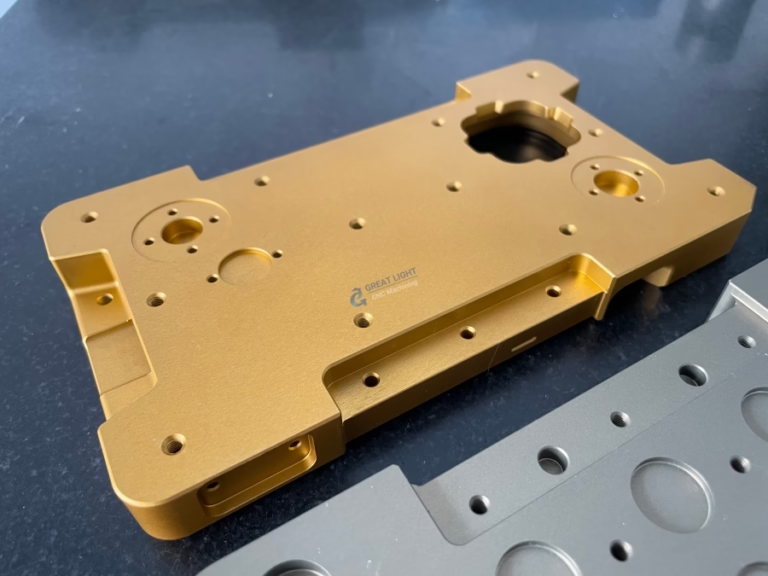
What this guide covers
- 1
- 2
- 3
- 4
- 5
- 6
- 7
- 8
Key takeaways
What to compare before you award the job
Use these rows as your RFQ checklist. Fill in the right column with the answers you get.
| Criterion | What to ask | Red flag |
|---|---|---|
| Tolerance | Held tolerance in production, and on which machines | Only quotes the best case number |
| Machine mix | 3-axis, 4-axis, 5-axis and mill-turn counts | No 5-axis but quotes complex geometry |
| Max part size | Largest travel available for your part envelope | Cannot state travel limits |
| Lead time | Days from PO to shipment, and on-time history | Promises dates without capacity data |
| MOQ | Minimum order quantity and setup charge | Setup fee hidden until after quoting |
| Certifications | ISO 9001, IATF 16949, ISO 13485, ISO 27001 | Certificate expired or out of scope |
| Inspection | In-process checks and final report format | No report unless you pay extra |
| Quote scope | Material, finishing, inspection, freight included | Price changes after PO release |
The short version
Pick the shop that answers your tolerance question with a specific number, a machine and an inspection method. Send the drawing, ask for the DFM note, and run one part before the full order.
Start with the tolerance your part actually needs
Most RFQs fail at the first question. A buyer sends a drawing with a general block tolerance of ±0.1 mm, then asks whether the shop can hold ±0.005 mm. Both answers can be true, and neither tells you much. What you need to know is which features need the tight number, on which machine, and how the shop verifies it.
A CNC milling service holds ±0.005 mm on critical features when the setup is right: rigid fixturing, sharp tooling, temperature-stable room, and a probe or CMM check before the run continues. On a 4,000 mm part, that tolerance is much harder because thermal growth and machine geometry stack up over length. Ask what the shop can hold on your specific envelope, not in general.
Surface finish follows the same logic. Ra 0.2–0.8 μm usually means a finishing pass with a small stepover and a new cutter. Ra 1.6–3.2 μm is a normal as-machined result. If your drawing calls for Ra 0.4 μm on a deep pocket, expect extra cost and a longer cycle, because the tool has to reach in with a small diameter and low feed.
Send the drawing and ask for a DFM note. A shop that comes back with three specific questions about datum strategy, wall thickness or thread depth is reading the part. A shop that only returns a price is guessing.
Match the machine to the part, not the marketing
Three-axis milling handles the majority of machining parts: plates, housings, brackets, manifolds with features on one face or a few faces reached by re-fixturing. If your part has features on five sides and a tolerance stack across them, 3-axis means multiple setups, and each setup adds error. That is where 4-axis and 5-axis earn their rate.
A simultaneous 5-axis center cuts compound angles and contoured surfaces in one setup. For a part with a curved blade or an angled port, this removes three fixtures and the positional error that comes with them. For a simple prismatic block, 5-axis is slower and costs more per hour. Choose the process your geometry needs.
Mill-turn centers matter when the part is round with milled features: a shaft with flats, a fitting with cross holes. One machine does both operations, so concentricity stays tight. Splitting turning and milling across two machines means re-chucking, and you pay for the extra setup and the risk.
Ask for the machine list and the travels. A shop with 4,000 × 400 × 150 mm travel can take long parts; a shop with 500 × 500 × 450 mm cannot, no matter what the website says. Size is the fastest disqualifier.
Lead time is a capacity question, not a promise
When a supplier says three to five days, ask what has to be true for that to happen. Material in stock, a machine slot open, no finishing queue, and inspection capacity. If any of those is tight, the date slips. A shop that tracks its own on-time rate can tell you the real number.
Quotation speed is a useful signal. A shop that returns a quote and a free DFM analysis within 12 hours has an estimating process, not a sales inbox. That usually means the same team that quotes also plans the job, so the routing you get is realistic.
Production start within 24 hours is achievable when material is standard and the shop holds stock. For specialty alloys or a finish like hardcoat anodizing, the clock starts later. Ask which step is the long pole for your part, and plan your build around that step.
Small runs and one-offs are where lead time is most volatile. A single prototype can jump the queue because setup is short. A 10,000-part run needs a schedule. Tell the shop your quantity and your deadline, and let them tell you which one drives the answer.
MOQ, certifications and what the quote includes
No minimum order quantity sounds generous, and for prototypes it is. It also tells you the shop is set up for mixed work: small batches moving through the same cells as larger runs. If your program is one prototype now and 10,000 parts later, that flexibility matters more than a lower unit price at volume.
Certifications are a filter, not a guarantee. ISO 9001:2015 means the quality system is audited. IATF 16949:2016 is what automotive and EV programs expect. ISO 13485:2016 covers medical devices. ISO 27001:2022 covers information security, which matters when your drawings are confidential. Check the scope and the expiry date.
Ask what the quote includes. Material, machining, finishing, inspection and freight are five separate lines. A price that omits finishing looks low until the second invoice. A price that omits inspection means you are the inspection department.
Confidentiality should be routine. Uploads should be secure, and an NDA should be available on request without a negotiation. If a supplier hesitates on an NDA for a simple bracket, that tells you how they handle a full assembly.
Material and finish choices that change the price
Aluminum 6061-T6 is the default for machining parts: easy to cut, stable, and takes anodizing well. 7075 is stronger but gummier, so cycle times rise. Stainless 303 machines freely; 316L is tougher and needed for corrosion or medical work. Titanium Ti-6Al-4V and Inconel cut slowly and wear tooling, so expect a higher hourly rate and longer lead time.
Plastics behave differently. POM and PEEK hold tolerance well; ABS and PP move with temperature and clamp pressure. If a plastic part has a tight bore, say so, because the shop may need to leave stock and re-cut after stress relief.
Finishing is often the hidden cost. Anodizing in clear or color, hardcoat for wear, electroless nickel, zinc, silver or gold plating, powder coating, black oxide, bead blasting, tumbling, brushing and polishing all add a step and a queue. Laser marking needs a minimum character height of 1.5 mm, so plan your part number layout.
List your finish and material on the RFQ. A shop that quotes machining only, then sends the part out for anodizing, adds a week and a margin you did not budget. One that controls the finishing step can hold the schedule.
How to run the RFQ in 6 steps
- 1Send a complete drawing packageInclude 3D STEP, 2D PDF with GD&T, material, finish, and quantity. Missing finish is the most common reason a quote comes back wrong.
- 2State the tolerance per featureMark the tight features instead of applying a blanket ±0.005 mm. A shop can then quote the operation that reaches them.
- 3Ask for a DFM note with the priceLook for comments on wall thickness, tool reach, thread depth and datum strategy. Specific notes mean the part was reviewed.
- 4Confirm the quote scope in writingMaterial, machining, finishing, inspection, packaging and freight. Ask for the inspection report format before you award.
- 5Check certifications and capacityRequest the certificate scope and the machine list. Match travel and axis count to your part envelope.
- 6Run one part before the full orderA first article confirms the setup. Measure the critical features and release the balance only after it passes.
Questions buyers ask before awarding a milling job
What tolerance can a CNC milling service hold on a production run?
On critical features, ±0.005 mm is achievable when the setup is rigid and the room is temperature-stable. The number depends on the feature, the material and the part size.
On a large part, thermal growth across 4,000 mm makes that tolerance harder. Send the drawing and ask what can be held on the specific features, not in general.
When should I choose 5-axis instead of 3-axis milling?
Choose 5-axis when the part has features on multiple faces, compound angles or contoured surfaces that would need three or more setups on a 3-axis machine.
For a prismatic plate with holes on one face, 3-axis is faster and cheaper. The extra axis only pays when it removes setups or reaches geometry you cannot fixture.
Is there a minimum order quantity for machining parts?
Some shops run with no minimum order quantity, from one prototype to 10,000+ part runs. That suits programs that start with a single part and scale later.
Ask about setup charges instead. A low MOQ with a large setup fee is a different commercial deal than a low MOQ with no setup fee.
Which certifications should I check?
ISO 9001:2015 for the general quality system. IATF 16949:2016 for automotive and EV. ISO 13485:2016 for medical devices. ISO 27001:2022 when your drawings are confidential.
Check the scope and expiry date. A certificate for a different process or an expired one does not support your audit.
How fast can a quote and a first shipment come back?
A quotation and free DFM analysis within 12 hours is a reasonable benchmark for a standard part. Production can start within 24 hours when material is in stock.
Parts typically ship in 3–5 days. Specialty alloys and finishes like hardcoat anodizing add time, so ask which step is the long pole.
What should be in the inspection report?
Ask for the measured values on the critical features, not a pass or fail note. A first article report should show the datum scheme and the instrument used.
A shop that inspects 100% before shipment and can send reports on request removes the need for you to re-measure everything on receipt.
Send your drawings, get a quote in 12 hours
Quotation and free DFM analysis within 12 hours. No minimum order quantity, from one prototype to 10,000+ parts. Uploads are secure and confidential.
12-hour quoteNo MOQ100% inspectionNDA on request
More from the shop floor
We publish setup notes, tooling trials and inspection data from the factory floor.











