
CNC Machining Parts Made in China
For engineers and buyers who need to know how Chinese CNC shops actually hold tolerance, control material and document inspection. This page covers the process chain, where cost comes from, and the checks that decide whether a supplier can run your part.
In this article
- 1
- 2
- 3
- 4
- 5
- 6
- 7
What actually happens after you upload a CAD file
A Chinese CNC shop does not start cutting when the file arrives. The first step is DFM review: wall thickness, tool reach, corner radii, thread depth, datum strategy. On a machined housing, a 2 mm internal corner is a problem unless the designer accepts a 4 mm cutter. Most redesign cost is decided here, before a spindle turns.
Then comes material sourcing. Aluminum 6061-T6 plate and 7075 bar stock behave differently under the same cutter. A shop that tracks heat numbers can tell you which mill lot went into your part. Without that record, a hardness shift shows up only after anodizing, when the part is already finished.
Setup and first-article follow. The operator touches off, cuts one part, and measures it against the drawing. If the drawing calls for ±0.005 mm on a 300 mm bore, the machine and the CMM both need to be in that range, not just the spindle.
Production, in-process checks, final inspection and finishing close the loop. On a 10,000-part run, inspection strategy matters more than machine count.
- 1DFM firstTool reach and corner radii decide cost before cutting starts.
- 2Heat lot recordsTraceable stock explains hardness changes after finishing.
- 3First articleOne part measured against the drawing before the run.
How ±0.005 mm tolerance is held on CNC machining parts made in China
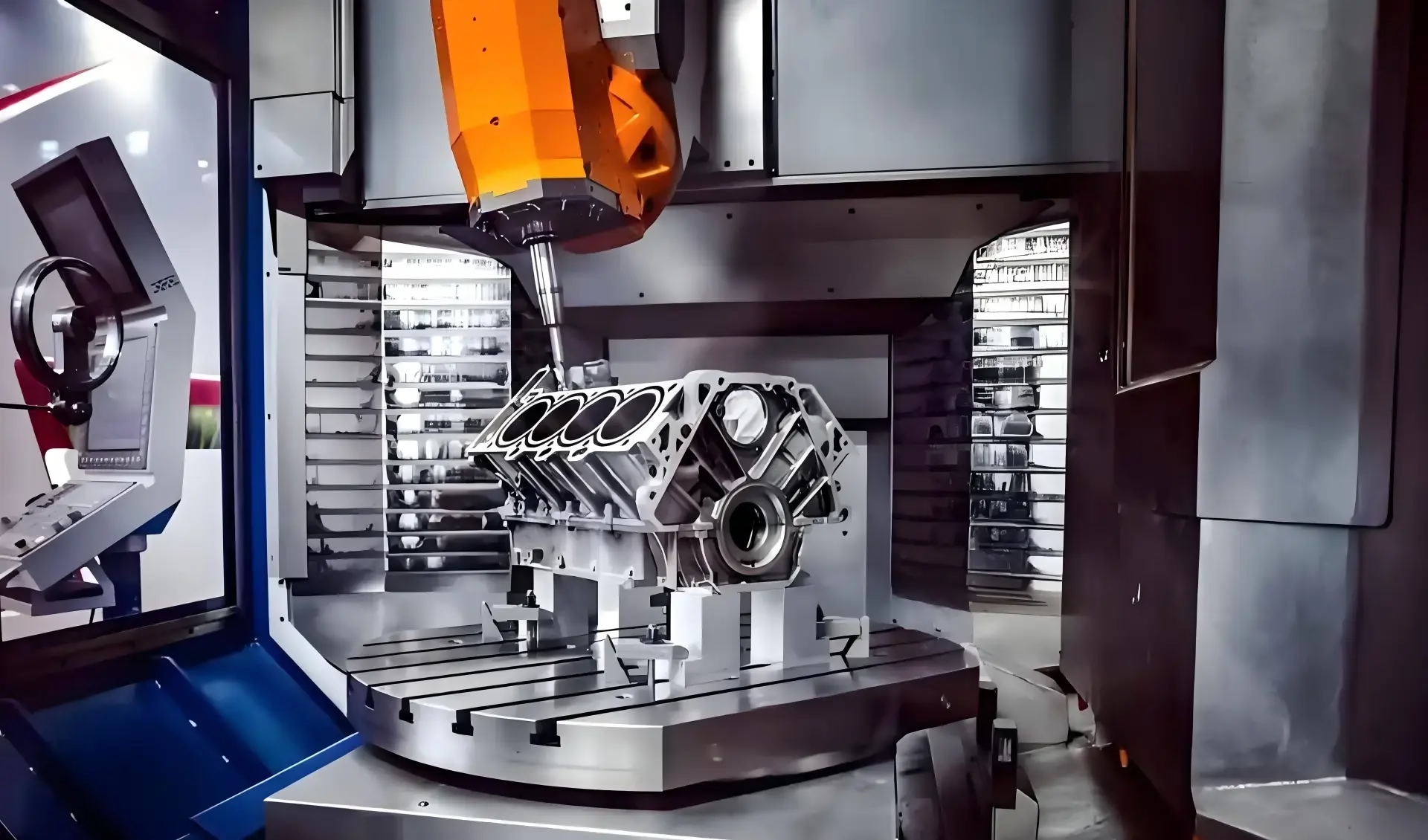
Tolerance is a system, not a number on a brochure. It needs a rigid machine, a stable thermal environment, sharp tooling and a measurement method that matches the drawing callout. A 5-axis machining center with a Ø400 mm rotary table can hold ±0.005 mm on features it can reach in one setup. Move the part to a second fixture and you add stack-up error.
Thermal drift is the usual limit. Aluminum expands about 23 μm per meter per degree Celsius. A 500 mm aluminum part that warms 5 °C during roughing moves roughly 57 μm before finishing starts. Shops that rough, cool and finish in separate passes control this. Shops that cut straight to size do not.
Surface finish and tolerance trade against cycle time. Ra 1.6–3.2 μm is a normal as-machined result. Ra 0.8–1.6 μm needs a finishing pass with a smaller stepover. Ra 0.2–0.8 μm often means a separate fine operation, sometimes on a different machine.
The practical question is not whether a shop owns a 5-axis machine. It is whether the shop can measure what it claims. Ask for the inspection method and the report.
- 1One setup winsFewer fixtures means less stack-up error.
- 2Rough, cool, finishSeparate passes control thermal growth on long parts.
- 3Match the gaugeA CMM reading must match the drawing datums.
- 4Finish costs timeRa 0.2–0.8 μm is a separate fine operation.
Material grades and what they change in the cut
Material choice changes feeds, speeds, tool wear and the finishing route. Aluminum 6061 machines fast and anodizes cleanly. Aluminum 7075 is stronger but galls more and needs sharper tooling. Stainless 304 work-hardens if the cutter dwells, so a light, steady feed beats a heavy slow one.
Steel 4140 and 4340 are common for shafts and housings that see load. They cut well in the normalized or pre-hardened state and hold thread form. Titanium TC4 (Ti-6Al-4V) and Inconel cut hot and slow, so tool life and cycle time drive cost more than the raw bar price does.
Copper and brass families, including C36000 and C110, machine easily but move with temperature. Thin walls in brass distort if the shop takes a heavy last pass. Beryllium copper is machinable but needs dust control at the bench.
Plastics are a separate discipline. POM and PEEK hold tight dimensions; ABS and PP flex under clamping. PEEK needs sharp tooling and low cutting temperature or the surface smears. A shop that runs both metal and plastic should tell you which machine your part will run on.
- 1Aluminum6061, 7075, 2024, 6082, ADC12 die casting alloy.
- 2Stainless303, 304, 316L, 17-4PH; watch work hardening.
- 3Steel1018, 4140, 4340, A36 and tool steel.
- 4Titanium and superalloyTC4 and Inconel: slow, hot, tool-limited.
Where the cost of CNC machining parts made in China comes from
Buyers often assume the price gap is labor. It is not the whole story. Setup time, programming, fixture design and inspection spread across the batch. On a one-off prototype, those fixed costs dominate. On a 10,000-part run, cycle time and material yield dominate.
Setup is amortized by quantity. A part that takes four hours to fixture and program costs the same to set up whether you order one or ten thousand. This is why unit price falls steeply between quantity 1 and quantity 100, then flattens.
Material yield matters on parts cut from plate or bar. A nested layout that wastes 40 percent of a 6061 plate costs more than the machining in some jobs. Shops that quote from the solid model, not from a guess, catch this early.
Finishing is quoted separately and often surprises buyers. Anodizing, electroless nickel, powder coating and laser marking each add handling, racking and lead time.
- 1Setup is fixedProgramming and fixturing do not scale with quantity.
- 2Yield mattersNesting and stock size change material cost.
- 3Finishing adds handlingEach process adds racking and lead time.
Inspection, documentation and certification: what each one proves
A certificate on a wall proves the system was audited, not that your part is correct. ISO 9001:2015 covers general quality management. IATF 16949:2016 adds automotive process controls and traceability. ISO 13485:2016 covers medical device manufacturing. ISO 27001:2022 covers information security, which matters when you send proprietary CAD.
Inspection is the part that touches your order. A sound sequence is raw material check, in-process monitoring during the run, and final inspection before shipment. Reports are available on request. If a shop cannot show you an inspection report for a comparable part, treat the tolerance claim as unverified.
For regulated industries, ask which certificate applies to your commodity. An automotive bracket and a surgical instrument housing do not follow the same control plan, even from the same shop.
Confidentiality is a separate track. Uploads should be secure, and an NDA should be available on request before you send drawings.
- 1ISO 9001:2015General quality management baseline.
- 2IATF 16949:2016Automotive process control and traceability.
- 3ISO 13485:2016Medical device manufacturing controls.
- 4ISO 27001:2022Information security for your CAD data.
When China is the wrong choice for a CNC job
Not every part belongs in a Chinese shop. If the design is still moving week to week, the travel and communication loop costs more than it saves. Keep the iteration local until the drawing freezes.
If the part needs a special alloy your shop does not stock, you will wait for mill lead time either way. The geography stops mattering.
If the batch is a single emergency replacement for a machine that is down, a local shop with a free spindle wins. Freight time is the constraint, not unit price.
And if the tolerance is tighter than the measurement chain can verify, distance makes the argument harder. You want to be in the room when the CMM runs.
- 1Design not frozenKeep iteration local until the drawing settles.
- 2Exotic stockMill lead time dominates, not location.
- 3Line-down emergencyA local free spindle beats a lower unit price.
Which sourcing route fits your part
Match the part profile to the route before you request quotes.
| Part profile | Best fit | Why | Watch out for |
|---|---|---|---|
| Frozen drawing, 100–10,000 pcs | China CNC shop | Setup amortized, unit price drops | Finishing and freight lead time |
| Prototype still changing weekly | Local machine shop | Same-day drawing changes | Higher unit cost per part |
| ±0.005 mm on a 300 mm bore | Shop with CMM + report | Measurement chain must match claim | Fixture stack-up on second setup |
| Ra 0.2–0.8 μm sealing face | Shop with fine finishing | Separate fine operation needed | Adds a process step and time |
| Aerospace bracket, traceable | AS9100-style controls | Heat lot and process records | Certificate must match commodity |
| Medical instrument housing | ISO 13485 shop | Device manufacturing controls | Cleanliness and packaging spec |
| Line-down emergency spare | Local shop, free spindle | Freight time is the constraint | Unit price is secondary |
| Thin-wall PEEK or brass | Shop that runs plastics | Clamping and heat control differ | Distortion after last pass |
The verdict
If your drawing is frozen and you need repeatable parts from one prototype to 10,000+, a Chinese CNC shop with documented inspection is the lower-cost route. If the design is still moving or the machine is down, stay local and pay for speed.
Questions buyers ask before ordering
Can a Chinese shop really hold ±0.005 mm?
Yes, on features it can reach in a single setup, on a rigid machine, in a temperature-stable room, with a matching measurement method.
The limit is usually the measurement chain and fixture stack-up, not the spindle. Ask which CMM or gauge will verify the callout.
What is the minimum order quantity?
A capable shop runs from one prototype to 10,000+ part runs with no minimum order quantity.
Unit price still depends on quantity because setup and programming are fixed costs that amortize across the batch.
How fast can parts ship?
Quotation and DFM analysis can come back within 12 hours, and production can start within 24 hours.
Parts typically ship in 3–5 days after that, depending on finishing and material availability.
Which certifications should I ask for?
Start with the one that matches your commodity. ISO 9001:2015 for general work, IATF 16949:2016 for automotive, ISO 13485:2016 for medical.
ISO 27001:2022 covers information security, which matters when you send proprietary CAD files.
How do I protect my design?
Uploads should be handled as secure and confidential, and an NDA should be available on request before you send drawings.
Ask for the NDA before the first file transfer, not after the quote.
What surface finishes are available?
Anodizing in clear, colour, hardcoat and conductive grades; electroless nickel, zinc, silver and gold plating; powder coating and black oxide.
Bead blasting, tumbling, brushing and polishing are also standard, along with laser marking down to 1.5 mm character height.
Send your drawing, get a DFM review
Quotation and free DFM analysis within 12 hours. No minimum order quantity, from one prototype to 10,000+ parts.
12-hour quote100% inspectionNDA on request
More from the shop floor
We publish setup notes, tooling trials and inspection data from the factory floor.











