
CNC Processing: Dead Trade or Still Evolving?
Every few years the same question returns: is CNC processing a dead trade? This page examines the signals that answer it, from machine capability to material range and digital integration. Engineers and sourcing teams can use it to judge where CNC still makes sense and where it does not.
In this article
- 1
- 2
- 3
- 4
- 5
- 6
Machine Capability Keeps Raising the Ceiling
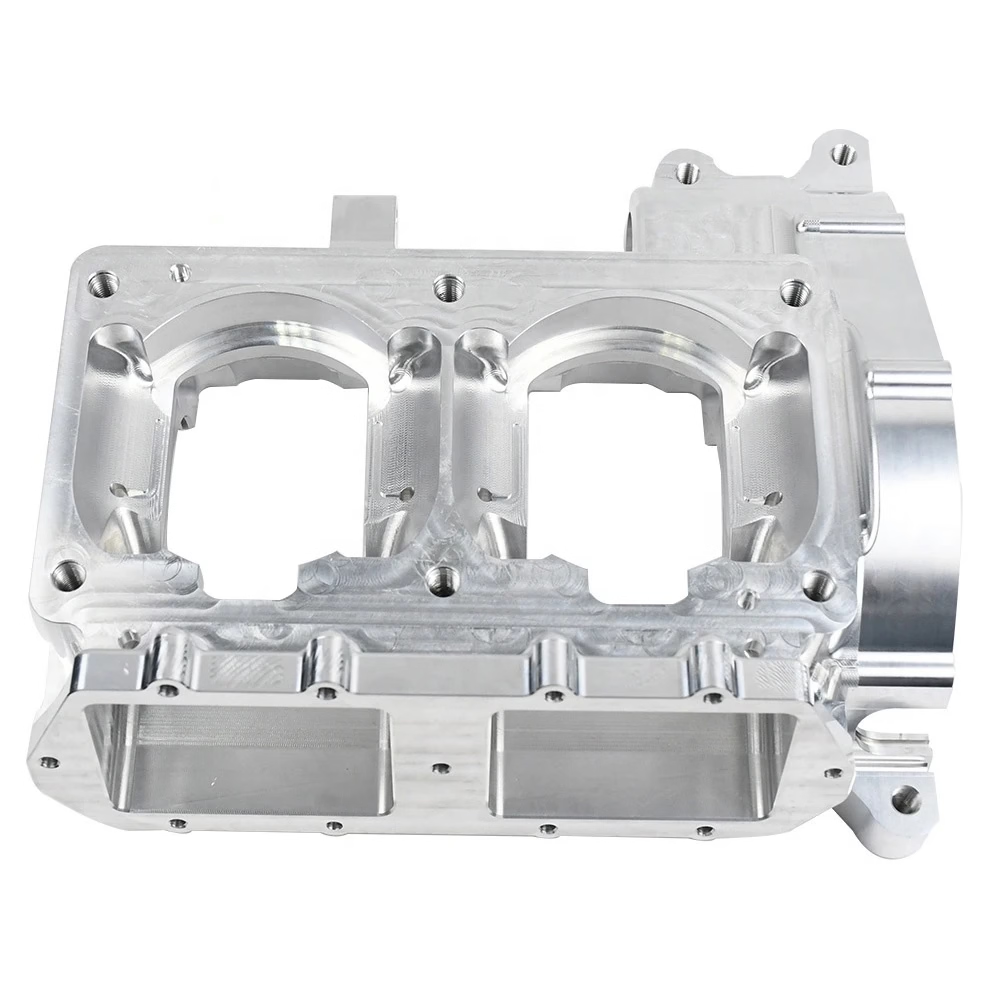
The claim that CNC processing is a dead trade usually comes from people looking at commodity 3-axis work. That view is out of date. Simultaneous 5-axis machining centers now cut contours that were impossible to reach with three orthogonal movements. A rotary table of Ø400 mm lets a single setup reach five faces of a part, so the datum stays fixed and the tolerance stack stops growing with each re-fixture.
Multi-tasking mill-turn centers push the same idea further. Turning, milling, drilling and tapping happen in one cycle, which removes the concentricity error you get when a part moves between a lathe and a mill. For a hydraulic manifold with bores on four sides, that is the difference between ±0.005 mm holding across the part and chasing runout after every setup.
This is the part the dead-trade argument misses. The trade did not die. The low-skill end of it was automated away, and the high-skill end grew into something that needs a process engineer, not just an operator with a hand wheel.
- 15-axis in one setupFewer datums, less stack-up, tighter true position on complex parts.
- 2Mill-turn centersTurning and milling in one cycle removes re-chucking error.
- 3Large travelsUp to 4,000 mm covers long frames and housings without splicing.
Material Range and Why It Matters
A trade that is dying stops taking new inputs. CNC does the opposite. Shops routinely cut aluminium 6061-T6 and 7075, stainless 303 and 17-4PH, titanium Ti-6Al-4V, Inconel, magnesium AZ31B and engineering plastics such as PEEK and POM. Each one has its own cutting behavior, and that is the point: the process adapts.
Take Ti-6Al-4V. It has low thermal conductivity, so heat sits at the cutting edge instead of leaving with the chip. Cutting speed drops, coolant flow rises, and tool life becomes the controlling cost. Inconel is worse on tool wear and often needs a slower feed and a rigid setup. Neither material is easy, and both are routine work for a shop that knows the parameters.
Magnesium AZ31B and AZ91D flip the problem. They cut fast and leave a good finish, but fine chips are flammable, so chip evacuation and coolant choice matter more than spindle speed. If a supplier treats magnesium like aluminium, walk away. That is a process knowledge gap, not a price difference.
- 1TitaniumLow conductivity, high heat at the edge. Slow speed, heavy coolant.
- 2InconelSevere tool wear. Rigid setup and conservative feed rates.
- 3MagnesiumFast cutting, flammable fines. Chip control is the real risk.
Digital Integration Did Not Replace CNC Processing
CAD and CAM did not kill the trade. They changed who does what. A model goes from CAD to CAM toolpath in hours, and simulation catches a gouge or a collision before a blank is loaded. That compresses the loop between design intent and a cut part, which is exactly when CNC becomes more useful, not less.
The same digital chain now feeds inspection. A CMM program written from the model measures the part against the same geometry the toolpath was built from. When a dimension drifts, the report points at a feature, not a feeling. That closed loop is why prototype work and production work can share one process plan.
Additive manufacturing sits next to CNC rather than against it. A printed near-net shape with internal channels gets its critical faces, bores and threads machined. Hybrid work like this handles geometry that neither process reaches alone. The machining step is still where the tolerance comes from.
- 1CAD to CAM in hoursSimulation catches collisions before the blank is loaded.
- 2Model-based inspectionCMM reports map to the same geometry as the toolpath.
- 3Hybrid additive plus CNCPrint the near-net shape, machine the critical faces.
Sourcing Reality: Prototype to Production in One Process
A healthy trade can serve a single part and a 10,000-part run without changing its core method. CNC does exactly that. The first article comes off the same machine type as the production run, so the geometry you qualify is the geometry you ship. That continuity is hard to get from a tooling-based process, where the prototype and the production part are made two different ways.
Volume economics still apply, and honesty about them matters. At very high volumes, die casting or injection molding will beat machining on piece price. CNC wins when the volume is low to medium, when the design is still moving, or when the tolerance and surface finish rule out a mold. A shop that tells you this is a shop worth keeping.
Lead time is part of the picture. When a quotation and DFM feedback come back within 12 hours and production can start within 24 hours, the process fits a development schedule instead of fighting it. That responsiveness is a sign of demand, not decline.
- 1One process, all volumesFrom one prototype to 10,000+ parts on the same platform.
- 2Know the crossoverVery high volume favors casting or molding on piece price.
- 3Schedule fitQuote and DFM in 12 hours; production start in 24 hours.
The Skill, Not the Spindle, Is the Real Asset
Anyone can buy a machine. The trade survives on the people who set it up. Deciding the order of operations, choosing a fixture that does not deflect, and knowing when to leave stock for a finishing pass are judgments that no CAM button replaces. That knowledge is what a buyer is really paying for.
The same applies to inspection. A 100% inspection routine before shipment, with raw material check, in-process monitoring and a final report, catches drift while there is still time to correct it. A supplier running 99.99% qualification on tight-tolerance work is not guessing. They are controlling the process.
This is the answer to the dead-trade question. The trade changed shape. It moved from manual skill at the spindle to process control across the whole chain, and that is a harder skill to replace, not an easier one.
- 1Setup judgmentOperation order and fixture choice decide the final tolerance.
- 2Inspection discipline100% inspection with reports on request.
- 3Process control99.99% qualification on tight-tolerance production.
Where CNC Processing Still Wins, and Where It Does Not
Use this table to check whether a part belongs on a CNC or on a mold, a die or a printer.
| Part or situation | Best process | Why |
|---|---|---|
| One-off prototype, design still moving | CNC | No tooling cost, edit the model and recut |
| ±0.005 mm tolerance on critical bores | CNC | Grinding and boring hold the band directly |
| Ra 0.2–0.8 μm sealing face | CNC plus finishing | Machined then polished or lapped to spec |
| 50,000 identical simple brackets | Die casting | Piece price falls once tooling is amortized |
| Internal cooling channels in one piece | Additive plus CNC | Print the channel, machine the mating faces |
| Large frame, 4,000 mm long | CNC | Long-travel machines cut it in one setup |
| Thin-wall housing, wall under 0.5 mm | Reconsider | Chatter and distortion risk; may need a mold |
The Verdict
If your volume is low to medium, your tolerance is tight, or your design is still moving, CNC processing is the right call. If your volume is very high and the geometry is simple, a mold or die will beat it on piece price. Neither answer makes the trade dead.
Questions Engineers Ask Next
Is CNC processing a dead trade because of 3D printing?
No. Printing builds near-net shapes well, but it does not hold ±0.005 mm on a bearing bore or produce a Ra 0.2–0.8 μm sealing face without a machining step.
The two processes are usually paired, not swapped. Print the internal geometry, then machine the faces and holes that carry the tolerance.
What part features tell me CNC is the wrong choice?
Very thin walls under about 0.5 mm, deep narrow slots with a high aspect ratio, and large fully enclosed hollow volumes are the usual warning signs.
Those features invite chatter, tool deflection or distortion. A mold or an additive build may handle them with less risk.
Does a tight tolerance always mean a higher price?
Not automatically. The cost driver is how many setups and how much hand work the tolerance needs.
A bore held to ±0.005 mm on a rigid part in one 5-axis setup is cheaper than the same tolerance spread across four faces that need re-fixturing.
How do I check whether a supplier actually controls the process?
Ask what they measure, when they measure it, and what happens when a reading drifts out of band.
A supplier with raw material check, in-process monitoring and a final report is controlling the process. One who only ships a part number is not.
Can CNC handle small batches without a big minimum order?
Yes. With no minimum order quantity, a single prototype and a 10,000+ part run go through the same process plan.
That means the geometry you qualify on the first article is the geometry you get in production, which removes a common source of surprise.
What surface finishes are realistic straight off the machine?
As-machined surfaces typically land in the Ra 1.6–3.2 μm range depending on material and toolpath.
Tighter finishes such as Ra 0.8–1.6 μm or Ra 0.2–0.8 μm usually need a finishing pass, finer stepover, or a secondary polish or lap.
Send the Drawing, Get a Straight Answer
Upload your model and we will tell you whether CNC is the right process for it, with a quotation and free DFM analysis within 12 hours.
12-hour quote100% inspectionNo MOQNDA on request
More From the Shop Floor
We publish setup notes, tooling trials and inspection data from the factory floor.











