
cnc processing services near me: how to choose a supplier you can audit
This guide is for engineers and sourcing staff comparing cnc processing services near me. We cover the checks that decide whether a shop can hold your tolerance, hit your date and stay quiet about your drawings. Read it and you can judge a quote in minutes, not weeks.
In this article
- 1
- 2
- 3
- 4
- 5
- 6
- 7
- 8
Key takeaways
What to verify before you send a drawing to cnc processing services near me
Use this as a checklist when you compare two or three shops.
| Check | What good looks like | Red flag | Why it matters |
|---|---|---|---|
| Achievable tolerance | ±0.005 mm on critical features, stated per feature | One blanket tolerance for the whole print | Blanket claims hide which features are actually controlled |
| Axis capability | 16 simultaneous 5-axis centers in house | 5-axis subcontracted to a partner shop | Your geometry, fixturing and date all leave the building |
| Size envelope | 4,000 mm maximum processing size | Oversize parts split and welded | Splitting adds joints, distortion and inspection work |
| Quote turnaround | Quotation and free DFM analysis within 12 hours | Quote arrives after a week of silence | Slow quoting usually predicts slow problem solving |
| Production start | Production can start within 24 hours | Start date depends on another job finishing | Your schedule is being used as buffer for someone else |
| Order size | No minimum order quantity, one to 10,000+ parts | Setup fee that forces you to order 500 | You buy inventory you cannot use yet |
| Certifications | ISO 9001, IATF 16949, ISO 13485, ISO 27001 | Certificate expired or scope mismatch | Auditors reject the part even if dimensions pass |
| Confidentiality | Secure uploads, NDA available on request | Drawings sent over personal email | Your design is your product; treat it that way |
The verdict: audit the process, not the brochure
Choose a supplier when the tolerance is stated per feature, the machine capability is in house, the quote comes with DFM notes and the inspection report is standard. Skip the shop that answers with a single number.
Which parts actually belong with cnc processing services near me
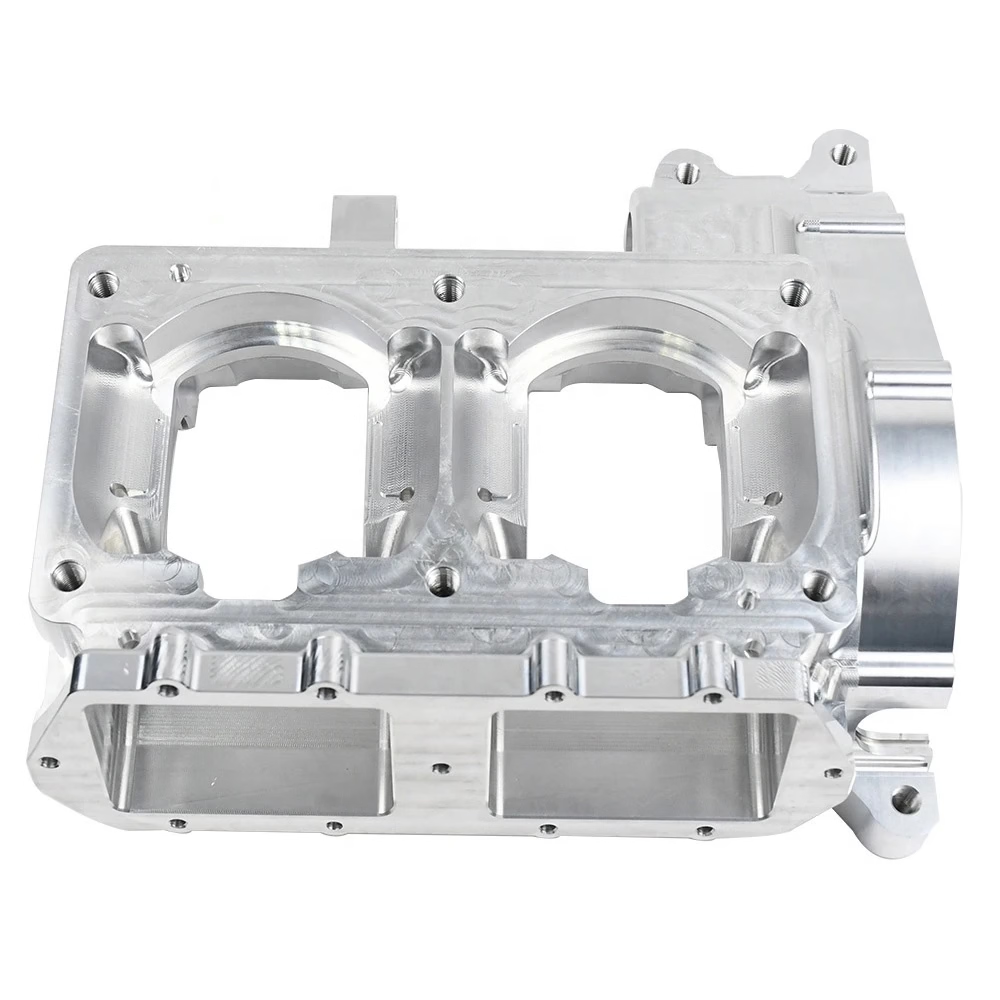
CNC processing suits parts where the geometry, the material or the quantity makes a mold uneconomical. Think brackets with pockets on five faces, manifolds with intersecting bores, housings that need a sealing face at Ra 0.8–1.6 μm, or a single prototype you need in your hands before a design review. If the part is a flat plate with four holes, laser cutting plus a drill is cheaper. If you need 50,000 identical simple caps, injection molding wins. The middle ground is where machining pays: 10 to 10,000 parts, tight features, and a design still moving.
Material drives the decision as much as shape. Aluminum 6061-T6 and 7075 cut fast and hold ±0.005 mm well. Stainless 316L and 17-4PH work harden, so light radial cuts and constant feed matter more than spindle speed. Titanium TC4 and Inconel 718 need sharp tooling and patience; a shop that quotes them like aluminum will miss the date. Magnesium AZ31B and AZ91D cut quickly but need chip control because fine magnesium swarf ignites. If your part is plastic, ABS, POM, PA and PEEK all machine cleanly, while HDPE and PP flex and need support to avoid chatter.
The useful question is not whether a shop can machine your part. Almost any shop can. The question is whether it can machine your part at the tolerance on the drawing, on the date you need, without you discovering a problem at goods-in. That is what the rest of this guide is about.
- 1Good fitComplex 3D geometry, tight tolerances, low to mid volume, prototypes and bridge parts
- 2Poor fitVery simple flat parts, very high volume, or parts where surface finish is the only requirement
- 3Watch outThin walls under 0.8 mm, deep holes over 10× diameter, and features needing a mirror finish
Tolerance, finish and inspection: read the fine print
A tolerance of ±0.005 mm (about ±0.0002 in) is achievable on a rigid setup with the right material and a controlled temperature. It is not achievable on every feature of every part. A 4,000 mm long extrusion will move with heat; a thin flange will deflect under clamping; a deep bore will taper as the tool wears. When a supplier quotes one tolerance for the whole print, ask which features are measured and how. The answer tells you whether they understand the part or are just repeating a number.
Surface finish has the same problem. Ra 0.2–0.8 μm is a fine finish that usually needs a finishing pass with a small stepover, sometimes followed by polishing. Ra 1.6–3.2 μm is as-machined and is fine for most brackets and covers. Specifying a fine finish everywhere adds time and cost. Specifying it only where a seal, bearing or sliding surface sits is a sign of a print written by someone who has run a machine.
Inspection is where quotes differ most. A shop that checks the part on the machine and ships is not the same as one that does raw material check, in-process monitoring and final inspection before shipment, with reports on request. If your part goes into a medical device or an automotive assembly, the report is not optional. Ask for the sample inspection report format before you place the order. It takes ten minutes and saves a rejected lot.
- 1Feature-level toleranceAsk which dimensions carry ±0.005 mm and how they are verified
- 2Finish by functionRa 0.8–1.6 μm on sealing faces, Ra 1.6–3.2 μm elsewhere
- 3Inspection evidence100% inspection before shipment; raw material, in-process and final checks
Lead time, MOQ and quoting: the commercial checks
Lead time is a process output, not a promise. A shop that can quote and deliver a free DFM analysis within 12 hours, start production within 24 hours and ship parts in 3–5 days is doing something specific: it stocks common materials, it has capacity headroom, and its engineering review is fast. If any of those three is missing, the fast quote is just a sales number. Ask what happens if the DFM turns up a problem on day one. The answer is your real lead time.
Minimum order quantity is a business model tell. No minimum order quantity, from one prototype to 10,000+ part runs, means the shop is set up for setup-heavy, low-volume work. It also means you are not subsidizing a production line you do not need. A shop that insists on 500 pieces for a part you need twice a year is optimizing its own schedule, not yours.
Quoting should be transparent about what is included. Does the price cover material certification, first article inspection, surface finishing, packing and freight? Does it assume a tolerance change you did not agree to? A quote that is 30% cheaper usually has a scope difference, not a cost advantage. Compare line by line, then compare the DFM notes. The shop that flags a thin wall or an unreachable feature before cutting metal is the one you want.
- 1Quote in 12 hoursIncludes free DFM analysis, not just a price
- 2Start in 24 hoursOnly realistic when material is stocked and the review is clean
- 3No MOQOne prototype and a 10,000+ run go through the same process
Certifications and confidentiality for regulated work
Certification matters when your customer audits your supply chain. ISO 9001:2015 covers general quality management and is the baseline. IATF 16949:2016 is what automotive and EV programs expect. ISO 13485:2016 is the medical device standard. ISO 27001:2022 covers information security, which matters if you are sending CAD data and process parameters across borders. A shop can hold all four, but check the scope on each certificate. A certificate that covers machining but not finishing will not help if your part needs anodizing.
Confidentiality is part of the same conversation. Uploads should be secure and confidential, and an NDA should be available on request. That sounds basic, but the weak point is rarely the server. It is the drawing that gets emailed to a tooling supplier or the photo posted on a shop floor tour. If your part is a new product, ask how the shop handles subcontracted operations and whether those partners are under the same terms.
For regulated programs, plan the documentation early. Raw material certificates, process records, inspection reports and traceability all take time to compile. A shop that produces them on request has done this before. One that says "we can put something together" has not.
- 1Quality baselineISO 9001:2015 for general machining work
- 2Automotive and EVIATF 16949:2016 expected by most programs
- 3Medical devicesISO 13485:2016 plus traceable inspection records
- 4Data securityISO 27001:2022, secure uploads and NDA on request
Finishing, secondary operations and where they go wrong
Most machining problems that reach the customer are finishing problems. Anodizing changes dimensions slightly, and a hardcoat adds more than a clear coat. If your bore is already at the top of tolerance, plating can push it out. Tell the shop which surfaces are functional and which are cosmetic before finishing, not after. Laser marking is a common one: minimum character height of 1.5 mm is a practical limit, so a 0.8 mm part number will not read cleanly.
Electroless nickel, zinc, silver and gold plating all have different thickness ranges and different effects on thread fit. Powder coating and black oxide are usually safer for dimensions but can hide a poor surface underneath. Bead blasting, tumbling, brushing and polishing change the texture, not the geometry, but they can round a sharp edge you need for a seal.
The cleanest approach is to list every operation in the RFQ: machining, heat treat, finish, marking, packing. Then ask which are done in house and which are subcontracted. A shop with 127 high-precision CNC machines and in-house surface finishing controls more of the schedule. A shop that subcontracts finishing adds a handoff, a queue and a second set of inspection records. Neither is wrong. You just need to know which one you are buying.
- 1Functional vs cosmeticMark which surfaces must stay in tolerance after finishing
- 2Plating and threadsBuild thickness into the pre-plate dimension or chase the thread after
- 3In-house vs subcontractedEvery handoff adds queue time and a second inspection
How to qualify cnc processing services near me in 7 steps
Run this before you release a purchase order.
- 1Send a real drawing, not a sketchInclude material, tolerance per feature, finish callouts, critical dimensions and any marking. A 2D PDF plus a STEP file is enough for a firm quote.
- 2Ask for a DFM note with the priceA useful quote flags thin walls under 0.8 mm, deep holes over 10× diameter, unreachable features and any tolerance the shop cannot hold. If the quote is just a number, ask again.
- 3Confirm the axis and size capabilityMatch your geometry to the machine: simultaneous 5-axis for undercuts and angled faces, mill-turn for parts with concentric features, and a 4,000 mm envelope for long parts.
- 4Check the tolerance and finish per featureWrite down which dimensions carry ±0.005 mm and which surfaces need Ra 0.8–1.6 μm. Ask how each is measured and what report you receive.
- 5Verify certifications against your industryISO 9001:2015 for general work, IATF 16949:2016 for automotive, ISO 13485:2016 for medical, ISO 27001:2022 for data security. Ask for the certificate scope, not just the logo.
- 6Agree the schedule in writingQuote and free DFM within 12 hours, production start within 24 hours, parts ship in 3–5 days. Put the dates and the inspection milestones in the PO.
- 7Run a small first orderNo minimum order quantity means you can start with one part. Check the first article against the drawing before releasing the production quantity.
Questions buyers ask about cnc processing services near me
How close is "near me" in practice for a CNC supplier?
Physical distance matters less than process control for most machined parts. What matters is whether the shop can reach your tolerance, hold your date and provide inspection records.
GreatLight runs three wholly-owned plants with 7,600 m² of floor space and a Singapore factory at No.3 Joo Koon Circle, so parts can be routed through the location that has the right machine and the shortest queue.
What tolerance should I put on my drawing?
Put the tightest tolerance only where the function needs it. A general tolerance of ±0.1 mm with critical features at ±0.005 mm is cheaper and easier to inspect than a blanket ±0.005 mm.
If you are unsure, send the drawing and ask for a DFM analysis. A shop that runs 16 simultaneous 5-axis centers can tell you which features are realistic and which will drive cost.
Can I order just one part?
Yes. There is no minimum order quantity, so a single prototype and a 10,000+ part run go through the same quoting and inspection process.
For one-off parts, expect the price to reflect setup and programming time rather than material. That is normal and it is why the DFM step matters more on small orders.
Which materials can you machine?
Aluminum 6061, 7075, 2024, 5052, 6082 and ADC12; stainless 303, 304, 316L, 17-4PH and 440C; steel 1018, 1045, 4140, 4340 and tool steel; copper and brass including C36000; titanium TA1, TA2 and TC4; Inconel; magnesium AZ31B and AZ91D.
Plastics include ABS, PC, PMMA, POM, PA, PEEK, PP, HDPE and carbon fibre. If your material is not on the list, ask before you assume.
How do you protect my design?
Uploads are secure and confidential, and an NDA is available on request. ISO 27001:2022 covers information security across the plants.
For new products, tell us which operations are subcontracted so you know exactly who touches the drawing and the part.
What surface finishes are available?
Anodizing in clear, colour, hardcoat and conductive; electroless nickel, zinc, silver and gold plating; powder coating and black oxide; bead blasting, tumbling, brushing and polishing; laser marking and engraving with a minimum character height of 1.5 mm.
Specify finishes by function. A sealing face and a cosmetic cover rarely need the same treatment.
Send your drawing and get a real answer
Upload a 2D drawing and a STEP file. You get a quotation and a free DFM analysis within 12 hours, and production can start within 24 hours once the review is clean.
Quote in 12 hours100% inspection before shipmentNo minimum order quantityNDA on request
More from the shop floor
We publish setup notes, tooling trials and inspection data from the factory floor.











