
Copper CNC machining treatment: a guide to effective processing
Copper cuts fast and pulls heat away from the tool better than steel, which is exactly why it grabs, smears and burrs when the feed is wrong. This guide covers alloy choice, cutting parameters and the finishing steps that decide whether a part leaves the machine clean.
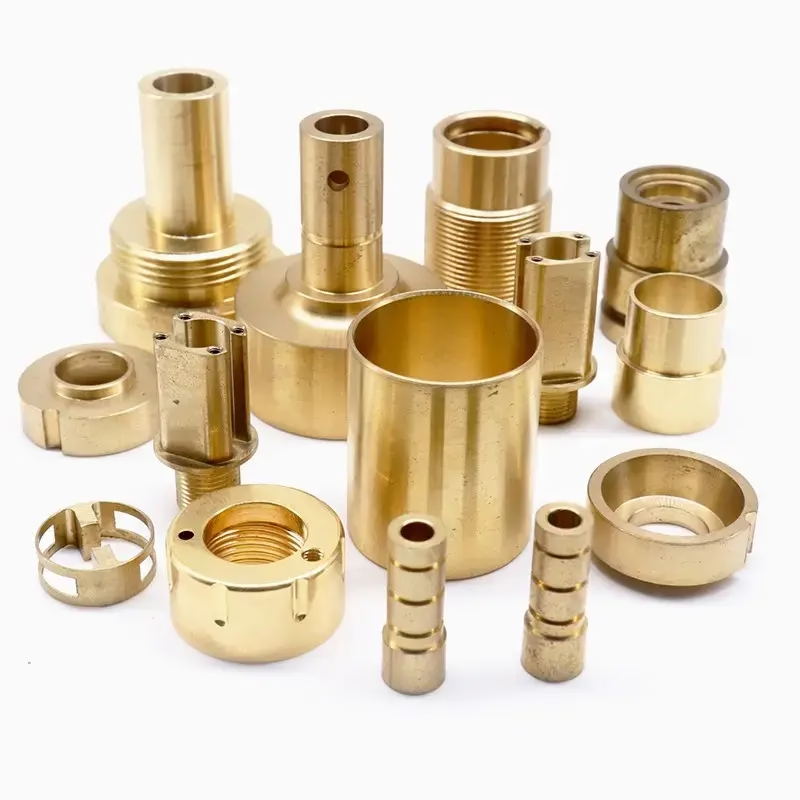
Why copper treatment at the spindle is not like cutting steel
Copper is soft, roughly 40 to 45 HV in the annealed state for C110, and it conducts heat about ten times faster than steel. That combination changes almost every decision at the machine. Heat leaves the shear zone quickly, so the tool stays cooler than it would in 304 stainless, but the same conductivity pulls heat into the workpiece and the fixture. Thin walls grow before the cut finishes, and a part that measured in tolerance at 08:00 can be out by the afternoon.
The second difference is friction. Copper has a high coefficient of friction against most tool coatings and no protective oxide layer worth mentioning. Fresh copper meets fresh carbide and the two tend to weld at the contact point. That built-up edge is what tears the surface, not the cutting edge itself. Operators see it as a rough, torn finish on a part that should have come off bright.
The third difference is chip control. Copper forms a continuous chip at almost any speed. It does not break the way grey cast iron does, so it wraps around the tool, the holder and sometimes the spindle nose. A nest of copper chips in a deep pocket will recut the surface and wreck the finish faster than any parameter error.
None of this makes copper hard to machine. It makes it unforgiving of a setup copied from an aluminum job. The alloy, the edge geometry and the coolant all have to point the same direction.
Pick the alloy before you pick the parameters
Copper is not one material. C101 and C110 are the two common grades for busbars, electrodes and RF components, both around 99.9 percent copper with high conductivity. They machine like soft leaded brass in terms of cutting force, but they burr heavily on exit edges and they scratch if anyone looks at them wrong.
C103 is the phosphorus-deoxidized grade. It welds and brazes better than C110 and is the usual pick for parts that get a torch or a furnace after machining. Cutting behavior is close to C110, so the same tooling applies.
Beryllium copper is a different animal. It machines clean, takes a mirror finish and holds tolerance after heat treatment, but the dust is a health hazard. We run it wet, enclose the work zone and control chips separately. If you need spring properties plus conductivity, it is often the only answer.
Brass is the easy branch. C36000 free-cutting brass breaks chips, runs at high surface speed and holds ±0.005 mm without drama. When a design can move from copper to brass and still meet the electrical spec, brass will usually be cheaper and faster.
Speeds, feeds and tool geometry that actually work
Use sharp, uncoated carbide or a light diamond-like coating. Most TiAlN and AlTiN coatings are designed for steel and add friction on copper. Polished flutes and a high rake angle, 12 to 20 degrees positive, reduce the built-up edge that tears the surface.
For C110 with a 10 mm carbide end mill, run 200 to 300 m/min surface speed and 0.05 to 0.12 mm per tooth. Keep the axial depth under 0.5 × D and the radial engagement under 0.3 × D. Copper will happily take a heavier chip than those numbers; the limit is usually the fixture, not the tool.
Never dwell. A tool spinning in one place work-hardens the surface and leaves a smear that no finishing pass will hide. If you need a sharp internal corner, change the tool, not the feed.
Coolant choice matters more than people expect. Flood coolant with a high oil content works for deep pockets and drilling. For finishing cuts on large faces, many shops get a better finish running dry with air blast, because a thin coolant film traps chips against the surface.
Rigidity decides the outcome. Copper forgives a weak setup on a single pass and punishes it on the second. A Ø400 mm rotary table on a stable base holds features far better than a vise clamped to an unsupported plate.
Deburring, stress relief and finish steps
Copper burrs are ductile. They bend instead of snapping off, so a wire brush just folds them over. Controlled edge breaking on the machine, with a 0.1 to 0.2 mm chamfer or a radius tool, saves a manual operation and keeps the edge repeatable across a run.
Stress relief matters for thin plates and long busbars. A roughing pass that removes 60 percent of the stock leaves internal stress that shows up as bowing after the part is released from the fixture. Rough, stress relieve, then finish. On C110 the relief cycle is short and cheap compared with scrapping a finished part.
For surface finish, the sequence that works is: leave 0.2 mm radial stock, use a sharp finishing tool, and run at the top of the speed range with a light chip. Bead blasting or tumbling evens out tool marks on non-critical faces, but it also rounds edges, so mask anything that has to stay sharp.
If the part needs plating, note that copper tarnishes in hours in open air. Electroless nickel or a silver flash gives a stable surface and keeps contact resistance predictable. Anodizing does not apply to copper, so do not plan for it.
Copper and brass alloys: where each one fits
Conductivity, machinability and typical parts
| Alloy | Machinability | Typical part |
|---|---|---|
| C101 / C110 | Soft, gummy, heavy burrs | Busbars, RF shields, electrodes |
| C103 | Similar to C110, welds well | Brazed assemblies, heat-treated parts |
| Beryllium copper | Clean chips, mirror finish | Spring contacts, molds, tooling |
| C27400 / C28000 | Chips break, good finish | Valve bodies, fittings, hardware |
| C36000 brass | Best chip control, high speed | Connectors, bushings, small fittings |
Which route to take
If the part carries current and needs high conductivity, machine C110 and control the burrs; if it needs spring properties or a mirror finish, switch to beryllium copper; if the electrical spec allows brass, take C36000 and cut your cycle time.
Questions engineers ask before quoting
Can you hold ±0.005 mm on a long copper busbar?
On a rigid setup with a rough-and-finish sequence, yes on features near the fixture. Over a long span, thermal growth is the limit, not the machine. We check the part at room temperature and report the measurement points.
Does copper need a different coolant than aluminum?
Yes. Aluminum often runs on a low-oil synthetic, which stains copper and leaves a film in blind holes. Copper does better on a higher oil content and a clean filtration loop.
What is the smallest internal radius you can cut in copper?
It follows the tool, not the material. A 1 mm end mill gives about a 1.2 mm corner radius. Copper's low cutting force means small tools survive longer than they do in stainless.
Will the edge stay sharp after bead blasting?
No. Bead blasting rounds edges by 0.02 to 0.05 mm. If a contact edge or a sealing face has to stay crisp, mask it or skip the blast on that side.
Do you machine copper parts from one piece up?
Yes. There is no minimum order quantity, so a single prototype and a 10,000-part run use the same process and inspection path.
How do you keep copper parts from tarnishing before shipping?
Parts are cleaned, dried and packed with a barrier film or a desiccant. Copper starts to dull in open air within a day, so the packing step matters as much as the machining.
Send us your copper part and the drawing
Upload a step file and get a quotation plus a free DFM analysis within 12 hours, with 100 percent inspection before shipment.
12-hour quoteNo minimum order100% inspection
More process notes from the shop floor
We publish setup notes, tooling trials and inspection data from the factory floor.











