
Cost Effective CNC Processing Services: A Buyer Guide
This page is for engineers and sourcing managers choosing a machining supplier. It shows where money actually leaves the project, which parts suit which machine, and the checks that separate a low quote from a low total cost.
In this article
- 1
- 2
- 3
- 4
- 5
- 6
- 7
- 8
Key takeaways
What each cost driver looks like
Use this to compare two suppliers quoting the same drawing.
| Cost driver | Cheap quote often means | Cost effective means | What to ask |
|---|---|---|---|
| Setup count | One op per face, five fixtures | 5-axis or mill-turn in one setup | How many setups on this part? |
| Tolerance | ±0.05 mm shop standard | ±0.005 mm only where marked | Which features need the tight call? |
| Material | Bought per job at retail | Bulk stock, certified heat lots | Do you hold this alloy in stock? |
| Inspection | Final check only | In-process plus final, reports on request | Can I see the inspection report? |
| Finish | Outsourced, adds a week | In-house anodizing and plating | Is finishing done on site? |
| Lead time | Vague date, no buffer | 3–5 day ship, under 2% late history | What is your on-time rate? |
| Order size | MOQ 100 pieces | From one prototype to 10,000+ | Can you run a single piece first? |
The verdict
Pick the supplier whose total cost is lowest across the whole order, not the one with the lowest hourly rate. Fewer setups, tight tolerances only where they matter, and in-house finishing beat a discount every time.
Cost effective CNC processing services: price is not the same as cost
A low hourly rate is easy to advertise. The number that matters is the total you pay from drawing release to accepted parts. Two shops can quote the same part at $40 and $55 per hour and the $55 shop still wins, because it programs once, fixtures once, and inspects the part while it is still on the table.
Cost effective CNC processing services are built on three things: fewer setups, fewer surprises, and a quote that lists what is inside it. When a supplier buys aluminum in bulk, holds certified stock, and anodizes in the same building, the savings come from the process, not from a discount.
Machining time is only part of the price. Programming, workholding design, tool wear, deburring, inspection and shipping all sit in the same line. A shop that hides these in a single lump sum is not cheaper. It is just harder to compare.
Our own baseline: 127 CNC machines across 3 plants, 16 of them simultaneous 5-axis centers, and a 4,000 mm maximum processing size. That mix exists because no single machine type is cost effective for every part.
- 1Setup timeUsually the largest single line on prototype and low-volume work.
- 2ProgrammingOnce for a simple part, several times for a part with tight datums.
- 3ToolingCustom cutters and fixtures are real cost, and they repeat on reorders.
- 4Inspection100% inspection before shipment is included in every job we run.
Match the part to the machine before you compare prices
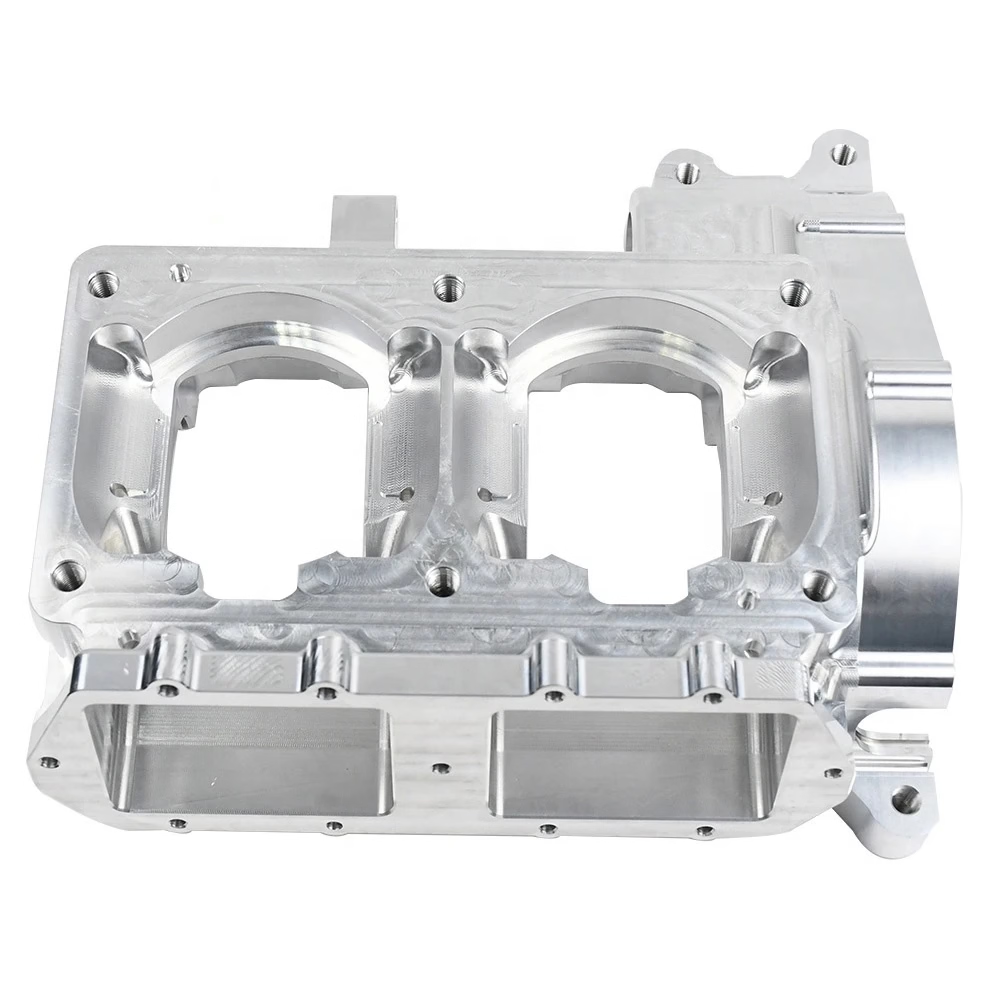
A 3-axis mill is the cheapest way to cut a flat plate with holes. Put the same part on a 5-axis center and you pay for capability you do not use. The reverse is also true. A part with angled ports, undercut pockets, or features on five faces will need three or four setups on a 3-axis machine, and every setup adds a datum error that someone has to inspect.
Simultaneous 5-axis work earns its place when a single setup replaces three, or when the part is short and stiff and the tool must reach past a wall. It also helps on deep cavities where a shorter, stiffer tool can be tilted instead of hanging out of the holder. On thin walls, a tilted tool cuts with less chatter.
Mill-turn centers sit in the middle. If a part is mostly round with some milled flats or cross holes, one mill-turn cycle beats a lathe plus a mill plus a fixture. We run 16 of them alongside 12 four-axis mills and 27 three-axis machines, so the choice is made on geometry, not on what happens to be free.
Size has its own limits. Travel ranges from 500 × 310 × 200 mm up to 4,000 × 400 × 150 mm, with a Ø400 mm rotary table for round work. Parts outside those envelopes need a different route, and it is better to say so at the quote stage.
Tolerance, finish and the features that actually cost money
A drawing that calls ±0.005 mm on every dimension will be expensive, and most of those calls do not matter. Mark the features that mate, seal, or locate. Leave the rest at the general tolerance block. This one change often removes a finishing pass and a CMM program from the quote.
Surface finish follows the same logic. Ra 0.8–1.6 μm is a normal machined finish for sealing faces and bearing seats. Ra 0.2–0.8 μm needs a slower pass, a sharper tool, and sometimes a second operation. Ra 1.6–3.2 μm is fine for brackets, covers, and anything that will be painted or anodized.
Radii are a quiet cost driver. A deep pocket with a 1 mm corner radius forces a small tool at low feed, so the cycle time climbs. If the function allows a 3 mm corner, say so. If it does not, expect the price to reflect it.
Material choice moves cost in a different way. Aluminum 6061 and 7075 cut fast and hold tight tolerances. Stainless 316 and 17-4PH work-harden, so feeds and speeds must be controlled. Titanium TC4 (Ti-6Al-4V) and Inconel cut slowly and wear tools, which shows up as time, not as a material surcharge.
- 1Tight only where it matters±0.005 mm on mating features, general block elsewhere.
- 2Name the finishRa 0.8–1.6 μm by default; finer only when the function needs it.
- 3Check corner radiiSmall internal radii force small tools and long cycles.
- 4Flag hard alloys earlyTitanium and Inconel change the cutting strategy, not just the price.
Certificates, confidentiality and the questions that expose a weak supplier
Certificates tell you which industries a shop is set up to serve. ISO 9001:2015 is the baseline for general machining. IATF 16949:2016 applies to automotive and EV work, where traceability and change control are audited. ISO 13485:2016 covers medical devices. ISO 27001:2022 covers information security, which matters when you send CAD files to an outside shop.
Ask how files are handled. Uploads should be secure and confidential, and an NDA should be available on request before you release drawings. A supplier that hesitates on this point is a risk regardless of price.
Ask about the inspection record. We check raw material on arrival, monitor in process, and inspect 100% before shipment, with reports on request. If a shop cannot show you a first-article or in-process record, you are buying a promise.
Ask about capacity in writing. Machine count, plant area, and shift pattern tell you whether your order will sit in a queue. Our three plants cover 7,600 m² with 150 technicians, which is enough to run prototypes and production at the same time.
Prototypes, bridge runs and production: one supplier or two
A shop that is excellent at one-off prototypes may not be the cheapest at 10,000 pieces, and the reverse is also true. High-volume work rewards automation, bar feeders, and dedicated fixtures. Prototype work rewards fast programming and flexible setups. Some shops do both; many do not.
There is no minimum order quantity here, so a single prototype and a 10,000+ part run can go through the same quality system. That continuity matters more than it sounds. The datum scheme, the fixture concept, and the inspection plan carry over from the first article to the production run, so you do not pay to solve the same problem twice.
When you split the work between two suppliers, budget for the transition. New fixtures, a new first article, and a new inspection plan all cost money and time. If the volume is small or the geometry is difficult, staying with one supplier is usually cheaper overall.
The practical test is simple. Ask both suppliers what changes between one piece and ten thousand. If the answer is only price and cycle time, the process is stable. If the answer involves new fixtures and a new setup plan, you are effectively buying the part twice.
Step by step: comparing quotes on the same drawing
Send the same package to every supplier so the numbers line up.
- 11. Freeze the drawing packageSend one revision, one material spec, one finish call. Add a STEP file so the supplier can check for features the 2D views do not show.
- 22. Mark tight tolerancesHighlight only mating, sealing, and locating features. Ask for ±0.005 mm there and the general block elsewhere. This alone can cut a finishing pass.
- 33. Ask for setup countA quote without a setup count is not comparable. Ask how many operations the part needs and which machine type runs each one.
- 44. Request the inspection planAsk what is checked, when, and whether a report comes with the parts. 100% inspection before shipment should be the default, not an add-on.
- 55. Confirm the finish routeIf anodizing, plating, or powder coating is in-house, the schedule is shorter. If it is outsourced, ask who owns the part if the finish is rejected.
- 66. Run one piece firstA single-piece run exposes programming and fixturing problems before you commit to volume. It also gives you a real part to measure.
- 77. Compare total cost, not rateAdd programming, fixturing, machining, finishing, inspection and freight. The lowest total wins, not the lowest hourly rate.
- 88. Agree the change processAsk what happens when a revision lands mid-run. A written answer protects both sides from surprise charges.
Questions buyers ask before the first order
Is 5-axis always more expensive than 3-axis?
No. The hourly rate is higher, but the part may need one setup instead of three or four. On a part with features on five faces, 5-axis is often cheaper once you count fixture time, datum error, and the inspection that follows.
What is your minimum order quantity?
There is no minimum order quantity. We run from one prototype to 10,000+ part runs on the same quality system, which keeps the datum and inspection plan consistent between the first article and production.
How fast can I get a quote and the first parts?
Quotation and free DFM analysis come back within 12 hours. Production can start within 24 hours after that, and parts ship in 3–5 days. Our historical late-delivery probability is below 2%.
Which tolerances can you hold on a production run?
±0.005 mm (±0.0002 in) on the features that call for it. Finishes run from Ra 1.6–3.2 μm as machined, Ra 0.8–1.6 μm standard, down to Ra 0.2–0.8 μm when the function needs it. Honest answer: not every dimension on a drawing needs that call.
Can you machine titanium, Inconel and engineering plastics?
Yes. Titanium TA1, TA2 and TC4 (Ti-6Al-4V), Inconel, and magnesium AZ31B / AZ91D are all in our standard material list, along with PEEK, POM, PC and carbon fibre. Hard alloys cut slower and wear tools, so they are priced on cycle time, not on a flat surcharge.
How do you protect our drawings and IP?
Uploads are secure and confidential, and we hold ISO 27001:2022 for information security. An NDA is available on request before you release files, and we can work from a simplified drawing if some features are not needed for quoting.
Send a drawing and get a comparable quote
Upload your CAD and we return a quote with free DFM analysis within 12 hours. Setup count, tolerance callouts and finish route are listed so you can compare line by line.
12-hour quoteNo MOQ100% inspectionNDA on request
More from the shop floor
We publish setup notes, tooling trials and inspection data from the factory floor.











