
Custom Acrylic CNC Machining: How to Choose a Shop
A buyer guide for engineers sourcing clear PMMA parts. It covers what drives cost and finish, which tolerances are realistic, and which shop answers tell you the job will run clean. Read it before you send the drawing.
In this article
- 1
- 2
- 3
- 4
- 5
- 6
- 7
- 8
Key takeaways
Acrylic grade and process fit
Use this to decide what to ask for before the quote is written.
| Part type | Sheet / stock | Process route | Watch out for |
|---|---|---|---|
| Optical window, 3–10 mm | Cast PMMA | 3-axis mill, vapor polish | Stress marks from heavy cuts |
| Display bezel, 2–4 mm | Extruded PMMA | 3-axis + edge polish | Chips at inside corners |
| Fluid manifold | Cast PMMA | Mill-turn, annealed | Solvent craze at threaded ports |
| Light pipe, long span | Cast PMMA | 4-axis, diamond fly cut | Wall deflection mid-span |
| Snap-fit housing | Extruded PMMA | 3-axis, annealed blank | Cracking on assembly |
| Prototype lens, 1-off | Cast PMMA | 5-axis, slow finishing pass | Tool marks left in the curve |
What a good quote answers
If a quote leaves these blank, the price is not comparable to the next one.
| Question | Weak answer | Useful answer |
|---|---|---|
| Sheet grade | Acrylic | Cast PMMA, 8 mm, stress-relieved |
| Coolant | Flood | Air blast for milling, flood on deep pockets |
| Annealing | Not needed | Pre-finish soak at 85 °C, slow cool |
| Tolerance plan | ±0.005 mm | ±0.005 mm on bore, ±0.1 mm elsewhere |
| Inspection | Visual check | Profile projector, report on request |
| Lead time | Fast | Parts ship in 3–5 days after drawing release |
The verdict
If the part is clear, bonded, or under load, pay for cast PMMA and an anneal. If it is a flat panel with no optical requirement, extruded sheet and a machined finish will do the job for less.
Cast and extruded PMMA machine differently
Custom acrylic CNC machining starts with a sheet decision, not a spindle decision. Cast PMMA is polymerized in a mold. It has a higher molecular weight, lower internal stress, and it cuts into a continuous chip instead of a dusty spray. Extruded sheet is pushed through a die, cools fast, and carries locked-in stress along the extrusion direction.
That difference shows up at the cutter. Cast sheet holds a polished edge with fewer micro-cracks. Extruded sheet can chip at a sharp internal corner or split along a thin rib after assembly, even when the cut looked fine on the bench. For a part that will be solvent-bonded or placed under load, cast is usually the safer call.
Cost runs the other way. Extruded sheet is cheaper per square meter and comes in tighter thickness bands, which matters when you are machining a flat panel and want to skip a facing pass. If the part is a flat sign, a simple cover, or a fixture plate with no optical requirement, extruded is fine. Say so on the drawing.
Thickness tolerance on the sheet also sets your floor. If the raw sheet varies by 0.4 mm and you need a 3.0 mm finished wall, the shop must face both sides, which adds a setup and can bow the part. Ask for the actual sheet tolerance before you commit to a finished dimension.
- 1CastBetter edge, lower stress, higher price. Default for optical and bonded parts.
- 2ExtrudedCheaper, flatter, more stress. Fine for non-critical covers and plates.
- 3Colored or frostedPigment and filler change chip behavior. Expect slower feeds.
Why acrylic melts instead of cutting
PMMA has a glass transition temperature around 105 °C. Reach it at the cutting edge and the material stops shearing and starts smearing. You get a gummy chip, a dull white edge, and a built-up edge on the tool that drags across the finished surface on the next pass.
The fix is a combination, not a single setting. Use sharp uncoated carbide with a high rake angle and two flutes for roughing, so the chip clears fast. Keep radial engagement light, in the 5–10% of tool diameter range for finishing, and raise the feed per tooth so the tool cuts rather than rubs. Rubbing is what generates heat.
Coolant choice depends on the feature. Compressed air or a cold-air gun handles most milling and keeps the part dry for inspection. Flood coolant helps on deep pockets and drilling, where chips pack and heat has nowhere to go. If you use flood, expect to dry the part and check for coolant staining in any bond line.
Drilling is where most scrap happens. Peck in steps no deeper than one diameter, retract fully to clear the flutes, and use a 118° point with a low helix for through holes. A standard jobber drill at high speed will grab, and PMMA cracks before it warns you.
- 1Roughing2-flute carbide, high rake, air blast, 5–10% radial stepover.
- 2FinishingSharp tool, light pass, high surface speed, no dwell.
- 3DrillingPeck at 1×D, 118° point, low helix, full retract each peck.
Annealing, tolerance, and what you can measure
Every machining pass leaves stress in the part. On a 2 mm wall or a thin lens, that stress releases over days and you get fine hairline cracks, called crazing, around holes and edges. Annealing the blank before the finish pass at 80–90 °C for a few hours, then cooling slowly, removes most of it. Not every shop offers this. Ask directly.
Tolerance is where buyers get misled. A shop quoting ±0.005 mm on a 4 mm acrylic wall is quoting a number, not a process. Acrylic moves with temperature and moisture, and a thin section deflects under cutting force. On rigid bosses and bores, ±0.005 mm is achievable with the right machine and a controlled shop floor. On a 0.8 mm fin, it is not.
The practical approach is a stated band per feature. Give tight tolerance only where it functions: a bearing bore, a mating face, an optical seat. Let cosmetic surfaces and clearance holes sit at ±0.1 mm. That single change often cuts cost more than switching suppliers.
Finish follows the same logic. As-machined PMMA sits around Ra 1.6–3.2 μm and looks frosty. A slow finishing pass gets you to Ra 0.8–1.6 μm. Beyond that you are buying a polishing step, vapor polish, or flame polish, which softens edges and can round a sharp corner by 0.1 mm or more. Decide whether the corner matters before you ask for optical clarity.
- 1Annealing80–90 °C soak, slow cool. Essential on walls under 2 mm.
- 2Tight tolerance±0.005 mm on rigid features only, not on thin sections.
- 3PolishVapor and flame polish round edges. Keep sharp corners out of the polish.
How to judge a custom acrylic CNC machining supplier
Machining plastics is not the same trade as machining aluminum. A shop that runs acrylic every week keeps separate tooling for it, because a tool that has cut aluminum and dulled will burn PMMA on the first pass. Ask whether plastic tooling is kept apart and how often it is replaced.
Shop environment matters more than machine count. Acrylic picks up dust, and a single chip caught between the part and the vise becomes a dent in a polished face. Look for a controlled area, soft jaws, and protective film kept on the sheet until the last operation. These are cheap habits that separate a clean shop from a busy one.
Certifications tell you the paperwork system is audited. ISO 9001:2015 covers general quality, IATF 16949:2016 covers automotive, ISO 13485:2016 covers medical devices, and ISO 27001:2022 covers information security. For a display part none of these change the cut, but for a medical or automotive program they decide whether you can be approved at all.
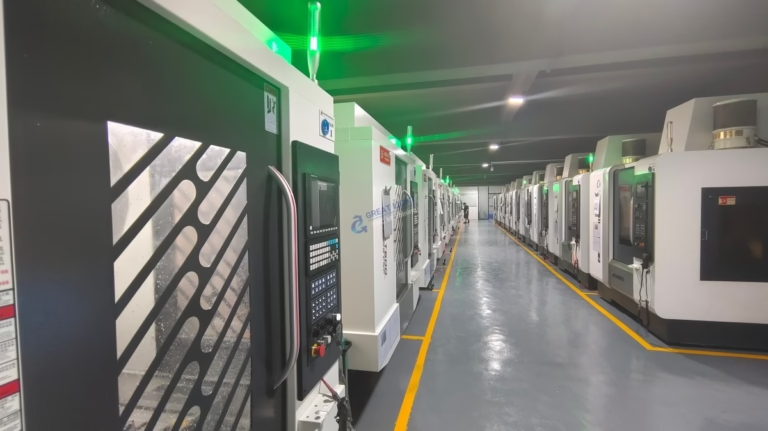
GreatLight runs 127 high-precision CNC machines across three plants in Dongguan and a factory in Singapore, with 16 simultaneous 5-axis centers and a 4,000 mm maximum processing size. Plastics including PMMA sit alongside aluminum, stainless, titanium, and PEEK. No minimum order quantity applies, from one prototype to a 10,000+ part run.
- 1Separate toolingPlastic-only cutters, replaced on a schedule, not when they fail.
- 2HandlingSoft jaws, protective film, gloved handling on polished faces.
- 3PaperworkMatch certifications to your program, not to a brochure.
Seven steps before you release the order
Work through these in order. Each one removes a common source of scrap.
- 1Pick the sheet gradeCast PMMA for optical, bonded, or load-bearing parts. Extruded only for flat, non-critical panels. Put the grade and thickness band on the drawing.
- 2State tolerance per feature±0.005 mm on bores and mating faces, ±0.1 mm on cosmetic and clearance features. Avoid one blanket tolerance across the whole part.
- 3Flag thin walls and long spansAnything under 2 mm wall or over 150 mm unsupported span needs a support plan and a slower finishing pass. Tell the shop up front.
- 4Ask about annealingRequest a pre-finish soak at 80–90 °C with a slow cool for thin sections and parts that will be solvent-bonded.
- 5Confirm coolant and chip clearingAir blast for open milling, flood for deep pockets and drilling. Peck at 1×D on all holes deeper than two diameters.
- 6Define the finish and its limitsSay whether you want Ra 0.8–1.6 μm machined finish or a polished face. If edges must stay sharp, exclude them from vapor or flame polish.
- 7Agree on inspectionAsk for 100% inspection before shipment and a report on request. For optical parts, confirm the measuring method before the first cut.
Questions buyers ask next
Can acrylic hold ±0.005 mm on every dimension?
No. Acrylic expands with temperature and deflects under cutting force, so a thin wall or a long unsupported span will move more than that.
±0.005 mm is realistic on rigid features measured in a controlled shop. On thin sections, agree on a looser band and keep the tight tolerance only where it functions.
Why did my last batch craze around the holes?
Crazing is stress release from machining and drilling heat, and it often appears days after delivery.
The usual causes are a dull drill, peck depths over one diameter, and no annealing. A pre-finish anneal at 80–90 °C plus full-retract peck drilling removes most of it.
Is vapor polishing worth the cost?
It gives a clear, glass-like surface that machining alone cannot reach on complex geometry.
It also softens edges and can round a sharp corner by 0.1 mm or more. Use it for optical and display faces, and keep functional edges out of the process.
What is the smallest order you will run?
There is no minimum order quantity. One prototype and a 10,000+ part run go through the same setup discipline.
For a single part, expect the quote to be dominated by programming and fixturing rather than material.
How fast can parts ship?
Quotation and a free DFM analysis come back within 12 hours, and production can start within 24 hours.
Parts ship in 3–5 days after drawing release. The historical late-delivery probability is below 2%.
Do you sign an NDA for a new design?
Yes. Uploads are secure and confidential, and an NDA is available on request before you share drawings.
Programs under ISO 27001:2022 information security controls handle design files and inspection records.
Send the drawing, get a real answer
Share your PMMA part and we will return a quotation with a free DFM analysis within 12 hours, with the tolerance and finish plan written out.
12-hour quoteNo minimum order100% inspectionNDA on request
More from the shop floor
We publish setup notes, tooling trials and inspection data from the factory floor.











