
Acrylic CNC Machining Services for Clear, Crack-Free Parts
Acrylic cuts fast, but it also chips, crazes and stress-cracks if the tool and feed are wrong. This page covers the process side: which geometries belong on a mill, where turning wins, what tolerance is realistic, and when you should not use acrylic at all. It is written for design and manufacturing engineers sourcing clear plastic parts.
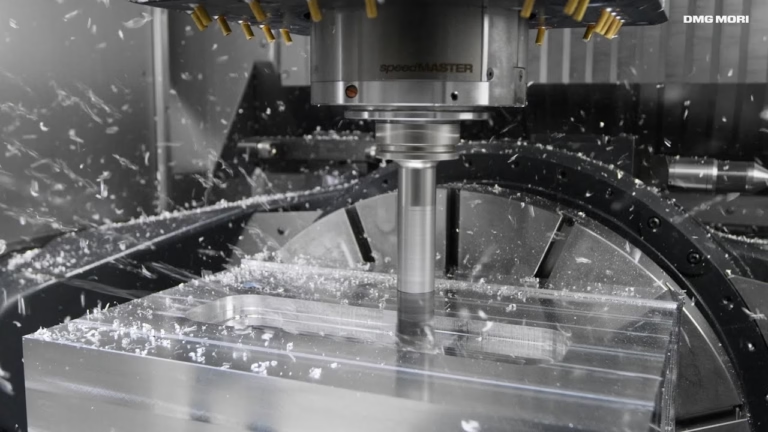
What acrylic CNC machining actually involves
Cast PMMA is machined on standard metal-cutting equipment, but the cutting parameters look nothing like aluminium.
Cast vs extruded sheet: pick the right one before you machine
Acrylic is PMMA, and the two sheet types behave differently under a cutter. Cast acrylic has a higher molecular weight, machines to a cleaner edge and polishes back to optical clarity. Extruded sheet is cheaper and more uniform in thickness, but it chips more readily and shows stress whitening around holes and threads. For a clear lens cover or a fluidic manifold, cast is the safer default.
Thickness also drives the choice. Cast sheet is commonly available from 1.5 mm to 50 mm and beyond; extruded is usually thinner stock. If your part is a 3 mm window, extruded may be fine. If it is a 20 mm block with an internal channel, cast gives you better internal stress distribution and less risk of crazing after solvent bonding.
Acrylic absorbs moisture, roughly 0.3 to 0.4 percent at equilibrium in humid air. That matters for two reasons. First, a wet blank machines with a rougher finish and can leave a milky edge. Second, a part measured wet will shrink slightly as it dries. For tight work we dry blanks before the finishing pass and let parts stabilize before final inspection.
Tooling and cutting parameters that avoid melting and chipping
PMMA is soft and has poor thermal conductivity, so the heat from cutting stays in the chip and the tool edge. A dull cutter rubs instead of shearing, and the result is a gummy, welded edge. We use sharp two-flute carbide end mills with polished flutes and high rake angles, which clear chips fast and cut at lower temperature. Diamond-coated or PCD tooling is reserved for long production runs where edge life pays for itself.
Spindle speed runs high and feed per tooth stays moderate. A typical starting point for a 6 mm two-flute cutter is 12,000 to 18,000 rpm at 0.05 to 0.10 mm per tooth, then adjusted by chip evacuation and surface finish. Climb milling on the finishing pass gives a cleaner wall. Ramping into a pocket beats plunging straight down, because a plunge concentrates heat and often leaves a mark you cannot polish out.
Cooling is mostly about chip removal, not flood coolant. Compressed air or a mist keeps the cut zone clear. Flood coolant can work on thick sections, but many acrylic grades are sensitive to some coolants and will craze. If a part needs flood, we test on scrap first. For thin sheet under 5 mm, we often cut on a vacuum table with a backing board to stop vibration and edge chipping.
- 1Two-flute carbidePolished flutes, high rake, sharp edge. Best all-round choice.
- 2Climb millingUse on finishing passes for a cleaner wall and fewer pull-outs.
- 3Ramp entryAvoid straight plunges; they trap heat and leave witness marks.
- 4Air or mistClear chips first. Test any flood coolant on scrap before a real part.
Features that machine well in acrylic, and features that fight you
Acrylic likes generous radii and thick walls. An internal corner should carry a radius at least one third of the cutter diameter, ideally more, so the tool can sweep through without dwelling. Sharp inside corners force a small cutter, and a small cutter deflects. If the corner is cosmetic, tell us and we can leave a radius and note it on the drawing.
Threads are the weak point. A tapped hole in acrylic holds far less load than the same hole in aluminium, and a coarse thread in thin sheet will strip. For anything that will be assembled more than a few times, use a metal insert or a through-bolt with a nut. We can machine a pocket for a heat-set insert, but keep the boss wall at least 1.5 times the insert diameter.
Deep pockets and tall thin walls are where acrylic punishes you. Roughing a 40 mm deep pocket with a 6 mm cutter means a long reach, and the tool will chatter. Chatter in acrylic does not just sound bad; it leaves a frosted band that no amount of flame polishing fully removes. If your part needs a deep cavity, expect to open the tolerance on the floor finish or split the part and bond it.
Acrylic process and capability reference
Values below reflect what we hold in normal production, not laboratory bests.
| Item | Practical range | Notes |
|---|---|---|
| General tolerance | ±0.005 mm | On critical features; standard work is looser |
| As-machined finish | Ra 1.6–3.2 μm | Visible tool marks on walls |
| Fine machined finish | Ra 0.8–1.6 μm | Good base for vapor polishing |
| Polished finish | Ra 0.2–0.8 μm | Hand or flame polish after machining |
| Minimum wall, free | 0.8 mm | Thicker if the wall is tall or unsupported |
| Min internal corner | 0.5 mm radius | Smaller radii need micro tooling |
| Max part envelope | 4,000 mm | Long parts on the large travel machines |
| Threads | Inserts preferred | Tapped PMMA strips under repeated use |
| Sheet thickness | 1.5 mm and up | Cast sheet for thick or clear parts |
Getting from a machined surface to an optically clear part
Machined acrylic is translucent, not transparent, because the cutter leaves fine tool marks that scatter light. To reach clarity you remove those marks in stages: hand sand from 400 grit up through 1500, then polish with a compound. Flame polishing with a hydrogen-oxygen torch is faster and gives a glass-like surface on edges, but it introduces heat. On a part with internal stress, that heat can trigger crazing days later.
Vapor polishing uses solvent vapor to melt the surface layer smooth. It reaches internal features that a buffing wheel cannot, which makes it useful for fluidic channels and small bores. The trade-off is dimensional change. Vapor polishing removes a thin skin of material, typically a few microns to tens of microns depending on dwell time, so we mask or compensate on features that must hold tolerance.
Annealing is the step most people skip. Machining leaves residual stress in the part, and stress plus a solvent or a warm environment equals cracks. A proper anneal cycle holds the part below its glass transition temperature for a controlled period and cools slowly. For parts that will be solvent bonded, drilled after delivery, or used near windows, we recommend annealing before the final finish.
What tolerance is realistic, and where acrylic will not hold it
We machine acrylic to ±0.005 mm on features that matter, and that number holds on a stable part measured at a controlled temperature. It does not mean every dimension on a 300 mm clear panel comes in at ±0.005 mm. Acrylic has a thermal expansion coefficient around 70 × 10⁻⁶ per °C, roughly seven times that of steel. A 100 mm dimension moves about 0.007 mm for every 1 °C change. Ship that part from a 22 °C shop to a 30 °C lab and the number moves.
Moisture adds a second drift. A part machined dry and then exposed to humid air will swell slightly. If your assembly has a hard interference fit, the fit can tighten or loosen with the season. Design acrylic assemblies with a small clearance rather than a press fit, or use a compliant element to take up the change.
The honest answer for optical surfaces is that flatness and parallelism are harder than hole position. A 200 mm wide window will not stay flat to ±0.005 mm across the face after machining and polishing; internal stress release causes a slight bow. If flatness is functional, tell us the allowable bow and we will rough, stress-relieve, then finish machine.
When acrylic is the wrong choice
Acrylic is brittle. It does not yield before it breaks, so a part that sees impact, drop loading or repeated flexing will eventually crack. If the application is a guard that gets bumped or a bracket under vibration, polycarbonate is the better material. PC takes roughly 200 times the impact energy of acrylic, at the cost of lower clarity and worse UV resistance.
Chemical exposure is another limit. Acrylic crazes on contact with many solvents, alcohols and some cleaning agents. If the part will be wiped down with IPA every shift, plain PMMA will develop a web of fine cracks. A hard-coated or chemically resistant grade can help, but the honest move may be to switch to a different polymer.
Heat is the third limit. PMMA softens near 100 °C and starts to deform well before that under load. Near an engine, a lamp housing or a heated chamber, acrylic will creep out of tolerance. For those jobs we would look at PEEK, PEI or a thermoset. As acrylic CNC machining services go, part of the value is telling you when not to specify acrylic, and our engineers will say so before the chips fly.
Acrylic machining questions engineers ask
Can you flame polish or vapor polish after machining?
Yes. Flame polishing works well on outer edges and simple profiles, and vapor polishing reaches internal channels and small bores that a wheel cannot touch.
Both change dimensions slightly. Vapor polishing removes a thin surface layer, so we mask or compensate on features that hold tolerance. Tell us which surfaces are optical and which are functional.
Why did my acrylic part crack after it was assembled?
The usual cause is residual stress from machining plus a solvent or a tight fit. Solvent bonding and press fits both add load to a part that is already stressed.
Annealing before finishing releases most of that stress. A small clearance instead of an interference fit also helps. Send us the assembly drawing and we will flag the risk points.
What is the smallest hole and thread you can machine in acrylic?
We drill holes down to roughly 0.5 mm with micro tooling, though the depth-to-diameter ratio has to stay modest or the drill wanders.
For threads, we recommend heat-set inserts rather than tapped PMMA. A tapped hole in acrylic strips after a handful of assembly cycles, especially in thin sheet.
Can acrylic be machined to the same tolerance as aluminium?
On a stable feature, yes, down to ±0.005 mm. Across a large part, no, because acrylic moves about seven times more than steel for the same temperature change.
We hold tight numbers on hole position and small features, and we will tell you when a dimension is not physically stable over the part size you have.
Do you machine cast and extruded acrylic differently?
Yes. Cast acrylic machines cleaner and polishes better, so we push the finish harder on it. Extruded sheet is more prone to chipping, so we take lighter finishing passes and often use a backing board.
If you have not chosen a grade yet, tell us the function and we will recommend cast or extruded before quoting.
What file format and information do you need for a quote?
A STEP or IGES model plus a 2D drawing with tolerances, material grade and any optical or cosmetic callouts is ideal.
Native CAD files are fine too. We return a quotation and a DFM analysis within 12 hours, and uploads stay confidential with an NDA available on request.
Send your acrylic part for a DFM review
Upload a model and drawing. We will come back with a quotation, a machining plan and any features that will not hold tolerance in PMMA.
12-hour quote±0.005 mm100% inspectionNDA on request









