
Custom CNC Machining Service: 7 Checks Before You Send an RFQ
This guide is for engineers and sourcing teams picking a custom CNC machining service for prototypes through 10,000+ part runs. It covers the checks that actually separate capable shops from fast-talking ones: tolerance, lead time, MOQ, certification, quote detail, and DFM feedback. Read it once and you can judge a supplier in a 20-minute call.
In this article
- 1
- 2
- 3
- 4
- 5
- 6
- 7
- 8
- 9
Key takeaways
Custom CNC machining service: what to compare
Use this table to score suppliers on the call. Each row is a question with a pass/fail answer.
| Check | What to ask | Weak answer | Strong answer |
|---|---|---|---|
| Tolerance | Can you hold ±0.005 mm on this feature? | We will try | 5-axis, temp-controlled, 100% inspection |
| Quote speed | When do I get the quote and DFM notes? | 3–5 business days | Within 12 hours with DFM analysis |
| MOQ | Minimum order quantity for this part? | 500 pieces | No MOQ, one prototype is fine |
| Lead time | When do parts ship after PO? | About 2 weeks | Production starts in 24 hours, ships in 3–5 days |
| Certification | Which quality systems are certified? | We follow ISO | ISO 9001, IATF 16949, ISO 13485, ISO 27001 |
| Material trace | Do you supply mill certs? | On request, maybe | Raw material check, reports on request |
| Finishing | Is anodizing done in-house? | We outsource it | Anodizing, plating, blasting under one roof |
| Confidentiality | Can you sign an NDA before I upload files? | Send files first | NDA available on request, secure uploads |
Start with tolerance, because it drives everything else
Tolerance is the first filter. A custom CNC machining service that quotes ±0.005 mm on every feature is either very good or not reading your drawing. That number is achievable, but only on specific features, with the right machine and a stable process. On a 200 mm aluminum bracket, ±0.005 mm across the whole part is a different job than ±0.005 mm on a bearing bore. Ask which features need the tight number and which can sit at ±0.05 mm. A good shop will ask you that before quoting.
The machine list tells you what a shop can actually hold. Five-axis machining centers handle angled holes and contoured surfaces in one setup, which removes stack-up error from multiple fixtures. Mill-turn centers cut turned and milled features on the same part without re-chucking, so concentricity stays tight. If your part has a Ø400 mm rotary table feature or a 4,000 mm long extrusion, you need to confirm the shop has that envelope before anything else.
Surface finish is a separate line on the drawing and often a separate cost. As-machined aluminum sits around Ra 1.6–3.2 μm. A fine finish at Ra 0.2–0.8 μm needs slower feeds, sharper tooling, and sometimes a finishing pass on a different machine. Do not let a quote lump finish into a single tolerance callout. Specify Ra per surface, or you will pay for the tightest value everywhere.
One more thing: temperature. Holding ±0.005 mm in a shop without thermal control is luck, not process. If the supplier cannot tell you how the shop is temperature-managed, treat tight tolerance claims as aspirational.
- 1Tight tolerance is feature-specificMark the features that need ±0.005 mm. Let the rest sit at ±0.05 mm.
- 2Machine envelope decides feasibilityConfirm max part size and rotary table before you send the model.
- 3Finish is a separate calloutRa 0.8–1.6 μm and Ra 0.2–0.8 μm are different price tiers.
Lead time: separate the quote from the ship date
Lead time gets quoted as one number and then breaks into three. Quote turnaround, production start, and shipping are separate events. A shop that quotes in 12 hours, starts production within 24 hours of PO, and ships in 3–5 days is built for iterative work. A shop that quotes in a week and ships in four weeks is built for scheduled volume. Neither is wrong, but you need to know which one you called.
For prototypes, the quote speed matters more than the ship date. You are going to change the design anyway. A 12-hour quote with DFM notes lets you fix a wall thickness or a thread depth before cutting metal. For production, the ship date matters more. Ask what the historical late-delivery rate is. A shop that tracks this can tell you. A shop that cannot is guessing.
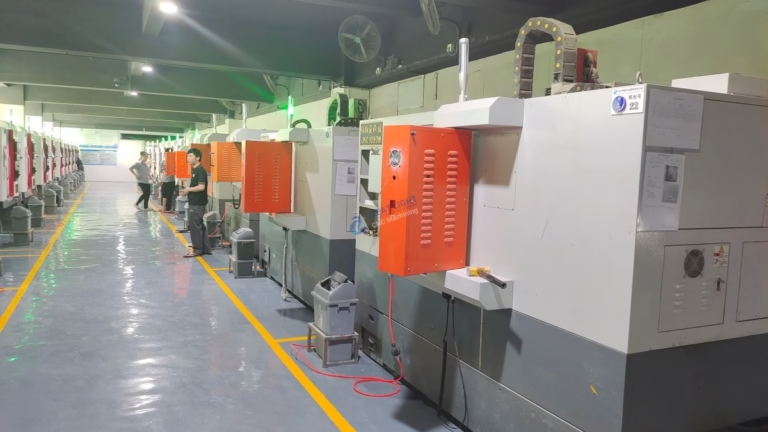
Watch for the phrase we will expedite it. Expediting means someone else's job got pushed. It works once. If your program needs speed on every revision, choose a supplier with capacity headroom, not one that promises to rush. Ask how many machines run on the part family you need. A shop with 127 machines and 16 five-axis centers has room to move your job; a two-machine shop does not.
Finally, ask where the parts ship from. A single location is simpler for customs and returns. If the supplier runs multiple plants, confirm which one will cut your parts and which quality system applies to it.
- 1Three dates, not oneQuote date, production start, ship date. Get all three in writing.
- 2Prototype vs production speedFast quotes help prototypes. Reliable ship dates help production.
- 3Capacity headroom beats expeditingAsk how many machines can run your part family.
MOQ, setup cost, and the real cost of a small run
No minimum order quantity sounds like a sales line until you compare quotes. A shop with no MOQ prices the setup into the piece price and runs one part. A shop with a 500-piece MOQ either refuses the job or charges a setup fee that makes one part cost more than fifty. If you are a hardware startup doing five revisions, the no-MOQ shop will cost less over the program, even if the unit price looks higher.
Ask how setup is charged. Some shops quote a separate programming and fixture fee. Others bury it. Both are fine, but they compare differently. A separate fee is easier to audit and easier to remove once the program is stable. A buried fee makes one-off parts look cheap and volume parts look expensive.
Volume pricing should step down in a predictable way. Ask for a price at 1, 100, 1,000, and 10,000 pieces. If the curve is flat, the shop is not set up for volume. If the curve drops sharply after 500, the shop is optimized for that range. Match the curve to your forecast, not to the lowest number.
One trap: cheap first articles. If the first article price is far below the volume price, the shop is buying the job to learn it. Your second order will carry the real cost. Ask what the price is at 10,000 pieces before you place the first order.
- 1No MOQ favors iterationFive design revisions cost less at a no-MOQ shop.
- 2Ask for the price curveGet quotes at 1, 100, 1,000, and 10,000 pieces.
- 3Beware the loss-leader first articleA price far below volume means the second order pays for it.
Certifications and inspection: what the paperwork actually covers
Certifications tell you which industries a shop is audited for. ISO 9001:2015 is the baseline quality system. IATF 16949:2016 adds automotive traceability and change control. ISO 13485:2016 covers medical device manufacturing. ISO 27001:2022 covers information security, which matters when your CAD files are the product. A shop with all four has been audited by outside bodies on all four scopes.
Certification is not the same as inspection. Ask what happens to your parts before they ship. A 100% inspection policy with raw material check, in-process monitoring, and final inspection is a process. A final inspection only is a spot check. Ask for the inspection report on the first article and read what was measured. If the report lists only outside dimensions on a part with a critical bore, the inspection plan is thin.
Material traceability is part of this. Ask whether the shop supplies mill certificates on request. For aerospace, medical, and automotive parts, the material cert is often a contract requirement, not a nice-to-have. A shop that treats it as paperwork will slow your release.
Finally, check who signs the inspection report. A report signed by the machinist who cut the part is weaker than one signed by a separate quality function. Both are common. Know which one you are buying.
- 1Match cert to industryIATF for auto, ISO 13485 for medical, ISO 27001 for IP.
- 2Inspection plan, not just inspectionRaw material, in-process, and final checks are three different gates.
- 3Material certs on requestNeeded for aerospace, medical, and automotive release.
Materials and finishing: in-house or outsourced
Material range is a quick capability test. Aluminum 6061, 7075, and 2024 cut differently and are used for different reasons. Stainless 303 machines freely, 316L resists corrosion, and 17-4PH can be heat treated. Titanium Ti-6Al-4V and Inconel need slower speeds and more tool wear, which shows up in the price. If your part is PEEK or carbon fiber, confirm the shop has cut it before. Plastics behave nothing like aluminum.
Finishing is where lead time quietly doubles. Anodizing, plating, powder coating, and bead blasting done under one roof keep the part in one queue. If the shop outsources finishing, your parts travel, and travel adds days and risk. Ask specifically whether anodizing is in-house. Color anodizing and hardcoat are separate processes with separate tanks; not every shop runs both.
Laser marking is a small detail with a real limit. Minimum character height is around 1.5 mm for a clean mark. If your part number or UDI needs smaller text, plan for a different marking method or a larger flat area. Raise this at quote time, not after the parts are anodized.
One question worth asking: can the shop hold the finish spec on a machined surface, or does it need a pre-finish step? Bead blasting before anodizing gives a different look than anodizing a turned surface. Send a photo of the target finish with the RFQ.
- 1Confirm the exact alloy6061 and 7075 are not interchangeable on a stressed part.
- 2In-house finishing saves daysOutsourced anodizing adds travel and queue time.
- 3Laser marking has a size floor1.5 mm minimum character height for a clean mark.
Quote quality: DFM notes are the real deliverable
A quote is a price. A DFM analysis is an engineering opinion. The second one saves money. A good DFM note will flag a wall too thin to hold tolerance, a thread too close to an edge, a deep pocket that needs a smaller tool and more time, or a datum that cannot be reached in one setup. These notes come back before cutting, which means you can change the design at zero cost.
Look at how the quote is structured. Line items for material, machining, finishing, and inspection let you compare suppliers and remove scope. A single lump sum hides where the cost is. If you are choosing between two shops and one gives line items and the other gives a number, the line-item quote is more useful even if it is higher.
Ask what happens if the parts fail inspection. A shop that reworks or remakes at its own cost on a clear drawing violation is carrying the process risk. A shop that bills you for its own setup error is not. Get this in writing before the PO, not after.
Also ask about confidentiality. If your design is the product, upload security and an NDA matter. A shop that offers an NDA on request and keeps uploads secure is set up for IP-sensitive work. Ask before you send the STEP file, not after.
- 1DFM notes come before cuttingDesign changes at quote time are free. After cutting, they are scrap.
- 2Line-item quotes compare betterMaterial, machining, finishing, inspection as separate lines.
- 3NDA before uploadAsk for it before the STEP file leaves your server.
Step by step: qualifying a custom CNC machining service
Run these steps in order. Each one can eliminate a supplier before you spend time on the next.
- 1Send one part with a real tolerance calloutPick a part with at least one tight feature and one loose feature. Mark both. See whether the quote reflects the difference. A flat price across both means the shop did not read the drawing.
- 2Ask for the quote and DFM notes togetherSet a 12-hour expectation and see what arrives. The DFM notes should name specific features, not say looks good. If there are no notes, ask why.
- 3Request a price curve at 1, 100, 1,000, and 10,000 piecesPlot the four numbers. You are looking for a curve that matches your forecast, not the lowest point. A flat curve means the shop is not set up for your volume.
- 4Confirm machine envelope and setup countAsk which machine will run the part and how many setups. Fewer setups means less stack-up error. For angled features, ask whether it runs on a 5-axis center.
- 5Check certification scope against your industryAsk for the certificate number and the scope. ISO 9001 alone is fine for industrial parts. Medical and automotive need the specific system.
- 6Ask about the first article inspection reportRequest the report format before the PO. It should list measured features with nominal and actual values, and the gauge used for each.
- 7Test communication on one revisionSend a small design change and time the response. A shop that answers in hours on a revision will answer in hours on a problem. Slow replies get slower under pressure.
Questions engineers ask before choosing a shop
What tolerance can a custom CNC machining service realistically hold?
±0.005 mm is achievable on specific features with 5-axis or mill-turn equipment, temperature control, and 100% inspection. It is not realistic across every dimension of a large part.
For general features, ±0.05 mm is a normal production tolerance and costs less. Mark the tight features on the drawing and let the rest sit at the wider value.
Is no MOQ actually useful, or is it a marketing claim?
It is useful when you are iterating. A no-MOQ shop prices the setup into the piece price, so one part is expensive but there is no separate setup charge. Over five revisions, that usually costs less than a shop with a 500-piece minimum.
For stable production runs above 1,000 pieces, a shop with volume pricing will beat it. Match the MOQ to your stage, not to the lowest headline number.
Which certifications should I look for?
ISO 9001:2015 is the baseline. Add IATF 16949:2016 for automotive parts, ISO 13485:2016 for medical devices, and ISO 27001:2022 if your CAD files are sensitive.
Ask for the certificate scope, not just the logo. A certificate that covers a different plant than the one cutting your parts does not apply to your order.
How do I compare quotes from two shops fairly?
Ask both for line items: material, machining, finishing, inspection. Then compare the same scope. A lump sum from one shop and a line-item quote from another cannot be compared directly.
Also compare the DFM notes. If one shop flagged a thin wall and the other did not, the second quote may be missing a cost that shows up later.
Can I get an NDA before sending my files?
Yes, ask for it before upload. A shop that handles IP-sensitive work will have a standard NDA and secure upload. Do not send a STEP file to a supplier who will not sign one.
If the design is the product, treat confidentiality as a selection criterion equal to tolerance and lead time.
What should the first article inspection report include?
Measured features with nominal and actual values, the gauge used for each, and the operator or quality function that signed it. A report with only outside dimensions on a part with a critical bore is incomplete.
Request the report format before the PO so there is no argument about what inspection covers.
Send one part and see how the quote comes back
Upload your drawing and get a quote with DFM analysis within 12 hours. No MOQ, 100% inspection before shipment, and an NDA on request.
Quote in 12 hoursNo MOQ100% inspection
More from the shop floor
We publish setup notes, tooling trials and inspection data from the factory floor.











