
Cheap Custom CNC Machining: Where the Cost Actually Comes From
This page is for engineers and buyers who need low unit cost without giving up tolerance. It breaks down the line items that make a quote cheap or expensive: setup count, fixturing, cycle time, inspection, and post-processing. Read it and you can tell which supplier is cutting price and which one is cutting corners.
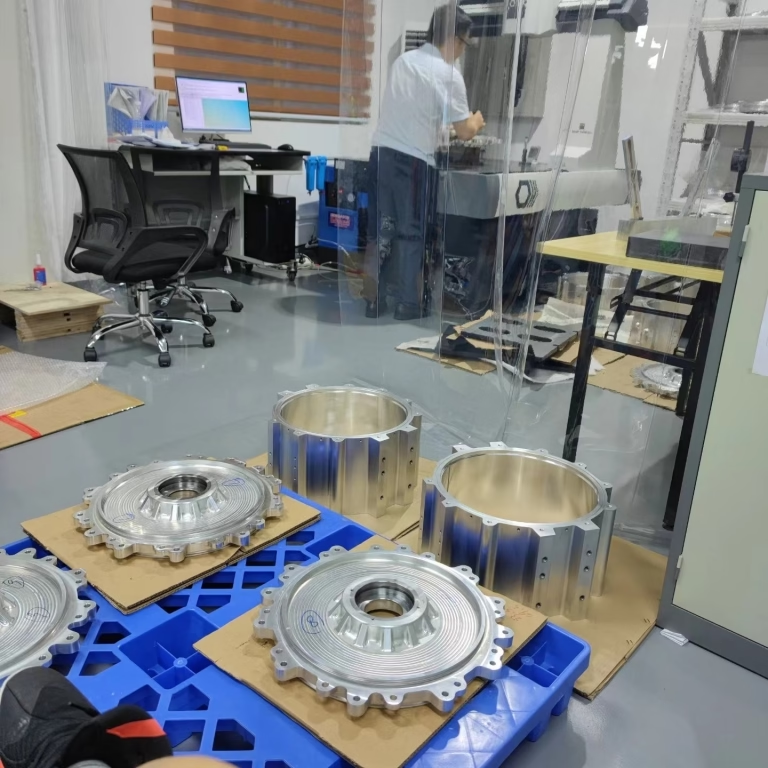
What Makes a CNC Quote Cheap
Price is a result, not a lever. Change the process and the number moves.
Setup Count Is the First Cost Driver
A machined part is not priced by material alone. Every time a part leaves the vise, someone re-dials the datum, re-probes, and re-cuts the fixture. That is a setup. Ten setups on a 50-piece order usually costs more than the aluminium. Suppliers that quote cheap custom CNC machining well look at the drawing and count setups before they count anything else.
One operation on a 5-axis center replaces three or four operations spread across 3-axis machines. Fewer setups means less handling, less scrap from re-clamping, and shorter queue time. On a bracket with features on five faces, moving from a 3-axis route to a single 5-axis cycle often drops the machining portion of the quote by a third or more.
The trade-off is real. A 5-axis cycle needs a machine that costs more per hour, and simple parts do not benefit. A flat plate with holes on one face is cheaper on a 3-axis mill every time. The rule we use: if the part has features on three or more faces, or a tolerance that depends on one datum, 5-axis is usually the cheaper route even at a higher hourly rate.
Cycle Time, Tooling, and Material Choice
Cycle time is where cheap quotes are won and lost. A supplier running modern spindles with high-feed toolpaths removes metal faster than an old machine taking light passes. That difference shows up directly in your unit price. GreatLight runs 127 high-precision CNC machines, including 16 simultaneous 5-axis centers, 12 four-axis mills, 27 three-axis machines, and 16 mill-turn centers. Mill-turn matters for shaft-type parts: turning and milling in one cycle removes a second setup and a second queue.
Material choice moves the number too. Aluminium 6061 cuts fast and is the default for prototypes and low-volume brackets. Stainless 304 and 17-4PH cut slower, wear tools faster, and often need more finishing passes. Titanium TC4 and Inconel cut slowest of all and are reserved for parts that genuinely need the properties. If a design can use 6061 instead of 7075 and still pass the load case, the quote usually drops noticeably.
Tooling is a smaller line but not a zero. Deep pockets, thin walls, and tight internal corners force small-diameter tools and slow feed rates. A 2 mm end mill cannot clear material the way a 12 mm cutter does. Redesigning a 2 mm corner radius to 3 mm can cut cycle time on a pocket by a large margin. This is exactly the kind of change our DFM review flags before the part is programmed.
Inspection Is Not Overhead You Can Skip
The most expensive CNC part is the one that fails at assembly. Scrap, rework, and expedited replacements cost far more than the original quote. That is why a serious shop builds inspection into the process instead of checking at the end. GreatLight checks raw material on arrival, monitors dimensions in process, and inspects 100% of parts before shipment, with reports available on request. Our qualification rate is 99.99%.
Tolerance is part of this. We hold ±0.005 mm (±0.0002 in) where the drawing calls for it. Not every feature needs that. A mounting hole at ±0.1 mm and a bearing bore at ±0.005 mm live on the same part all the time. Telling your supplier which features are critical lets them spend inspection time where it counts and machine the rest at a normal tolerance.
Surface finish follows the same logic. As-machined at Ra 1.6–3.2 μm costs nothing extra. Ra 0.8–1.6 μm needs a finishing pass or bead blasting. Ra 0.2–0.8 μm needs controlled parameters and often a separate operation. Specifying Ra 0.4 μm on a face that only needs to look clean adds cost with no functional gain.
What Moves the Price on a CNC Quote
Typical direction of each line item on a machined part.
| Cost item | Cheaper when | More expensive when |
|---|---|---|
| Setup count | One 5-axis cycle covers all faces | Four or more separate operations |
| Cycle time | Aluminium 6061, open geometry | Titanium TC4, deep pockets |
| Tooling | Corner radii 3 mm or larger | 2 mm internal corners, thin walls |
| Tolerance | ±0.1 mm on non-critical features | ±0.005 mm across all features |
| Surface finish | As-machined, Ra 1.6–3.2 μm | Polished, Ra 0.2–0.8 μm |
| Post-processing | Bead blasting only | Hardcoat anodizing plus laser marking |
| Inspection | Sampled check on loose tolerance | Full CMM report on every part |
| Order quantity | 10,000+ part runs | One-off prototype with new fixture |
Vendor Overhead: What One Shop Can Cover
Splitting a job across three suppliers adds freight, coordination, and re-qualification time. Machining at one shop, anodizing at another, and laser marking at a third means three purchase orders and three delivery windows. Keeping the chain short is one of the simplest ways to lower total cost. GreatLight handles CNC milling and turning, sheet metal, die casting, vacuum casting, 3D printing, and surface finishing in house.
The finish list is broad: clear, colour, hardcoat, and conductive anodizing; electroless nickel, zinc, silver, and gold plating; powder coating and black oxide; bead blasting, tumbling, brushing, and polishing; laser marking and engraving down to 1.5 mm character height. When one shop can do all of it, there is no re-packing and no second incoming inspection.
Order size flexibility also removes cost. We have no minimum order quantity, so a single prototype and a 10,000+ part run both go through the same process. Prototype pricing is naturally higher per piece because the setup is not amortised, but the same fixture and program carry into production, which keeps the ramp cheap.
Lead Time and Late Delivery Risk
Slow delivery is expensive. A part that arrives two weeks late can idle a production line and force air freight, and neither shows up in the unit price. We quote and return a free DFM analysis within 12 hours, start production within 24 hours, and ship parts in 3–5 days. Our historical late-delivery probability is below 2%.
That schedule depends on a clean drawing package. STEP files, 2D drawings with tolerance call-outs, material, finish, and quantity are the minimum. Missing call-outs force a clarification round, and that delay is on the clock. GreatLight works in aerospace, automotive and EV, medical devices, robotics and automation, electronics, industrial machinery, and new energy, so the drawings we see are usually complete.
Confidentiality is part of the schedule too. Uploads are secure and confidential, and an NDA is available on request. Buyers sending new product designs often ask for one before releasing files. We sign it before any drawing is opened.
Questions Engineers Ask About Cheap Custom CNC Machining
Can a cheap custom CNC machining quote still hold ±0.005 mm?
Yes, if the tolerance is applied where it is needed. We hold ±0.005 mm (±0.0002 in) on critical features and machine the rest at normal tolerance. A blanket tolerance call-out on every dimension forces extra passes and extra inspection on features that do not need it, and that raises the price.
Send a drawing with the critical dimensions marked. We will tell you which ones drive the cost and which ones can be relaxed.
What is the minimum order quantity?
There is no minimum order quantity. We run from one prototype to 10,000+ part runs on the same equipment and the same fixtures.
Per-piece cost is highest on a one-off because setup and programming are not spread over many parts. Once the program and fixture exist, the same route carries into production with a lower unit price.
How fast can you quote and ship?
Quotation and free DFM analysis come back within 12 hours. Production can start within 24 hours, and parts ship in 3–5 days.
Our historical late-delivery probability is below 2%. The clock starts when the drawing package is complete: STEP file, 2D drawing with tolerance call-outs, material, finish, and quantity.
Which materials keep the price low?
Aluminium 6061 and 6061-T6 are the cheapest common choices because they cut fast and hold a good finish. Plastics like ABS, POM, and PC are also inexpensive to machine.
Stainless 304, 17-4PH, titanium TC4, and Inconel raise the price because they cut slower and wear tooling faster. Use them when the part actually needs corrosion resistance, strength, or heat resistance.
Can you handle finishing and assembly so I do not need other vendors?
Yes. Anodizing, plating, powder coating, black oxide, bead blasting, tumbling, brushing, polishing, and laser marking are all done in house, along with CNC milling and turning, sheet metal fabrication, die casting, vacuum casting, and 3D printing.
One supplier means one purchase order, one delivery window, and no re-packing between operations.
How do you protect my design files?
Uploads are secure and confidential, and an NDA is available on request. We sign it before any drawing is opened.
GreatLight holds ISO 27001:2022 for information security, alongside ISO 9001:2015, IATF 16949:2016, and ISO 13485:2016.
Send a Drawing, Get a Number You Can Work With
Upload your STEP file and 2D drawing. You get a quote and a free DFM analysis within 12 hours, with the cost drivers marked.
12-hour quoteNo minimum order quantity100% inspectionNDA on request









