
Custom CNC Machining Services in SLO: How to Choose a Shop
A practical buyer guide for engineers and sourcing staff around San Luis Obispo. It covers the seven checks that separate a shop you can scale with from one that stalls at the second order.
In this article
- 1
- 2
- 3
- 4
- 5
- 6
- 7
- 8
- 9
Key takeaways
What to verify before you place a PO
Seven checks, the usual answer, and the failure mode when a shop gets it wrong.
| Check | What good looks like | If it is weak |
|---|---|---|
| Tolerance | ±0.005 mm (±0.0002 in) on critical features | Datum stack-up found at first article |
| Machine mix | 5-axis, 4-axis, 3-axis and mill-turn under one roof | Part re-quoted or subcontracted mid-run |
| Max part size | Up to 4,000 mm on the long travel | Oversize parts split into weldments |
| MOQ | One prototype up to 10,000+ part runs | You pay setup twice for a bridge order |
| Lead time | Quote in 12 hours, parts in 3–5 days | Schedule slips with no early warning |
| Certifications | ISO 9001, IATF 16949, ISO 13485, ISO 27001 | Audit evidence missing late in the program |
| Inspection | 100% before shipment, reports on request | Escape found at your assembly line |
Pick the shop that can hold the process, not just the price
For prototypes and low-volume runs, choose on quote turnaround and DFM feedback. For anything heading to production, choose on machine mix, tolerance control, and document pack. GreatLight covers both with one process from one prototype to 10,000+ parts.
Why custom CNC machining services in SLO get sourced outside the county
San Luis Obispo County runs on a mix of aerospace suppliers, medical device developers, agritech hardware, and a growing cluster of robotics and EV work. Most of these teams are small. A design group of six people may need twenty machined housings in March and two hundred in September, with no machine shop on staff and no room to warehouse parts.
That pattern shapes how custom CNC machining services in SLO are actually bought. The order is rarely a single large release. It is a prototype, then a pilot build, then a production step, each with the same drawing revision and the same surface finish callout. A shop that cannot hold the same process across all three stages forces a new first article every time.
Local capacity in the area is real but narrow. Shops tend to specialize: one does turning, another does sheet metal, a third handles plastics. When a part needs milling on five faces, an anodize, and a laser mark, the work crosses two or three vendors and the tolerance stack grows at every handoff.
So the sourcing question is not only price. It is whether one supplier can hold a tolerance, a finish, and a delivery rhythm across the whole build ramp. That is what the rest of this guide tests.
The tolerance question: what the drawing actually demands
Start with the features that matter. A bracket with three clearance holes does not need ±0.005 mm. A manifold face that seals against an O-ring does. When a shop quotes a single tight tolerance across the whole part, it is either padding the price or has not looked closely at the print.
Ask which features drive the tight callout and how they will be measured. A CMM report on a bore position is useful. A caliper reading across an outside dimension tells you very little about true position. GreatLight works to ±0.005 mm (±0.0002 in) on critical features, and finish can be held at Ra 0.2–0.8 μm where a sealing or sliding surface needs it.
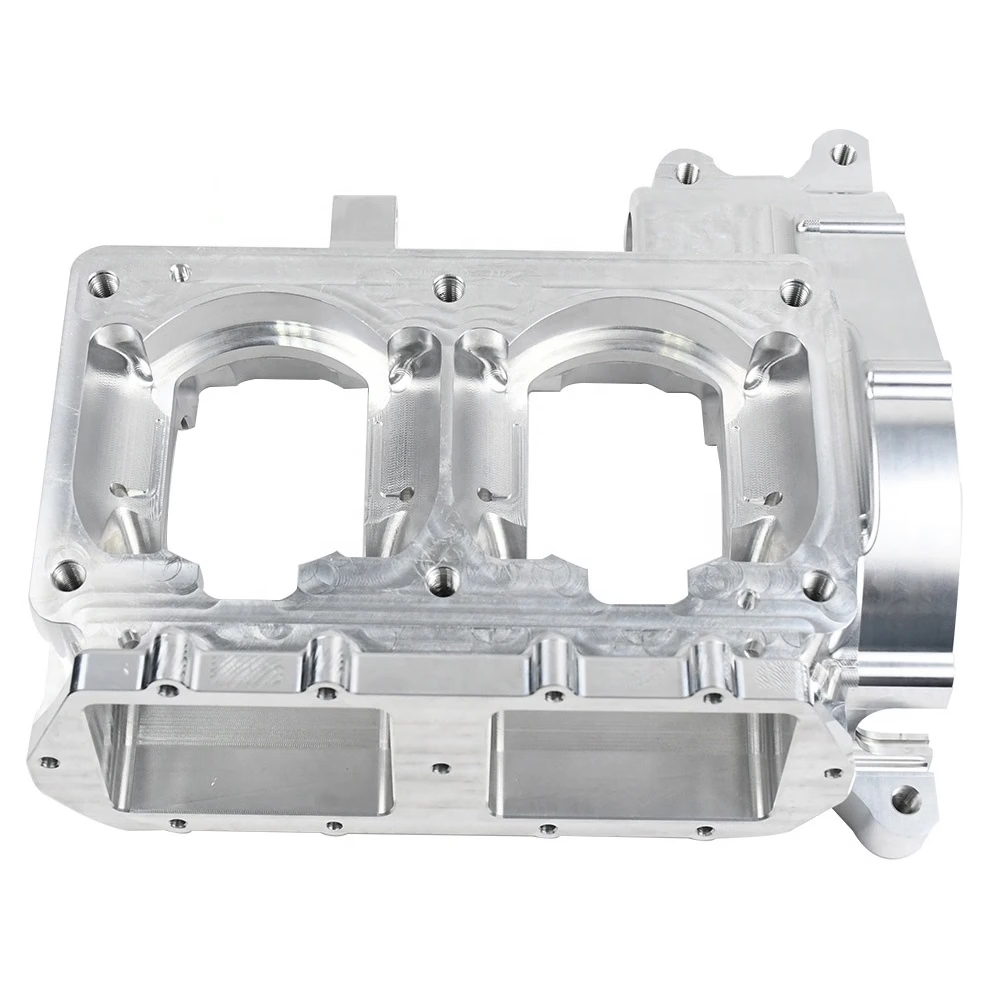
The harder question is stack-up. If a part is machined in three setups, each setup adds a datum shift. On a 5-axis machine the same part can often be finished in one setup, which removes that shift entirely. This is the main reason tight-tolerance geometry moves to 5-axis work.
Do not accept a blanket tolerance note. Send the drawing, flag the critical dimensions, and ask for a DFM note on each one. A shop that returns comments within a day is reading the part, not just counting hours.
Machine mix and part size: the capacity check
A shop's machine list tells you what it can do without a subcontract. GreatLight runs 127 high-precision CNC machines: 16 simultaneous 5-axis machining centers, 12 four-axis mills, 27 three-axis machines, and 16 mill-turn centers. That spread matters because not every part should go on a 5-axis machine. Simple round work runs faster and cheaper on a lathe.
Size range matters too. Travel options include 4,000 × 400 × 150 mm for long parts, 750 × 1,150 × 550 mm and 600 × 600 × 600 mm for mid-size work, and 500 × 500 × 450 mm plus 500 × 310 × 200 mm for compact parts. A Ø400 mm rotary table handles round features that would otherwise need a second machine.
When you audit a supplier, ask for the largest part they machined in the last six months and how it was held. The answer reveals whether they have real fixturing experience or just a large machine sitting idle. Long parts are a fixturing problem before they are a spindle problem.
If your part is 600 mm long with a tight bore at each end, a shop with only compact 3-axis machines will quote it as two parts and a press fit. That is a design change disguised as a quote.
Materials, finishes, and where the cost hides
Material choice drives both price and risk. Aluminum 6061 and 7075 machine cleanly and hold tight tolerances. 316L stainless and 17-4PH are tougher on tooling but common in medical and marine work. Titanium TC4 (Ti-6Al-4V) and Inconel cut slowly and wear tools, so cycle time rises. None of this is a surprise, but the quote should show it.
Finishes are where budgets quietly move. Anodizing is priced by surface area and rack space, not by part count. Hardcoat anodize costs more than clear. Electroless nickel and gold plating add masking steps if part of the surface must stay conductive. Bead blasting before anodize changes the color slightly, which matters on cosmetic panels.
Laser marking has a practical floor: minimum character height 1.5 mm. If your part number or traceability code is smaller than that, the mark will be unreadable and the drawing needs to change before the run starts, not after.
Ask for a finish sample before the production order if the part is visible to an end user. A photo of a previous part in the same finish is enough. Color matching by description alone is a reliable way to reject a lot.
Certifications, documentation, and confidentiality
Certifications answer a narrow question: which industries has this shop already been audited for? ISO 9001:2015 covers general quality systems. IATF 16949:2016 is the automotive and EV standard. ISO 13485:2016 is for medical devices. ISO 27001:2022 covers information security, which matters if you are sending CAD files to an overseas supplier.
Do not treat a certificate as a quality guarantee. Treat it as evidence that a process exists and has been reviewed. Then ask for the inspection routine behind it. GreatLight inspects 100% of parts before shipment, with raw material checks, in-process monitoring, and final inspection, and can supply reports on request.
Confidentiality is the other half. If your design is patentable or under NDA with your own customer, the supplier's file handling matters as much as the machining. Uploads are kept secure and confidential, and an NDA is available on request before drawings change hands.
For medical and automotive programs, ask early which documents come with the shipment. A first article report, material certs, and a finish certificate are normal. If a shop cannot say what its standard document pack contains, that is a gap you will feel at the audit.
Lead time, MOQ, and the quote you should expect
Lead time promises are easy to make and hard to verify. What you can verify is the quote turnaround and the production start. A quotation with a free DFM analysis within 12 hours tells you the shop read the file. Production can start within 24 hours once the order is released, and parts ship in 3–5 days for standard work.
MOQ is the check most teams forget until the second order. If a shop has a 500-piece minimum, your 20-piece pilot becomes a warehousing problem. No minimum order quantity means the same supplier can run one prototype and a 10,000+ part production batch without a re-quote that changes the process.
When the quote arrives, read the line items. Material should be separate from machine time. Finish should be separate from inspection. Setup should be visible, not folded into a unit price. A quote with four lines can be argued with. A quote with one number cannot.
Watch for these traps: a tolerance stated only as a general note, a finish named without a Ra value, a lead time given without a start date, and a price that assumes a material grade nobody confirmed.
Seven steps to qualify a machining supplier
Run these in order. Each one can stop the process before money is committed.
- 1Send the drawing with critical features flaggedMark true-position and sealing dimensions yourself. Ask for a DFM note on each within one business day.
- 2Ask for the machine that will run the partGet the model and axis count. A 5-face part quoted on a 3-axis machine will need extra setups.
- 3Confirm the tolerance on those featuresTie ±0.005 mm (±0.0002 in) to specific dimensions, not a general note. Ask how each is measured.
- 4Check the largest similar part they have runCompare it to your envelope. Travel up to 4,000 mm covers long parts, but fixturing is the real limit.
- 5Settle finish and marking before quotingName the finish and Ra range. Laser marking needs characters at least 1.5 mm tall to stay readable.
- 6Fix the MOQ and the ramp planConfirm the shop can go from one prototype to a 10,000+ part run without changing the process.
- 7Agree the document pack and NDAList what ships with the parts: inspection report, material certs, finish certs. Sign the NDA first if needed.
Questions buyers ask before the first order
How do I know if my part needs 5-axis machining?
Count the faces that need work and the number of setups a 3-axis machine would need. If the answer is three or more, or if two tight features sit on different faces, 5-axis work is usually cheaper once you count refixturing and scrap.
Parts with compound angles, deep pockets on multiple sides, or a tight true-position callout between features are the clearest cases.
What should the first quote include?
Material, machine time, setup, finish, and inspection as separate lines. The tolerance should be tied to specific features, and the finish should carry an Ra value rather than a name alone.
If the quote is a single number, ask for the breakdown before you compare it with anyone else.
Is there a minimum order quantity?
At GreatLight there is no minimum order quantity. The same process covers one prototype and a 10,000+ part production run.
That matters most at the pilot stage, when a design change is still likely and a large first order would lock in the wrong revision.
Which certifications should a supplier hold?
It depends on your industry. ISO 9001:2015 is the baseline. Automotive and EV programs usually want IATF 16949:2016. Medical work calls for ISO 13485:2016, and ISO 27001:2022 covers file security.
GreatLight holds all four. Still ask what document pack ships with the parts, because a certificate does not tell you what arrives in the box.
How fast can parts ship?
Quotation and free DFM analysis come back within 12 hours. Production can start within 24 hours of release, and standard parts ship in 3–5 days.
Complex geometry, exotic material, or a multi-step finish adds time. Ask for the schedule in writing at the quote stage rather than after the PO.
How are my designs protected?
Uploads are kept secure and confidential, and an NDA is available on request before files are exchanged.
If your design is under NDA with your own customer, say so at first contact so the file handling matches your obligation.
Send your drawing and get a DFM review in 12 hours
Upload the file, flag the critical features, and we will return a quote with a free DFM analysis. No minimum order quantity, and your files stay confidential.
12-hour quoteFree DFM analysisNo MOQ100% inspection before shipment
More machining notes
We publish setup notes, tooling trials and inspection data from the factory floor.











