
Do You Need Exp to Run a CNC Machine?
Short answer: you can run a loaded machine with days of training. Setting up a job, proving a program, and holding ±0.005 mm takes years. This page separates the two so you can judge a job, a hire, or your own next step.
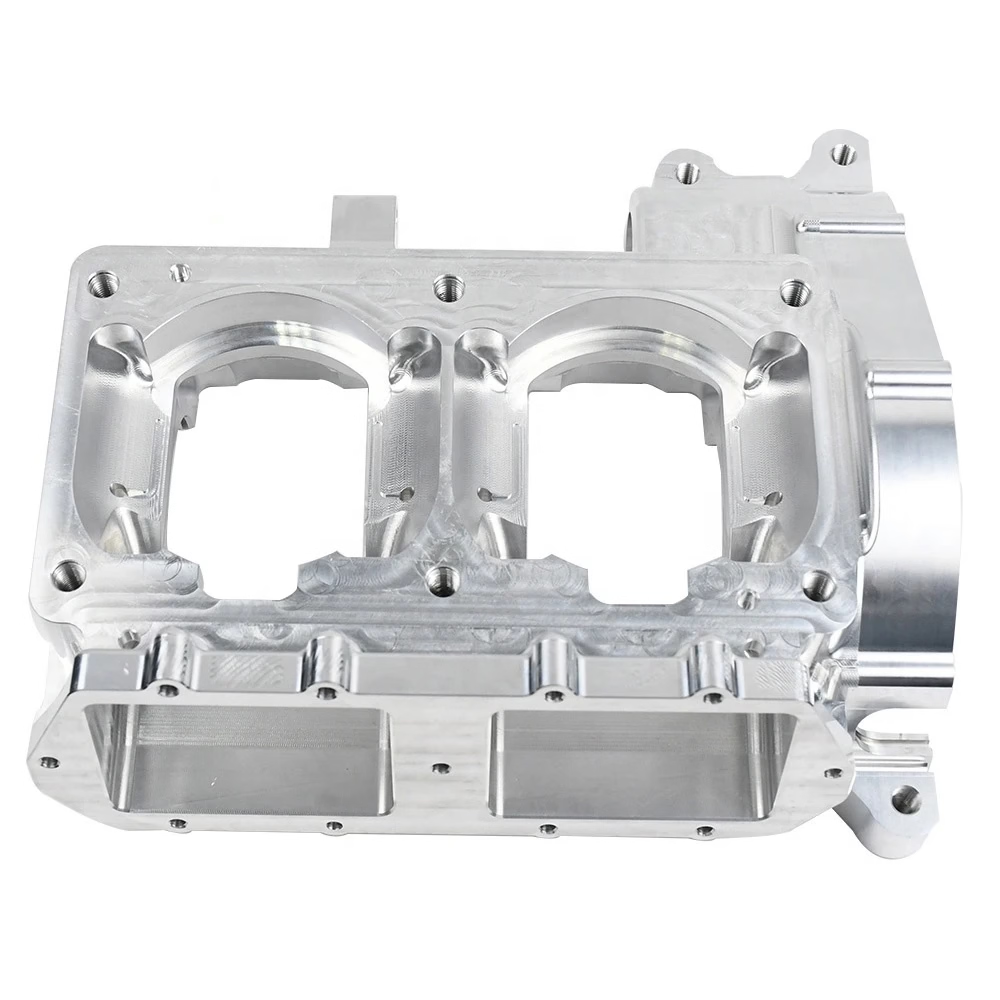
What "run a CNC machine" actually covers
People use one phrase for four different jobs. The first is operation: load the part, close the door, press cycle start, swap parts when the cycle ends, check a few dimensions with calipers. That job is learned on the floor in a few days. The machine already has a proven program and a proven setup.
The second is setup. Someone has to mount the vise or fixture, indicate it true, touch off tools, set work offsets, load the program, and dry-run it with the rapid and feed overrides down. This is where experience shows. A wrong offset at 8,000 rpm ends in a broken tool or a scrapped casting, not a warning message.
The third is programming and proving. The programmer decides toolpath, stepover, chipload, tool engagement, and workholding before any metal moves. Then they prove the program on the machine, listening for chatter and watching load meters. On a 5-axis job with a Ø400 mm rotary table, a wrong post-processor setting can drive a tool straight into the fixture.
The fourth is process ownership. That person decides feeds and speeds for a new material, chooses the insert grade, sets the inspection plan, and signs off the first article. When someone asks whether you need experience to run a CNC machine, they usually mean this fourth layer, even when they describe the first.
So the honest answer is layered. Operating: no real barrier. Setup: months to a few years. Programming and process ownership: three to five years of varied work, and it never really stops. The rest of this page explains where each line falls and how to tell which job you are looking at.
What a beginner can safely run
A new operator can run a machine that is already set up, with a proven program, on a part family they have seen before. Think simple 3-axis milling of a flat bracket, or turning a shaft with one diameter and one thread. Cycle time is stable, tolerances sit at ±0.05 mm or looser, and the fixture is a standard vise.
The skills that matter here are attention and discipline, not machining theory. Check the part matches the drawing before you start. Keep the tool list in order. Stop the cycle when the sound changes. Record dimensions on the inspection sheet at the intervals the setup sheet states. Know where the e-stop is and how to use feed hold.
What a beginner should not do alone: change a work offset, swap a tool without a tool setter, edit a program at the control, or restart a cycle after an alarm without understanding the alarm. Each of those can move the toolpath in a way the operator cannot see coming.
A useful test before letting someone run a machine alone is simple. Ask them to explain what the program is about to do, in order, before they press cycle start. If they can describe the tool changes and the cutting moves, they understand enough to operate. If they cannot, they are guessing.
Where experience becomes mandatory
Tight tolerance is the first wall. Holding ±0.005 mm on a production part means controlling thermal growth, tool wear, and fixture deflection. A machine may drift 0.01 mm over a long run as the spindle and ball screws warm up. An experienced machinist compensates before the parts go out of tolerance, not after.
The second wall is workholding. Thin walls, tall parts, and anything with interrupted cuts need support that a standard vise cannot give. Soft jaws bored to the part, vacuum plates, or a custom fixture are normal answers. Choose the wrong one and the part rings, moves, or deforms during clamping.
The third wall is 5-axis. Simultaneous 5-axis work adds rotary axes, tool length offsets, and post-processor behavior to the problem. A 16-machine 5-axis shop still assigns those jobs to people with years of setup time behind them, because the failure mode is a crash rather than a bad finish.
The fourth wall is material. Aluminum 6061 and 7075 cut cleanly and forgive small errors. Inconel, titanium TC4, and 17-4PH stainless do not. They work-harden, pull heat into the tool, and eat inserts if the chipload is too light. Knowing which way to move the feed on a hard material is pure experience.
How people actually get the experience
Formal courses teach the vocabulary: G-code, coordinate systems, cutter compensation, feeds and speeds. That is useful and it is fast. But a classroom cannot teach the sound of a tool about to break, or the feel of a part that moved in the vise. Those come from hours at the machine.
The usual path starts with deburring and inspection, then moves to operating a loaded machine. From there it goes to setting up simple jobs under supervision, then to first articles, then to programming. Each step adds a failure mode the person has already seen once.
Structured on-the-job training works because it sequences those failures. A good shop lets a trainee set offsets and check the result with an indicator before pressing start. The cost of that check is two minutes. The cost of skipping it is a tool, a fixture, or a batch.
How long it takes depends on variety, not years alone. Someone who runs one part number for five years has five years of one experience. Someone who sets up 40 different parts in two years has seen far more failure modes. When you hire or train, count setups, not tenure.
What this means when you buy machined parts
If you are sourcing parts rather than running them, the same split applies to your supplier. A shop can have 127 machines and still need the right person on the right job. Ask who sets up your part and who signs the first article. That answer tells you more than a machine list.
For prototypes and low-volume work, the risk is concentrated in setup. One part, one fixture, one prove-out. A shop that quotes fast but cannot show a first-article report is asking you to absorb that risk. At GreatLight, quotation and free DFM analysis come back within 12 hours, and production can start within 24 hours.
Materials and finishes narrow the field too. Aluminum and brass are forgiving. Titanium, Inconel, and 17-4PH need a shop that runs them often. If your part needs anodizing, electroless nickel, or bead blasting, the finishing route has its own setup and its own first-article check.
Volume changes the question again. There is no minimum order quantity here, so a single prototype and a 10,000-part run go through the same plant. The prototype proves the process. The run proves the process holds. Both need experience, just in different places.
Which jobs need which level of experience
Match the job on the left to the lowest skill level that can run it safely.
| Job type | Operator level | Setup level | Why |
|---|---|---|---|
| 3-axis run, proven program | Days | Not needed | Cycle is stable, tolerances loose |
| First article on 3-axis | Not alone | Months | Offsets and inspection decide pass or fail |
| 4-axis with indexer | Weeks | 1-2 years | Rotary offset errors scrap the batch |
| Simultaneous 5-axis | Not alone | 3+ years | Crash risk, post-processor issues |
| Thin-wall or tall part | Not alone | Years | Deflection and chatter control |
| Inconel or titanium run | Not alone | Years | Tool life and heat management |
| Production run, tight tolerance | Supervised | Years | Thermal drift and wear compensation |
The verdict
If the job is operating a loaded machine on a proven program, hire for care and train for days. If the job is setup, first article, or 5-axis work, buy experience. There is no shortcut at that layer.
Questions engineers ask next
Can I learn to run a CNC machine at home?
Yes, for the operation layer. A benchtop mill or a small lathe with a control lets you load programs, touch off tools, and cut parts. The limits show up fast on workholding and tolerance.
What home machines do not give you is a production environment, where thermal drift, tool wear, and inspection plans are part of the job. Treat it as a starting point, not a substitute for shop time.
Does a machinist need a formal certificate?
Most shops do not require one. They test instead: set up this vise, indicate it, touch off these tools, and prove this program. A certificate gets you an interview. The test gets you the job.
Certifications help when you move into quality or regulated work, where documented training records matter for ISO 9001:2015 or IATF 16949:2016 audits.
How long before someone can set up a job alone?
For simple 3-axis work in aluminum, six to twelve months of regular setup time is realistic. For tight-tolerance parts, thin walls, or hard materials, plan on two to three years.
The variable is how many different setups the person has done. Forty varied setups teach more than one part number repeated for two years.
Can a 5-axis machine be run by a beginner?
Not alone. A beginner can load and unload parts while the machine runs a proven program, but the setup, offsets, and prove-out need someone with years of experience.
The reason is the failure mode. In 3-axis work a bad offset usually means a scrapped part. With rotary axes and a Ø400 mm table, it can mean a crash into the fixture.
Does experience matter more than the machine?
On most jobs, yes. A good machinist on a mid-range 3-axis machine will beat a weak machinist on a 5-axis center, because setup and process control decide the result.
Machine capability sets the ceiling. Experience decides whether you reach it. That is why shops pair new equipment with senior people rather than handing over the keys.
What tolerance can a beginner realistically hold?
With a proven setup and a stable program, ±0.05 mm is a fair target for a new operator using calipers and micrometers at set intervals.
Below that, you need in-process checks, thermal awareness, and tool wear tracking. That is setup-level work, not operation-level work.
Send us the drawing, we will tell you what it needs
Upload your CAD file and get a quotation plus free DFM analysis within 12 hours. No minimum order quantity, from one prototype to 10,000+ parts.
12-hour quoteNo MOQ100% inspection
More from the shop floor
We publish setup notes, tooling trials and inspection data from the factory floor.











