
Five-Axis Machine Tools Are Expensive: What You Actually Buy
Five-axis machine tools are expensive, and everyone knows that. The question worth answering is what you actually get for the extra money. This page breaks down the real return: how two rotary axes change setup count, datum stack-up, tool reach, and surface finish. Read it before you quote a part or approve a new machine.
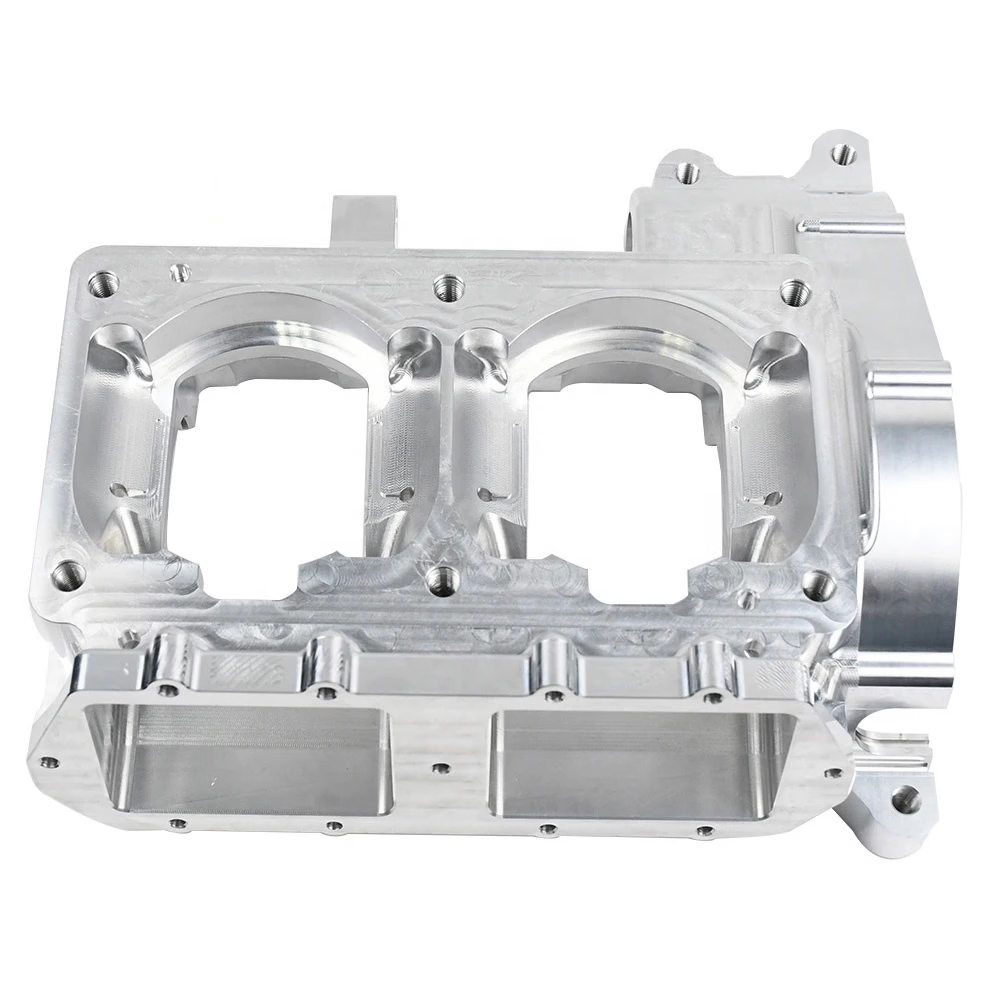
What you actually buy when five-axis machine tools are expensive
A three-axis mill moves the part in X, Y, and Z. The tool always comes down from one direction. A five-axis machine adds two rotary axes, so the tool can tilt and the part can rotate. That sounds like a small change. It is not. The extra two axes let you present a different face of the part to the cutter without unclamping it.
The return is not speed. It is the removal of repositioning. Every time you unclamp a part to reach a new face, you lose the datum and you add a setup error. On a bracket with four machined faces, three setups can stack 0.03 mm of position error before a single cut is measured.
One setup removes that stack. The rotary table holds the part, the control rotates it to the next face, and the same zero carries through. For a buyer, this is the whole argument: you are not paying for a faster spindle, you are paying to stop moving the part.
How the two rotary axes change the cut
Most five-axis centers in our shop are trunnion or table-table designs. The C axis spins the part around Z, and the A axis tilts it. A Ø400 mm rotary table handles a wide range of brackets, housings, and impellers without a special fixture.
Tilting the tool or the part lets a short, stiff cutter reach a wall that a long end mill would have to approach from far away. Stiffness matters more than length. A 12 mm end mill at 60 mm of stickout will chatter; the same cutter at 30 mm, with the table tilted 45°, will not.
The third effect is on finish. When the tool axis stays normal to a curved surface, the scallop height between passes drops. That is how a single cycle produces Ra 0.8–1.6 µm on a contoured face instead of leaving witness lines for a second operation.
Where the return stops: limits and trade-offs
Five-axis is not automatically better. A flat plate with two drilled faces should stay on a three-axis machine. The hourly rate is lower, the setup is one vise, and the tolerance is easy. Moving that part to a rotary table adds cost with no measurable gain.
Rotary axes also cost rigidity. A trunnion table hangs the part out on a bearing set, so heavy cuts on a large block may favor a three-axis machine with the part clamped flat on the bed. If your part is 500 mm across and made of 4140, check the table load before you assume five-axis.
Programming time is real. A five-axis toolpath needs collision checks and post-processor tuning. For a one-off prototype, that can add hours. For a 500-piece run, the same program amortizes to almost nothing. Volume decides.
How we judge a part before quoting five-axis
We look at the drawing first, not the machine list. Count the machined faces and the angles between them. If two or more faces need better than ±0.05 mm relative to each other, that points to a single setup.
Next, look at reach. If the pocket is deeper than three times the cutter diameter, a tilted approach will help. Then check the wall thickness. Thin ribs and 0.5 mm walls often distort under vise pressure, and a rotary table with light clamping solves that.
Finally, match the machine to the envelope. Our five-axis centers cover 500 × 500 × 450 mm and 500 × 310 × 200 mm travels, plus a Ø400 mm rotary table. Larger parts up to 4,000 mm go on our large-travel machines, where the process plan changes.
We send a DFM note with the quote, usually within 12 hours. If three-axis is the cheaper path for your part, we say so. That answer costs us a sale and saves you money, which is why buyers come back.
When five-axis machine tools are expensive and still worth it
Match the part to the process, not the other way around.
| Part feature | 3-axis | 5-axis |
|---|---|---|
| Faces on 5+ sides | 3–6 setups, stacked error | 1 setup, one datum |
| Deep pocket, short tool | Long tool, chatter risk | Tilted tool, stiff reach |
| Sculpted surface | Ball nose lines, hand blend | Tool normal, Ra 0.8–1.6 µm |
| 0.5 mm wall, thin rib | Fixture pressure distorts | Rotary support, less clamping |
| Simple plate, 2 faces | Lower hourly rate wins | Extra cost, no gain |
| ±0.005 mm true position | Setup stack eats the budget | Single datum holds it |
The verdict
If your part has three or more machined faces with tight relative position, five-axis wins on total cost. If it is a flat plate with two faces, stay on three-axis and spend the savings elsewhere.
Common questions
Does five-axis always hold tighter tolerance?
No. The machine can hold ±0.005 mm, but the gain over three-axis comes from removing setup stack-up, not from a better spindle. If your part needs only one setup on a three-axis machine, the tolerance result may be the same.
Can five-axis cut a part that three-axis cannot?
Yes, in two cases: features that sit on many faces at compound angles, and contoured surfaces where the tool must stay normal to the surface. Impellers, turbine blades, and some medical implants fall into that group.
Is programming harder?
It takes longer. Five-axis toolpaths need collision checks and a tuned post-processor. For a single prototype that cost is visible; for a 500-piece run it spreads across the batch and stops mattering.
What size parts can you run?
Our five-axis centers cover 500 × 500 × 450 mm and 500 × 310 × 200 mm travels with a Ø400 mm rotary table. Larger work up to 4,000 mm runs on our large-travel machines with a different setup plan.
Do you charge more for five-axis time?
The hourly rate is higher, so we compare total cost, not rate. If five-axis saves two setups and one secondary operation, the part often lands cheaper overall. We show both paths in the quote.
How do you keep dimensions stable across a run?
One datum, in-process monitoring, and a final inspection before shipment. Reports are available on request. We inspect 100% of parts before they leave the shop.
Send the drawing, get a process plan
Upload your part and we will tell you whether five-axis or three-axis is the cheaper path, with a DFM note inside 12 hours.
12-hour quote100% inspectionNo minimum orderNDA on request
More from the shop floor
We publish setup notes, tooling trials and inspection data from the factory floor.











