
Fast Bulk 4 Axis CNC Machining Services
A working guide for engineers and buyers who need thousands of identical parts, not a one-off sample. It covers what a 4 axis machine can and cannot hold at volume, how to read a supplier's capacity claims, and which checks decide whether a run ships on time or turns into scrap.
In this article
- 1
- 2
- 3
- 4
- 5
- 6
- 7
- 8
Key takeaways
What to compare before you commit a bulk run
Read each row as a pass or fail question for your supplier.
| Criterion | What good looks like | Red flag |
|---|---|---|
| Rotary axis setup | Dedicated 4 axis cells for recurring parts | Shared mill, re-fixtured per lot |
| Fixture strategy | Soft jaws or tombstone, repeatable clamp | Vise per part, shimmed by hand |
| Tolerance control | In-process checks and trend charts | Final inspection only, no data |
| Parts per cycle | 2 to 8 identical parts per load | One part per cycle on a bulk order |
| Quote detail | Cycle time, setup, fixturing split out | Single lump-sum price |
| Order range | One prototype to 10,000+ parts, no MOQ | MOQ blocks the pilot run |
| Documentation | Material certs and inspection reports on request | Reports only after chasing |
When fast bulk 4 axis cnc machining fits a part
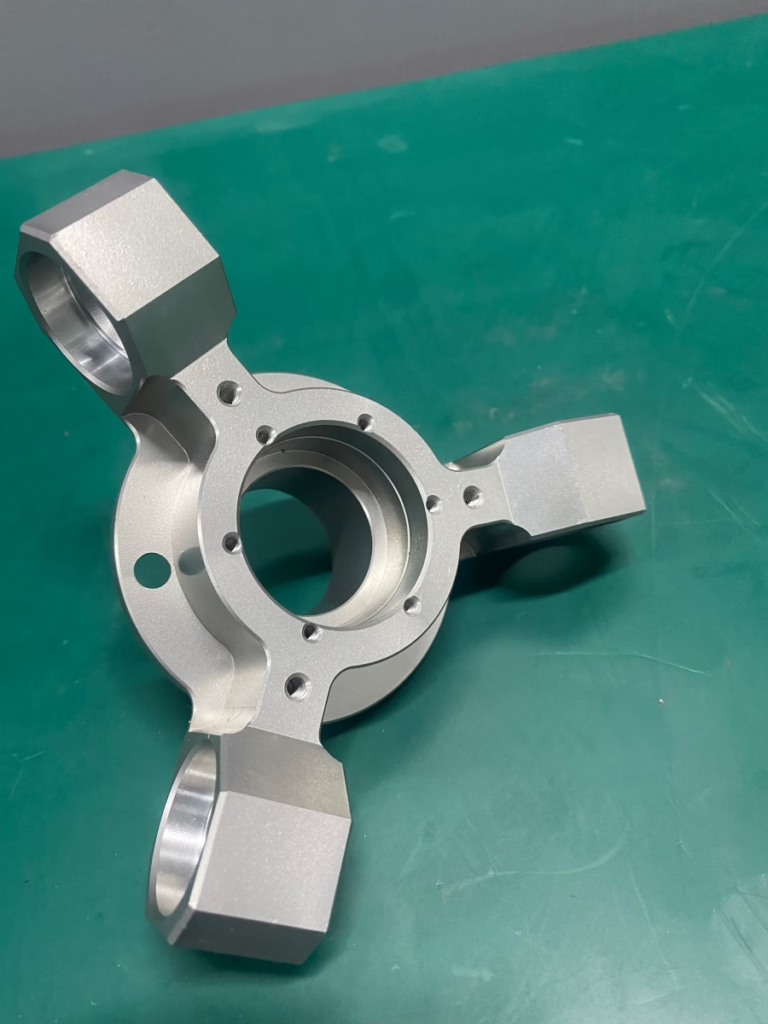
A 4 axis mill cuts on X, Y and Z while the workpiece rotates on a fourth axis, usually A (rotation about X) or B (about Y). That single rotary move is the whole point: the spindle reaches three, four or five faces of a part without a human unclamping it and flipping it. On a bracket with bores on two sides, that can remove two setups per part. Multiply by 5,000 parts and the saving is not marginal.
The geometry that benefits most is prismatic with features on multiple faces. Motor housings, manifolds, gearbox covers, sensor bodies, fixture plates with edge holes, and any part where hole patterns sit at 90° or 180° to each other. If the drawing has true position callouts on features in two or three planes, a 4 axis cell is usually the cheaper route than 3 axis with multiple ops.
It also fits parts that are too long or too heavy to flip by hand. With a Ø400 mm rotary table and travels up to 4,000 × 400 × 150 mm, a long extrusion or rail can be indexed around its own axis while the tool stays in one setup. That keeps the datum stable across every feature, which is what holds concentricity on a long part.
Where it stops making sense is sculpted surfaces and undercuts that need the tool tilted. Deep cavities with draft, impeller blades, and organic housings belong on a 5 axis machine. Forcing them onto 4 axis means long reach tools, chatter, and hand blending after machining.
- 1Good fitFeatures on 3 to 5 faces, mostly flat or cylindrical, moderate depth-to-diameter ratios.
- 2Poor fitFreeform surfaces, deep thin ribs, or features that need the tool axis tilted off normal.
- 3Rule of thumbIf a 3 axis run needs more than three setups, price the 4 axis option before you commit.
How to read a supplier's capacity for fast bulk 4 axis cnc machining
Machine count is the easiest number to quote and the least useful. Twelve 4 axis mills only matter if some of them are reserved for repeat production rather than pulled into every prototype job that comes through the door. Ask how many machines are dedicated to production cells, and how many hours per week those cells actually run.
Then ask about the machines themselves. A 4 axis mill with a 40-taper spindle and a 12,000 rpm spindle behave differently on aluminium versus 17-4PH. Travel matters too: a compact 500 × 500 × 450 mm machine cannot take a long rail regardless of how many axes it has. Match the part envelope to the machine before you discuss price.
Support equipment decides throughput more than the mills do. Presetters, tool cribs with duplicate holders, and a CMM near the cell keep a run moving. If the shop stops the spindle to measure a first article on a far-away CMM, your cycle time claim is fiction.
Finally, ask what happens when a tool breaks at 2 a.m. on an unattended run. A shop with tool life monitoring and a load monitor catches it in seconds. A shop without it discovers it in the morning with 300 scrap parts.
- 1Dedicated cellsAsk how many 4 axis machines stay on production work, not shared with prototype jobs.
- 2Spindle and travelMatch spindle taper and rpm to material, and machine envelope to part size.
- 3Metrology close byIn-process CMM or gauging at the cell beats a remote inspection room.
Holding ±0.005 mm across thousands of parts
A tolerance of ±0.005 mm (±0.0002 in) is achievable on a 4 axis mill, but it is a process capability question, not a machine spec. The machine has to be thermally stable, the fixture has to clamp the same way every cycle, and the cutting conditions have to be conservative enough that tool wear drifts slowly. On aluminium, that usually means finishing passes with light radial engagement and sharp, dedicated finishers.
Rotary axis accuracy deserves separate attention. A rotary table with backlash or a worn worm drive will throw angular position off, and on a part with features 200 mm from the centreline, one arc-minute of error becomes roughly 0.06 mm of linear error. That is 12 times the tolerance. Ask for the rotary table's positioning accuracy and repeatability, and how often it is checked.
Thermal drift is the silent killer on long runs. A spindle that grows 20 μm over four hours will walk the part out of tolerance even if the first article was perfect. Shops that run bulk work warm up spindles, keep coolant temperature controlled, and re-check a reference feature every few hours.
Surface finish is a separate spec. Ra 0.8–1.6 μm is a normal machined finish; Ra 0.2–0.8 μm needs finer steps and often a different tool. State the finish on the drawing with the tolerance, not in a separate email, because the two interact.
- 1Rotary accuracyAsk for positioning accuracy and repeatability of the fourth axis, not just the linear axes.
- 2Thermal controlSpindle warm-up cycles and controlled coolant temperature keep long runs in tolerance.
- 3Finish calloutPut Ra values on the drawing next to the tolerance zone they apply to.
Fixture and setup strategy that keeps cost per part down
On a bulk order, setup and fixturing are paid once and amortised across the lot, so a small extra cost up front usually pays back within a few hundred parts. A tombstone that holds four parts per cycle, or a set of matched soft jaws, can cut load and unload time from minutes to seconds. That is where fast bulk 4 axis cnc machining actually gets fast.
Ask how the shop handles the first operation. On a casting or a sawn blank, the first op establishes the datum that every later feature references. If that op is done in a plain vise with a shim, run-to-run variation creeps in and every downstream feature shifts with it. Purpose-built first-op jaws cost more to make and less to run.
Chip evacuation matters more on 4 axis than on 3 axis because the part rotates. Chips that fall into a cavity can be recut, and recut chips wreck surface finish and sometimes the tool. Through-spindle coolant or directed coolant lines are worth specifying on deep pockets.
For long runs, plan a spare fixture. If the primary tombstone is damaged mid-lot, the run stops while it is repaired. A duplicate fixture made at the same time as the first keeps the schedule intact, and it costs far less than a week of downtime.
- 1Amortise the fixtureSpend on multi-part tombstones and matched jaws when the lot is several hundred parts or more.
- 2Control the datumFirst op should use dedicated jaws, not a shimmed vise, so every later feature is stable.
- 3Chips rotate tooDirect coolant at the pocket floor on 4 axis work to avoid recutting chips.
Qualifying a supplier for fast bulk 4 axis cnc machining
Start with the quote. A lump-sum price tells you nothing about where the cost sits, so you cannot tell whether the shop plans a proper fixture or intends to hand-load each part. Ask for cycle time, setup time, fixture cost and material cost as separate lines. A supplier who can break it down that way has thought about the run.
Next, ask for the quality plan. On a bulk order you want in-process monitoring, not just a final inspection. That means first-article approval, periodic checks at defined intervals, and a record of the readings. GreatLight inspects 100% of parts before shipment, with raw material checks, in-process monitoring and final inspection, and reports on request.
Certifications are a filter, not a guarantee. ISO 9001:2015 covers general quality systems. IATF 16949:2016 matters if the parts go into automotive or EV assemblies. ISO 13485:2016 matters for medical devices. ISO 27001:2022 covers information security, which is relevant if your drawings are sensitive. Match the certificate to your industry, not to a marketing badge.
Finally, test the communication loop. Send a drawing with one ambiguous feature and see whether you get a DFM note back with a specific question. GreatLight returns a quotation and free DFM analysis within 12 hours, and production can start within 24 hours of approval. A supplier who spots the ambiguity before cutting metal is the one who will not scrap 500 parts over it.
- 1Itemised quoteCycle, setup, fixture and material priced separately so you can sanity-check the plan.
- 2Quality planAsk for the check interval, the gauge used, and how readings are recorded.
- 3Certificate fitMatch ISO 9001, IATF 16949, ISO 13485 or ISO 27001 to your actual industry requirement.
- 4DFM responseA specific question back on an ambiguous feature is a good sign, not a delay.
Seven steps to launch a bulk 4 axis run
Use this sequence from drawing to shipment.
- 1Classify the part geometryList every face that carries a tolerance. If three or more faces need machining and they sit at 90° to each other, 4 axis is the default. If freeform surfaces dominate, move to 5 axis.
- 2Set the datum and op sequenceDefine the first-op datum on a face that will not be machined again. Then assign each feature to an op. Keep toleranced features in the same op as their datum wherever possible.
- 3Check the part envelope against machine travelConfirm the part plus fixture fits the machine envelope, including rotary swing. A Ø400 mm table and 4,000 mm maximum processing size cover most prismatic work, but long parts need the right cell.
- 4Request an itemised quoteAsk for cycle time, setup, fixture and material as separate lines. Compare per-part cost at 100, 1,000 and 10,000 units to see where the setup amortises.
- 5Approve the fixture and process sheetReview how many parts per cycle, how the part is clamped, and what the first-op jaws look like. Push back if the plan is a plain vise with shims.
- 6Sign off the first articleInspect the first part against every callout, including the rotary features and surface finish. Do not release the lot until the first article is signed.
- 7Lock the in-process check intervalAgree how often the operator checks a feature during the run and what triggers a stop. Tie it to the tolerance band, not to a fixed clock.
Questions buyers ask before a bulk run
Is 4 axis always faster than 3 axis for bulk parts?
No. If the part only needs one face machined and the rest is stock, a 3 axis machine with a simple fixture will beat a 4 axis cell because there is nothing to index.
The gain appears when a part needs three or more faces. Then the rotary axis removes setups, and setups are what dominate cost on a long run.
What order quantity makes a dedicated fixture worthwhile?
It depends on part size and complexity, but as a working rule, if the lot is several hundred parts and the cycle includes two or more setups, a purpose-built tombstone or matched jaws usually pays back.
Ask the supplier to price the run with and without the fixture. That comparison is more useful than a general rule.
Can a 4 axis mill hold ±0.005 mm on a 10,000-part run?
Yes, if the process is controlled. That means thermal stability, a repeatable fixture, conservative finishing conditions, and in-process checks that catch drift before parts go out of tolerance.
The rotary axis needs its own accuracy check. On features far from the centreline, small angular errors become large linear errors.
What materials suit a bulk 4 axis run?
Aluminium grades such as 6061, 6061-T6, 6082 and 7075 are the most common for volume work because they cut fast and hold tolerance well.
Stainless grades including 303, 304, 316L and 17-4PH, steels such as 1045 and 4140, and plastics like POM, PEEK and PC are also routine. Titanium and Inconel are possible but need slower parameters and more tool changes.
How do I protect my design during a bulk quote?
Send the drawing through a supplier that treats uploads as confidential and offers a non-disclosure agreement on request. That should be settled before you share a full 3D model.
If your parts are in a regulated field, check whether the shop holds ISO 27001:2022 for information security.
What finish can I expect straight off the 4 axis machine?
As-machined surfaces typically fall in the Ra 1.6–3.2 μm range. A high-quality machined finish is Ra 0.8–1.6 μm, and a fine finish of Ra 0.2–0.8 μm needs tighter parameters and often a separate finishing pass.
Anodizing, plating, powder coating, bead blasting and laser marking are all available after machining. Laser marking needs a minimum character height of 1.5 mm to stay legible.
Get your bulk 4 axis run costed
Send the drawing and quantity. We return a quotation and free DFM analysis within 12 hours, with setup, fixture and cycle time broken out.
12-hour quote100% inspectionNo MOQNDA on request
More from the shop floor
We publish setup notes, tooling trials and inspection data from the factory floor.











