
Fast Bulk CNC Machining: 7 Checks Before You Place a Volume Order
This guide is for engineers and sourcing teams who need thousands of machined parts, not one prototype. It covers the checks that separate a shop that ships on schedule from one that reports a problem three weeks late. Read it before you compare unit prices.
In this article
- 1
- 2
- 3
- 4
- 5
- 6
- 7
- 8
What matters most in a bulk order
Which production route fits your batch
Use this table to decide where a job should run before you send RFQs.
| Batch size | Best route | Watch out for |
|---|---|---|
| 1-50 parts | 3-axis or 4-axis VMC, simple fixtures | High unit cost from setup time |
| 50-500 parts | Mill-turn or pallet-loaded VMC | Fixture changeover between operations |
| 500-5,000 parts | Dedicated cell, 2-3 operations split | Inspection lag between batches |
| 5,000-50,000 parts | Multi-machine cell plus in-process probing | Cavity or tool wear drift over time |
| Complex geometry, any volume | Simultaneous 5-axis, one setup | Programming lead time before first cut |
| Tight tolerance, thin walls | 5-axis with thermal control | Chatter and distortion after clamping |
The verdict
Pick the supplier whose process plan you can read. Capacity, inspection and finishing under one roof beat a low unit price on a route nobody explained.
Why fast bulk CNC machining is a system problem, not a spindle problem
Most buyers define fast bulk cnc machining by spindle speed. That is half the picture. In a 5,000-part run, the spindle is cutting for maybe 60 percent of the calendar time. The rest is setup, fixturing, tool changes, in-process measurement, deburring, finishing and packing. A shop with a fast spindle and a slow inspection queue will miss the date every time.
The practical consequence: ask a supplier to break down the schedule. How many hours for programming and first article? How many machines run in parallel? Where does inspection sit in the flow? A shop that can answer this in specific terms has actually planned your job. A shop that answers with adjectives has not.
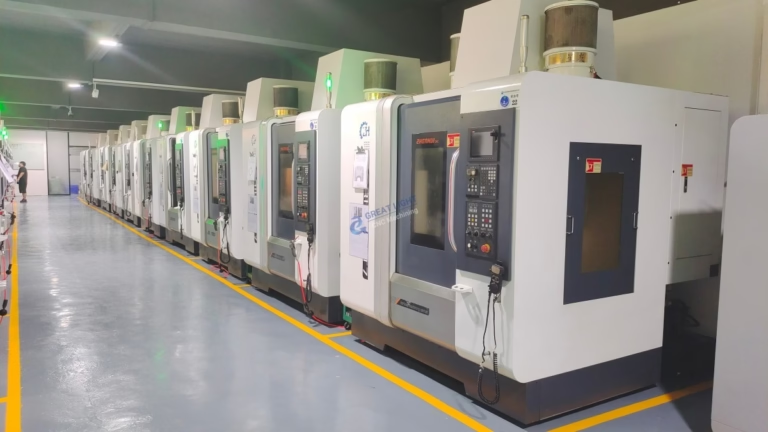
Vertical integration changes the math. When milling, turning, EDM, finishing and inspection sit in the same building, parts do not wait in a truck. GreatLight runs 3 wholly-owned plants covering 7,600 m², with 127 high-precision CNC machines. That density is what allows a bulk order to be split across identical machines and still hold one inspection standard.
One caveat. Integration only helps if the part actually needs those steps. A simple aluminum bracket with a loose tolerance does not need a 5-axis cell. Sending it to one wastes money. Match the route to the geometry, not to the supplier's brochure.
- 1Count the non-cutting hoursSetup, inspection and finishing often exceed cycle time on small parts.
- 2Ask for parallel capacityHow many machines can run this part family in the same week?
- 3Check where inspection sitsIn-process beats end-of-line for catching drift early.
Tolerance, finish and the numbers you should pin down before ordering
A general tolerance callout like ±0.1 mm is fine for brackets and covers. It is not fine for a bearing bore or a sealing face. Before you request quotes, mark which dimensions actually matter and what they must hold. GreatLight machines to ±0.005 mm (±0.0002 in) when the drawing requires it, but that capability has a cost in cycle time and inspection.
Surface finish follows the same logic. As-machined finish sits around Ra 1.6-3.2 μm. A high-finish cut reaches Ra 0.8-1.6 μm. Fine finish, down to Ra 0.2-0.8 μm, usually means slower feeds, smaller stepovers and sometimes a separate finishing pass. If your drawing says Ra 0.4 μm on every face, expect the quote to reflect it.
The mistake we see most often is a tolerance stack that was never checked. Each individual dimension is achievable, but the assembly does not close. Ask your supplier to flag stack-ups during DFM review. GreatLight returns a quotation and free DFM analysis within 12 hours, which is early enough to change a callout before tooling is committed.
Material choice also moves the finish target. 6061 aluminum cuts clean and takes anodizing well. 316L stainless work-hardens and needs different feeds. Titanium Ti-6Al-4V holds tolerance but wears tools faster. None of this is a reason to avoid a material. It is a reason to state the material and temper exactly on the RFQ.
- 1Mark critical dimensionsSeparate cosmetic faces from functional ones on the drawing.
- 2State finish per faceA blanket Ra callout inflates cost without adding function.
- 3Check tolerance stack-upsIndividual dimensions can pass while the assembly fails.
Inspection and certification: what fast bulk CNC machining suppliers must prove
In bulk production, a missed dimension is not one bad part. It is the whole batch between the last good check and the moment someone noticed. That is why in-process measurement matters more than a final inspection report. Probing on the machine, plus statistical process control on the critical feature, catches drift while there is still time to correct the offset.
GreatLight inspects 100 percent of parts before shipment, with raw material checks, in-process monitoring and final inspection. Reports are available on request. The historical qualification rate is 99.99%, and the late-delivery probability is below 2%. Those numbers are only meaningful if the inspection plan behind them is written down for your part.
Certifications are a separate question. ISO 9001:2015 covers quality management. IATF 16949:2016 applies to automotive work. ISO 13485:2016 covers medical devices. ISO 27001:2022 covers information security. A supplier may hold all four and still route your job through a cell that was not part of the audited scope. Ask which plant and which process line will run the order.
For regulated industries, the paperwork is part of the deliverable. Material certificates, inspection reports and traceability records need to be defined at PO stage, not requested after shipment. If your customer requires lot traceability, say so in the RFQ.
- 1Require in-process probingEnd-of-line inspection alone lets a full batch go bad.
- 2Confirm audit scopeMatch the certification to the plant that will run your parts.
- 3Define records at PO stageMaterial certs and traceability are easier to plan than to backfill.
MOQ, lead time and post-processing in one production plan
Minimum order quantity is often used as a filter by suppliers, not a technical limit. GreatLight has no minimum order quantity and runs from one prototype to 10,000+ part runs. That flexibility matters when a pilot build needs 20 units and the production order needs 8,000 from the same drawing revision.
Lead time should be quoted in stages, not as a single number. A quotation and free DFM analysis within 12 hours, production start within 24 hours, and parts shipping in 3-5 days is a workable baseline for many machined parts. Complex 5-axis work, exotic alloys or multi-stage finishing will extend it. Ask which stage is the constraint on your job.
Post-processing is where bulk schedules usually slip. Anodizing, plating, powder coating, bead blasting and laser marking each add a queue. If those steps are external, the queue is invisible to you until it becomes a delay. Keeping finishing in-house or in a controlled partner line removes that blind spot.
Laser marking has a practical limit worth knowing: minimum character height is 1.5 mm. Serial numbers and lot codes below that size will not be legible. If your traceability scheme needs smaller marks, plan for a different method during DFM review, not after the first batch.
- 1Quote lead time by stageProgramming, first article, production and finishing have different constraints.
- 2Ask where finishing happensExternal finishing queues are the most common cause of slip.
- 3Check marking size limitsLaser marking needs at least 1.5 mm character height.
Common traps when sourcing volume CNC parts
The first trap is comparing unit prices from quotes built on different process plans. One supplier assumes a 3-axis route with three setups. Another assumes a 5-axis route with one. The second quote may look higher per part while actually using fewer labor hours. Ask what process each quote assumes before you compare totals.
The second trap is treating the prototype quote as a production quote. Prototype pricing is dominated by programming and setup. At 5,000 pieces, material and cycle time dominate. A supplier that cannot explain how the price curve drops between 10 and 5,000 parts has not modeled your job.
The third trap is ignoring fixturing. Soft jaws and simple vises work for small batches. Volume work often needs dedicated fixtures, which cost money up front and pay back in repeatability. If a quote has no fixture line item on a 10,000-part order, ask why.
The fourth trap is confidentiality. Drawings and CAD files carry your design intent. Uploads should be secure and confidential, and an NDA should be available on request. That is a process question, not a trust question. ISO 27001:2022 certification is one indicator that information handling is managed, not improvised.
- 1Compare process plans firstUnit price means nothing if the assumed route differs.
- 2Ask for the price curveVolume pricing should reflect material and cycle time savings.
- 3Look for fixture costsMissing fixture line items on large orders are a warning sign.
How to run a bulk CNC order without schedule surprises
Seven steps from RFQ to shipped parts.
- 1Send the full drawing packageInclude 2D drawings with critical dimensions, 3D models, material and temper, finish per face, and any marking or traceability requirement. Missing finish specs are the most common cause of a revised quote.
- 2Read the DFM notes before approvingGreatLight returns a quotation and free DFM analysis within 12 hours. Check the flagged features: thin walls, deep pockets, tight radii and tolerance stack-ups. Changing a callout here is cheap.
- 3Approve the first articleFor volume work, review the first article against the drawing and the inspection report. Confirm the fixture and the process plan are locked before the run continues.
- 4Lock the inspection planAgree which features are probed in-process and which are checked at final inspection. Define sampling or 100 percent inspection based on the criticality of each feature.
- 5Confirm the finishing routeAnodizing, plating, powder coating and laser marking each add queue time. Confirm whether they run in-house or through a controlled partner, and how that affects the ship date.
- 6Set the reporting cadenceFor long runs, agree on a weekly status update covering produced quantity, scrap, open deviations and remaining capacity. Silence is not a status.
- 7Review final inspection records before releaseInspection reports and material certificates should be ready at shipment, not requested afterward. If your customer needs lot traceability, verify the records match the shipped lots.
Questions engineers ask before a volume order
What batch size counts as bulk for CNC machining?
There is no fixed threshold. In practice, bulk starts where setup cost stops dominating the unit price, usually somewhere between 200 and 500 parts for a simple geometry.
Above 5,000 pieces, fixture design, tool life management and in-process inspection become the main cost drivers rather than machine time.
Can fast turnaround and tight tolerance hold at the same time?
Yes, if the process plan is built for it. GreatLight machines to ±0.005 mm and ships parts in 3-5 days on many jobs, with production able to start within 24 hours.
The trade-off is usually in finishing. Fine surface finish, down to Ra 0.2-0.8 μm, needs slower passes and may add a separate operation.
How should I compare quotes from different suppliers?
Compare the process plan, not the total. Ask how many setups, which machine class, what fixture, and where inspection sits.
A higher unit price from a one-setup 5-axis route can beat a lower price from a three-setup route once labor and scrap are counted.
Do I need an NDA for CNC machining quotes?
It depends on what you are sending. A simple bracket drawing carries little risk. A full assembly with internal geometry carries a lot.
Uploads should be secure and confidential, and an NDA should be available on request if your design is sensitive.
What materials are available for volume CNC work?
Aluminum grades include 6061, 6061-T6, 2024, 5052, 5083, 6063, 6082, 7075 and ADC12. Stainless covers 303, 304, 316, 316L, 17-4PH and others.
Steel, copper, brass, titanium, Inconel, magnesium and engineering plastics like POM, PEEK and PC are also machined in volume.
What causes late delivery on bulk CNC orders?
External finishing queues, late fixture readiness and inspection bottlenecks are the usual causes, not spindle time.
Keeping milling, turning, EDM, finishing and inspection in one facility removes most of the handoff risk. GreatLight operates 3 wholly-owned plants for this reason.
Send your drawings and get a plan, not just a price
Quotation and free DFM analysis within 12 hours, 100 percent inspection before shipment, and no minimum order quantity.
12-hour quote100% inspectionNo MOQ
More from the shop floor
We publish setup notes, tooling trials and inspection data from the factory floor.











