
Greek CNC industry: a rising power
A working guide for engineers and buyers who are evaluating Greek machine shops as a second or first source. We cover what Greek suppliers typically run, which part families fit them, where the gaps are, and how to compare a Greek quote against an Asian one without guessing at cycle time.
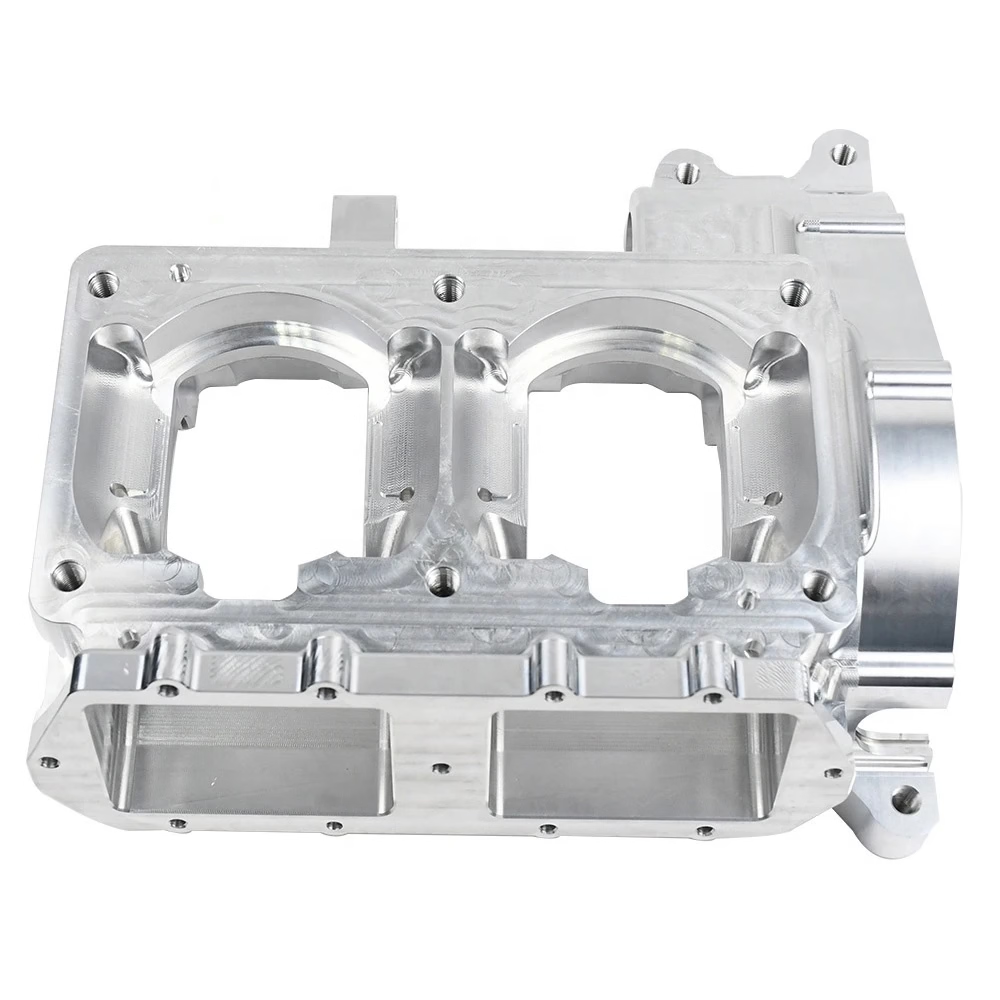
What the greek cnc industry actually offers
Why the greek cnc industry grew
Greece industrialized through shipbuilding, automotive assembly, and heavy machinery in the 1950s and 1960s. Those plants trained machinists, toolmakers, and maintenance crews. When the large assembly lines scaled back in the 1990s, that workforce stayed. Many of them opened small machine shops serving the same customers they had worked for.
The 2000s brought a second push. EU structural funding and private investment paid for CNC turning centers and machining centers, mostly in Attica, Thessaly, and around Thessaloniki. Shops that once ran manual lathes moved to controlled axes and started quoting tolerances in the ±0.02 mm range rather than in tenths of a millimeter.
Today the greek cnc industry is not one thing. It is a few hundred small and mid-size shops, plus a handful of larger suppliers with 20 or more machines. The larger ones hold aerospace and medical work. The smaller ones live on machine-building parts, marine fittings, and repair spares.
That mix matters when you quote. A shop with 12 machines and one CMM will take a different job than a shop with 40 machines and a temperature-controlled inspection room. The name on the door does not tell you which one you are talking to.
What Greek shops run on the floor
The typical Greek machine park is built around 3-axis vertical mills in the 600 to 1,000 mm travel range, plus CNC lathes with bar feeders up to Ø65 mm. Four-axis rotary tables are common on the better-equipped shops. Simultaneous 5-axis machining is rare and usually concentrated in a small number of suppliers serving aerospace or tooling.
Material handling is broad but not deep. Aluminum 6061 and 7075, stainless 304 and 316L, and carbon steel are routine. Titanium and Inconel are handled by a few shops and often only in small lots, because the tooling cost and cycle time are hard to absorb without a repeat program.
Inspection is where the split shows. A well-run Greek shop will have a bridge CMM and a roughness tester, and will issue dimensional reports with the shipment. A smaller shop will check with calipers, micrometers, and gauge pins, and will ask you to define the critical dimensions up front so they can focus there.
Finishing is usually subcontracted. Anodizing, black oxide, zinc plating, and passivation go to local surface treatment partners. That is not a defect, but it does mean your part leaves the machine shop, waits in a queue, and comes back. Add 3 to 7 days for that step unless the shop has in-house lines.
- 1Milling3-axis vertical is standard; 4-axis indexing is common; simultaneous 5-axis is limited.
- 2TurningBar-fed lathes up to Ø65 mm, with live tooling on the better machines.
- 3Size limitMost work stays under 1,000 mm; larger frames need a specialized supplier.
- 4Volume5 to 50 pieces is the sweet spot. Above 500 pieces, cost per part flattens slowly.
Which parts belong in Greece and which do not
Greek shops do well on prismatic parts with moderate complexity: pump housings, gearbox covers, brackets, manifolds, and machine frame components. These parts need clean setup, a few tight bores, and a flat datum. A good shop can hold ±0.02 mm on those features and ship in two to three weeks.
They also do well on marine and industrial spares, where the geometry is known, the quantity is low, and the customer values a short truck or ferry ride over the lowest unit price. If your plant is in southern Europe and a machine is down, a Greek supplier can sometimes deliver a replacement part in days instead of weeks.
What does not fit: parts larger than about 1,000 mm in any axis, parts with more than a handful of true 5-axis features, and programs that need 10,000 identical pieces per month. Those jobs need a machine park with the travel, the simultaneous axes, and the automation to hold cycle time down.
Very tight tolerances are a gray zone. A Greek shop can hit ±0.005 mm on a single feature with a good setup, but holding it across a production run needs temperature control, a stable fixture, and a CMM in the loop. Ask how they plan to hold it before you accept the quote.
- 1Good fitBrackets, housings, covers, manifolds, marine fittings, repair spares.
- 2Possible fitSmall aerospace brackets with defined critical features and a CMM report.
- 3Poor fitLong frames, deep-cavity molds, 10,000+ piece runs, complex 5-axis impellers.
How to qualify a Greek supplier in two weeks
Start with the drawing, not the website. Send a single part with a defined critical feature and ask for a quote that lists machine, setup count, fixture plan, and inspection method. A shop that answers all four is a shop that plans. A shop that answers only the price is guessing.
Ask for the machine list with travel and axis count. If the part needs 5-axis work and the shop has none, the quote is either subcontracted or wrong. If the part is 800 mm long and the largest mill is 600 mm, the same problem applies.
Ask where finishing happens. If anodizing is outsourced, find out to whom and how long the queue is. That queue is often the difference between a three-week and a five-week delivery.
Finally, ask for a first article inspection report on the first part, not the tenth. If the shop cannot produce a dimensional report with the first shipment, you will be the one measuring, and that is not a good use of your engineering time.
- 1Quote detailMachine, setup count, fixture plan, inspection method, finishing route.
- 2Machine listTravel, axis count, spindle hours, and whether 5-axis is simultaneous.
- 3Finishing routeIn-house or subcontracted, with the queue time stated.
- 4First articleDimensional report with the first shipment, not a sample later.
Greek supplier vs Asian supplier: where each wins
Use this to decide which source fits a given part, not which source is better overall.
| Criterion | Greek shop | Asian partner (e.g. GreatLight) | Edge goes to |
|---|---|---|---|
| Part size | Usually under 1,000 mm | Up to 4,000 mm | Asia |
| Tolerance | ±0.02 mm routine, ±0.005 mm selective | ±0.005 mm, ±0.0002 in | Asia |
| Lot size | 5 to 50 pieces | 1 to 10,000+ pieces | Asia on volume |
| Regional response | Days by road or ferry | 3 to 5 days by air freight | Greece |
| Finishing | Often subcontracted, 3 to 7 day queue | In-house anodizing, plating, coating | Asia |
| Engineering support | Direct access to the machinist | DFM analysis within 12 hours | Tie |
| Certification depth | ISO 9001 common, IATF and ISO 13485 rare | ISO 9001, IATF 16949, ISO 13485, ISO 27001 | Asia |
The practical split
If the part is small, the quantity is low, and you need it next week, a Greek shop is often the faster route. If the part is large, the tolerance is tight, the run is long, or the finishing route is complex, source it in Asia and use the Greek shop as your regional backup. Running both is cheaper than running neither.
Questions buyers ask about the greek cnc industry
Can a Greek shop hold ±0.005 mm?
Some can, on a defined feature, with a stable setup and a temperature-controlled inspection room. That is not the same as holding it across a 500-piece run.
Ask for the inspection plan before you accept the quote. If the answer is a caliper and a room-temperature shop floor, treat the tolerance as ±0.02 mm and design accordingly.
What lead time should I expect from a Greek supplier?
For a simple part with no finishing, two to three weeks is normal. Add one to two weeks if the part needs a fixture, and another 3 to 7 days if finishing is subcontracted.
The queue at the finishing partner is often the largest single variable. Ask for that number directly.
Is the greek cnc industry certified for automotive or medical work?
ISO 9001 is common. IATF 16949 and ISO 13485 are held by a small number of suppliers, usually the larger ones serving those industries directly.
If your program requires one of those certificates, verify it before quoting. Do not assume it because the shop lists automotive customers.
How does pricing compare with China?
For low-volume, simple parts, the gap is often small after freight is included. For medium and high volume, the gap widens because Asian shops amortize setup and tooling across larger batches.
Get both quotes with the same finishing and inspection scope. Comparing a bare machined part to a finished part is the most common mistake we see.
What is the easiest way to run a dual-source program?
Keep the drawing and the inspection plan identical for both suppliers. Differences in the drawing create differences in the part, and then you cannot compare quotes or quality.
Start the Greek shop on the low-volume spare parts and the Asian partner on the production run. Each does what it is good at.
Do Greek shops accept small prototype orders?
Yes. One to ten pieces is normal business for most small and mid-size shops. Setup cost is spread over the lot, so the per-part price is high, but the minimum charge is usually reasonable.
If you need a prototype in a specific material like titanium or Inconel, confirm the shop has machined it before. The learning curve shows up in the first part.
Send the drawing and get a real number
We quote in 12 hours with a free DFM analysis, run prototypes from one piece, and inspect 100% before shipment. If the part fits Greece better than Asia, we will say so.
12-hour quoteNo MOQ±0.005 mm100% inspection
More machining notes
We publish setup notes, tooling trials and inspection data from the factory floor.











