
How to Pick a CNC Aluminum Machining Service Dealer
Most aluminum parts are easy to cut. The hard part is finding a dealer whose numbers hold up on the tenth order, not just the first. This guide gives you the checks that separate a real production partner from a broker with a website.
In this article
- 1
- 2
- 3
- 4
- 5
- 6
- 7
Key takeaways
Dealer checklist by part type
Match the requirement to the part, not to the sales pitch.
| Part type | Critical requirement | What to verify |
|---|---|---|
| Flat bracket, 2.5D pockets | ±0.05 mm is enough | 3-axis mill, 750 × 1,150 × 550 mm travel |
| Long extrusion housing | Straightness over 4,000 mm | 4,000 × 400 × 150 mm travel, in-process probing |
| 5-face housing, tight bore | ±0.005 mm and true position | 16 simultaneous 5-axis centers, Ø400 mm rotary table |
| Turned shaft with hex end | Concentricity under 0.01 mm | 16 mill-turn centers, one setup |
| Thin-wall enclosure | No chatter, Ra 0.8–1.6 μm | Fixture plan and low-stress roughing |
| Prototype, single unit | No MOQ, 3-5 day ship | Setup cost shown separately in the quote |
| Aerospace bracket, 7075 | Traceability per lot | IATF 16949 plus material certs |
| Surgical instrument body | Cleanliness and finish | ISO 13485, passivation or anodize line |
Tolerance: what a cnc aluminum machining service dealer can actually hold
Every dealer claims tight tolerance. The useful question is which features hold it. On aluminum, a 6061 or 7075 part can reach ±0.005 mm on a bored hole or a ground face, but the same part will drift to ±0.05 mm on a long unsupported wall. Ask for the tolerance per feature, not for the part.
Aluminum moves with heat. A spindle running at 12,000 rpm warms the part 2-3 °C above ambient, which is 5-7 μm on a 100 mm aluminum length. Shops that hold ±0.005 mm rough the part, let it cool, then finish. If a dealer quotes the tight number without mentioning a cool-down step, the number is optimistic.
Surface finish follows the same logic. Ra 0.2–0.8 μm needs a fine finishing pass and a sharp cutter. Ra 1.6–3.2 μm is normal as-machined output and costs much less. Tell the dealer which faces touch a seal or a bearing and leave the rest as-machined.
Watch for the fallback clause. A good quote states the tight tolerance, the general tolerance, and the datum scheme. A weak quote states one number and lets you assume it applies everywhere.
- 1Ask for per-feature toleranceA single number for the whole part is a warning sign.
- 2Confirm the datum schemeTolerance without a datum is not measurable.
- 3Separate cosmetic and functional facesFinishing every surface adds cost with no benefit.
Lead time, MOQ and what a service dealer will not tell you
Quotation speed is a capacity signal. A dealer that returns a quote with DFM notes within 12 hours is not sitting on a full schedule. That does not guarantee your parts ship fast, but a slow quote usually means a slow shop.
Ask when production can start. A shop with in-house programming and its own fixture shop can start within 24 hours of PO. A shop that outsources fixtures will add three to five days before a chip is cut.
MOQ is the clearest test of setup skill. A dealer that takes one prototype and a 10,000-part run has standard workholding and proven programs. A dealer that demands 500 pieces minimum is protecting itself from setup cost, not serving you.
Check how the lead time is stated. A range of 3-5 days for repeat aluminum parts is realistic when material is in stock. If your alloy is 7075 or 6082 and the dealer does not stock it, add mill lead time. Ask whether the quoted days start at PO or at material arrival.
Late delivery risk is worth asking about directly. A shop that tracks on-time percentage can answer. A shop that cannot is guessing.
- 1Quote in 12 hoursIncludes free DFM analysis in the fact sheet.
- 2Production start in 24 hoursRequires in-house programming and fixture making.
- 3Parts ship in 3-5 daysFor repeat aluminum work with material on hand.
Certifications that matter for aluminum parts
ISO 9001:2015 is the baseline. It says the shop has a documented quality system, not that it can hold your tolerance. Treat it as a gate, not a score.
If your part goes into a vehicle or an engine bay, you need IATF 16949:2016. That certification covers PPAP-style documentation, traceability and change control. An aluminum bracket for an EV battery tray usually falls under this.
Medical device housings and instrument bodies need ISO 13485:2016. The shop must control cleaning, contamination and material traceability, which affects how it stores and handles aluminum.
When your drawings are the valuable part, check ISO 27001:2022. It covers information security, which matters if you upload CAD files through a dealer portal. Ask for the NDA before the first upload, not after the first PO.
Certificates are per site. A dealer with several plants may hold a certificate at one address only. Ask which plant will run your parts and whether that plant is on the certificate scope.
- 1ISO 9001:2015Baseline quality system.
- 2IATF 16949:2016Automotive and engine hardware.
- 3ISO 13485:2016Medical devices.
- 4ISO 27001:2022Data security for uploaded CAD.
Shop floor evidence behind a hot sale cnc aluminum claim
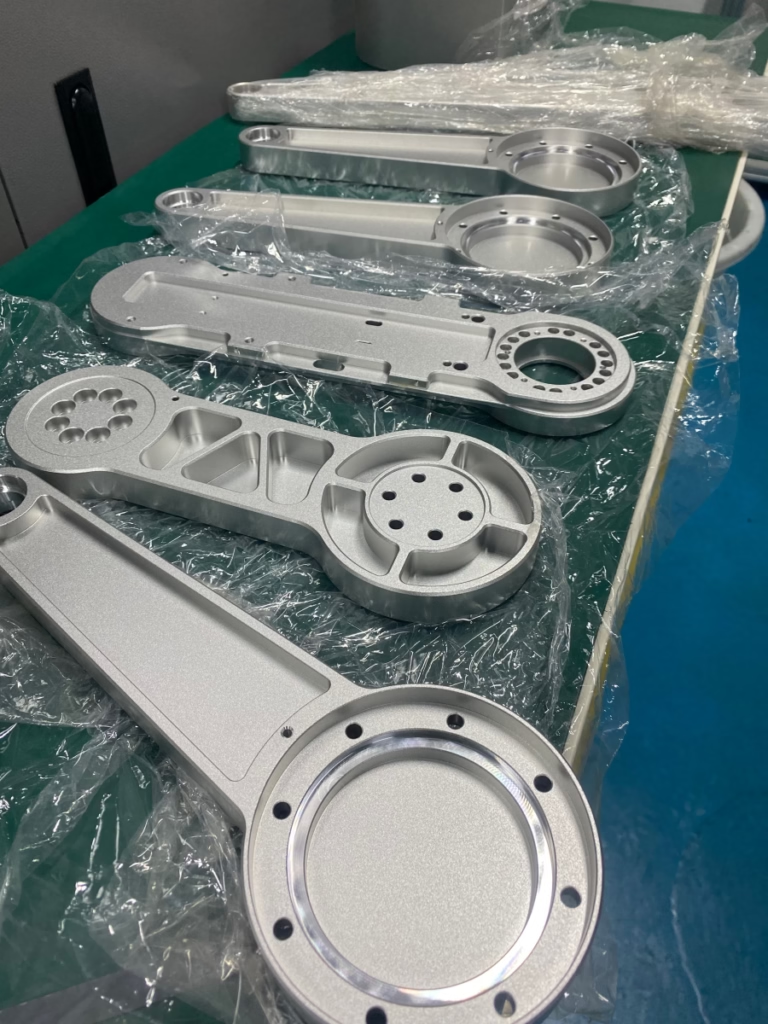
A dealer is only as good as the machines it owns. Ask for the machine list with axis count and travel. Aluminum parts with deep pockets need a 4,000 × 400 × 150 mm envelope. Complex housings with angled ports need simultaneous 5-axis work.
A shop running 16 simultaneous 5-axis centers and 16 mill-turn centers can finish a part in one setup that a 3-axis shop needs four setups for. Every extra setup adds a datum error and a queue delay.
Inspection matters as much as cutting. Look for 100% inspection before shipment, incoming material checks and in-process monitoring. Ask whether you get a dimensional report with the parts, and whether CMM data is available on request.
Material stock tells you how fast the shop can move. A dealer that keeps 6061, 7075 and 6082 on the floor can start immediately. One that buys per order adds days.
Ask how the shop handles a first article. A documented first-article inspection on the first part is normal for production work. If the dealer only checks the last part of the run, reject it.
- 1Machine list with travelMatch the envelope to your part, not to the brochure.
- 2Setup countFewer setups means fewer datum errors.
- 3100% inspection before shipmentAsk for the report format up front.
- 4First-article inspectionStandard practice on production orders.
Five steps before you release a PO
Run these in order. Each one can stop a bad supplier early.
- 1Send a real drawing, not a sketchInclude the 2D drawing with GD&T, the alloy grade and the finish callout. A dealer that quotes from a STEP file alone is guessing on tolerance. Ask for the DFM notes in the reply.
- 2Ask for per-feature toleranceRequest the tight tolerance, the general tolerance and the datum scheme in writing. If the reply gives one number for the whole part, push back before you send the PO.
- 3Request the machine and inspection planAsk which machine will run the part, how many setups it needs and how the first article gets measured. A shop that answers in one paragraph knows its floor.
- 4Confirm certifications and site scopeMatch the certificate to your industry and confirm the plant address on the certificate is the plant that will run your parts. Ask about the NDA before you upload files.
- 5Check the quote for hidden linesLook for setup cost, fixture cost, material surcharge and finishing as separate lines. A single lump price hides where the risk sits. Then confirm MOQ and the lead-time start point.
Common questions
What tolerance can a CNC aluminum machining service dealer realistically hold?
On 6061 and 7075, bored holes and ground faces can hold ±0.005 mm when the shop roughs, cools and finishes. Long unsupported walls usually hold ±0.05 mm. The number depends on the feature, the wall thickness and the fixture, not on the alloy alone.
Ask for tolerance per feature and a datum scheme. If a dealer quotes one tight number for the whole part without conditions, the quote will not survive first-article inspection.
Is there a minimum order quantity for aluminum CNC parts?
It depends on the dealer. A shop with standard workholding and proven programs can run one prototype and a 10,000-part order on the same process. Setup cost is quoted separately instead of being hidden in a high MOQ.
If a dealer insists on a 500-piece minimum, ask what the setup cost would be for a single unit. The answer tells you whether the minimum protects the shop or the price.
Which certifications should I check for automotive or medical aluminum parts?
For automotive and engine hardware, check IATF 16949:2016. It covers traceability, change control and PPAP-style documentation. For medical device bodies and instrument parts, check ISO 13485:2016.
ISO 9001:2015 is the baseline for any shop. If you upload CAD files, ISO 27001:2022 covers information security. Always confirm the certificate lists the plant that will run your parts.
How fast can aluminum parts ship?
Quotation with DFM analysis usually comes back within 12 hours. Production can start within 24 hours when material is in stock and programming is in-house. Repeat aluminum parts typically ship in 3-5 days.
Add time if your alloy is not on the floor. 7075 and 6082 often need to be ordered, which pushes the start date. Ask whether the quoted days start at PO or at material arrival.
What should a quote include besides the part price?
Setup cost, fixture cost, material grade and surcharge, finishing and inspection should all appear as separate lines. A lump price hides where your risk sits.
Also ask for the tolerance per feature, the general tolerance, the datum scheme and the inspection report format. A quote that answers these is easier to compare against a second supplier.
How do I protect my design when I send files to a dealer?
Ask for an NDA before the first upload, and send files through a portal rather than email attachments. Check whether the dealer holds ISO 27001:2022 for information security.
Limit early files to what the quote needs. A STEP file and a 2D drawing with GD&T are usually enough for a DFM review. You do not need to release the full assembly to get a price.
Get a quote with DFM notes in 12 hours
Send your drawing and alloy. We return a quote with per-feature tolerance, setup lines and a machine plan, plus free DFM analysis.
12-hour quoteNo MOQ100% inspectionISO 27001 uploads
More from the shop floor
We publish setup notes, tooling trials and inspection data from the factory floor.











