
CNC Service Fast Delivery: What to Check Before You Send a PO
This guide is for engineers and sourcing staff comparing suppliers who promise fast delivery on machined parts. We cover how a real delivery window is built, which machine capacity decides it, and where quotes go wrong. Read it and you can judge a supplier's schedule claim in one call.
In this article
- 1
- 2
- 3
- 4
- 5
- 6
- 7
Six things that decide whether the schedule holds
Fast-delivery claims versus what to verify
Use the right column as the question you actually ask on the call.
| What the supplier says | What it depends on | What to ask |
|---|---|---|
| 3-5 day shipping | Machine availability and queue depth | How many spindles are free this week? |
| Tight tolerance | Machine geometry and probe routine | Which machine holds ±0.005 mm, and how is it verified? |
| No minimum order | Changeover and programming capacity | Do you charge a separate setup fee for one part? |
| Full inspection | Metrology staff and report format | Can I see a dimensional report with the shipment? |
| Fast quote | DFM review before pricing | Do you send DFM notes with the quote? |
| Complex geometry | Simultaneous 5-axis capability | Is the 5-axis simultaneous or 3+2 indexed? |
| Confidential handling | Information security controls | Will you sign an NDA before I upload files? |
The short version
If the part has multiple faces, tight mating features or a hard alloy, pick a supplier with simultaneous 5-axis capacity and a documented inspection step. If it is a simple bracket in aluminium, speed comes from stock availability and setup count, not from the machine. Ask for the three dates before you send the PO.
How a CNC service fast delivery window is actually built
A delivery date is the sum of four blocks: quoting, programming, machining and inspection. Most suppliers quote only the machining block and let the other three float. That is why a part promised in three days arrives in nine. When we quote a job, we give a date for each block so the buyer can see where the risk sits.
Quoting starts with DFM. A part with a deep pocket, a 0.5 mm wall or a thread that cannot be reached needs a redesign note before anyone prices it. We return quotation and a free DFM analysis within 12 hours, which is early enough for the buyer to change the model before tooling is ordered.
Programming and fixturing run in parallel with material purchase. For a 5-axis part, the CAM programmer also designs the soft jaws or the dovetail block. If that step is skipped, the first article will be scrapped and the schedule restarts. Production can start within 24 hours once the drawing is frozen and the stock is on site.
The last block is inspection and packing. Parts ship in 3-5 days for typical runs, and 100% inspection happens before shipment. On a 200-piece order, inspection can be a full shift. Suppliers who exclude it from the quote are quoting a different job than the one you need.
- 1Freeze the drawing earlyEvery revision after programming costs a day, not an hour.
- 2Ask for the block-by-block dateQuote date, production start date, ship date.
- 3Send the full assembly contextMating parts and datum callouts change the machining plan.
Machine capacity is the real limit on delivery speed
You cannot schedule work onto a machine that does not exist. GreatLight runs 127 high-precision CNC machines across three wholly-owned plants, including 16 simultaneous 5-axis machining centers, 12 four-axis mills, 27 three-axis machines and 16 mill-turn centers. That mix matters because a shop with only 3-axis machines will split a complex part into several setups, and each setup adds queue time.
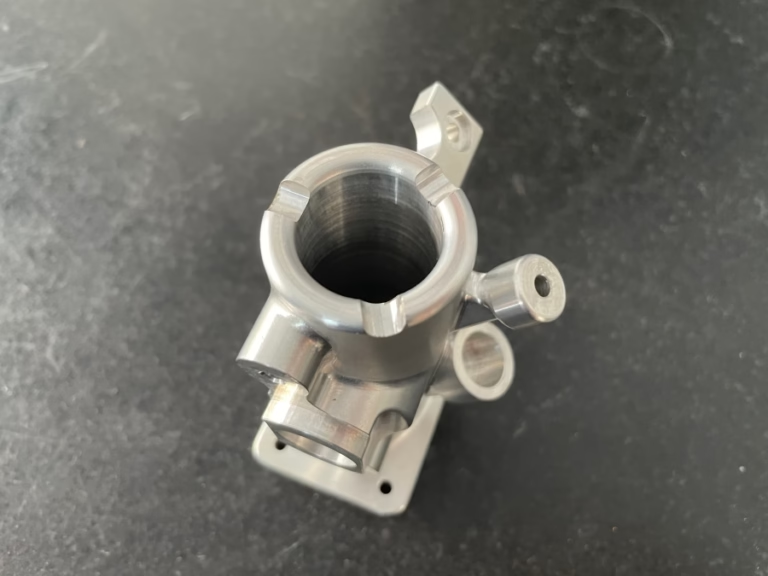
Simultaneous 5-axis is the difference between one cycle and four. A housing with ports on five faces can be cut in a single setup with the tool approaching from any angle. The same part on a 3-axis mill needs a fixture per face, and every refixture reintroduces position error. For parts with angled holes, sculpted surfaces or undercuts, 5-axis is usually the faster route even though the hourly rate is higher.
Size decides which machine you land on. Our large travel reaches 4,000 × 400 × 150 mm, medium platforms cover 750 × 1,150 × 550 mm and 600 × 600 × 600 mm, and compact machines handle 500 × 500 × 450 mm and 500 × 310 × 200 mm. A Ø400 mm rotary table covers round and cylindrical work. If your part sits near a travel limit, the setup becomes the schedule risk, not the cutting time.
Material availability is the other half. We machine aluminium 6061, 7075 and 6082, stainless 303, 304, 316L and 17-4PH, steels including 4140 and 4340, titanium TC4 (Ti-6Al-4V), Inconel, and plastics from POM to PEEK. Titanium and Inconel cut slowly and wear tools, so add days for those, not hours.
- 15-axis pays off on multi-face partsOne setup, one datum, fewer scrapped first articles.
- 2Mill-turn suits shafts and fittingsTurning and milling in one cycle removes a handoff.
- 3Hard alloys need longer cutting timePlan the schedule around tool life, not just the spindle.
Matching tolerance and finish to the process
Tolerance is the number buyers check first and understand last. We hold ±0.005 mm (±0.0002 in) on parts where the drawing, datum scheme and inspection method all support it. That is not a default. It applies to a specific feature on a specific machine, measured with a specific instrument.
A ±0.005 mm callout on a 400 mm long aluminium bracket will move with temperature and clamping. If the feature is not functional, relax it to ±0.05 mm and the part gets cheaper and faster. Tight tolerances belong on mating diameters, bearing bores and locating features, not on every dimension on the sheet.
Surface finish follows the same logic. As-machined surfaces sit at Ra 1.6–3.2 μm. A high-quality finish is Ra 0.8–1.6 μm, and fine finishing reaches Ra 0.2–0.8 μm. Getting to Ra 0.2 μm usually means a separate finishing pass or a secondary operation such as polishing, which adds a day to the route.
Inspection closes the loop. We check raw material on receipt, monitor dimensions in process, and inspect 100% before shipment, with reports on request. The historical qualification rate is 99.99% and the late-delivery probability sits below 2%. Those numbers only hold if the drawing is stable, so send the revision you actually want built.
- 1Tighten only what matesNon-critical dimensions should carry general tolerances.
- 2Specify finish by functionSealing faces and sliding surfaces need different values.
- 3Name the inspection methodCMM, micrometer or gauge changes the achievable number.
MOQ, certifications and confidential files
There is no minimum order quantity here. We run from one prototype to 10,000+ part runs. For a single part, the cost is dominated by programming and setup, so expect the unit price to reflect that. The advantage is that the same fixture and program carry into the production run, which removes the re-qualification step later.
Certifications decide which suppliers can even bid. ISO 9001:2015 covers general quality management. IATF 16949:2016 is required for automotive and EV work. ISO 13485:2016 applies to medical devices. ISO 27001:2022 covers information security, which matters when your CAD files are the product.
Confidentiality is a workflow, not a sentence in a contract. Uploads are secure and confidential, and an NDA is available on request. If your design is not public, sign the NDA before the first file transfer rather than after the quote. It costs nothing and removes the awkward conversation later.
Finishing options affect the schedule too. Anodizing in clear, colour, hardcoat or conductive, electroless nickel, zinc, silver and gold plating, powder coating, black oxide, bead blasting, tumbling, brushing and polishing are all available. Laser marking needs a minimum character height of 1.5 mm. Any outsourced finish adds transit time, so ask whether it is done in-house or sent out.
- 1One part is fineSetup cost is the price of a fast prototype.
- 2Match certification to industryAerospace, automotive, medical and IT each need different paperwork.
- 3Sign the NDA firstBefore files move, not after the quote.
How to vet a supplier for fast delivery in one day
Work through these in order. Each step produces a yes or no, not a maybe.
- 1Send the drawing with datums and materialInclude the CAD file, the 2D drawing with GD&T, the material grade and the finish spec. A STEP file alone leaves the tolerance open.
- 2Request a quote with DFM notesA useful quote names the stock size, the machine, the setup count and any feature that needs changing. Ours comes back within 12 hours with a free DFM analysis.
- 3Ask for the three datesQuote date, production start date and ship date. Production can start within 24 hours on a frozen drawing; parts ship in 3-5 days.
- 4Confirm the tolerance and the gaugeState which feature needs ±0.005 mm and how it will be measured. If the supplier agrees without asking, be suspicious.
- 5Check the certification setISO 9001:2015, IATF 16949:2016, ISO 13485:2016, ISO 27001:2022. Ask for the certificate scope, not just the logo.
- 6Agree the inspection report formatFirst-article report, in-process records or full dimensional report with the shipment. Decide before the run starts.
- 7Sign the NDA if the design is sensitiveDo this before uploading. It protects both sides and takes one exchange.
- 8Run a small first orderOne to five parts proves the process, the finish and the paperwork before you commit to a 10,000-part run.
Questions buyers ask before the first order
What does fast delivery actually mean for a machined part?
It means a defined sequence: quotation and DFM within 12 hours, production start within 24 hours, and parts shipping in 3-5 days.
Those windows assume a frozen drawing and available stock. If the drawing changes after programming, or the material is a special grade, the clock restarts.
Can I order a single prototype without a minimum order quantity?
Yes. There is no minimum order quantity, and runs go from one prototype to 10,000+ parts.
The unit price on a single part reflects programming and setup, not material. If the design is likely to go to production, ask for the setup to be documented so it can be reused.
How tight a tolerance can a fast-delivery job hold?
±0.005 mm (±0.0002 in) is achievable on features that support it. Surface finish ranges from Ra 1.6–3.2 μm as machined to Ra 0.2–0.8 μm fine finished.
Speed and accuracy pull against each other. If every dimension is called at ±0.005 mm, the shop has to slow down and inspect more, which costs days.
Which certifications should I ask for?
ISO 9001:2015 is the baseline. Add IATF 16949:2016 for automotive and EV, ISO 13485:2016 for medical devices, and ISO 27001:2022 when your files are sensitive.
Ask for the certificate scope and expiry date. A logo on a website is not the same as an audited scope covering the process you are buying.
What part sizes can be machined?
Maximum processing size is 4,000 mm, with large travel of 4,000 × 400 × 150 mm. Medium platforms cover 750 × 1,150 × 550 mm and 600 × 600 × 600 mm.
Compact machines handle 500 × 500 × 450 mm and 500 × 310 × 200 mm, and a Ø400 mm rotary table covers round parts.
How are my drawings protected?
Uploads are secure and confidential, and an NDA is available on request. Information security is covered by ISO 27001:2022.
Sign the NDA before the first upload. It is one exchange and it removes any question about how the files are stored or shared.
Send your drawing and get a date you can plan around
Quotation and free DFM analysis within 12 hours. Production start within 24 hours on a frozen drawing. Parts ship in 3-5 days with 100% inspection before shipment.
12-hour quote100% inspectionNo MOQNDA on request
More from the shop floor
We publish setup notes, tooling trials and inspection data from the factory floor.











