
How Many Axes Can a CNC Machine Have?
A working answer for engineers and buyers: the common counts are 3, 4, 5 and mill-turn, and the right number depends on how many part faces you must reach without re-clamping. This guide walks through axis definitions, machine limits, and a step-by-step way to pick the count for your part.
Key takeaways
What counts as an axis on a CNC machine
An axis is a controlled direction of motion. Linear axes move in a straight line: X, Y and Z on a mill, X and Z on a lathe. Rotary axes spin around one of those lines and are labeled A, B or C. A machine sold as 3-axis has three linear slides. A 4-axis mill adds one rotary table. A 5-axis machine adds a second rotary axis, either as a trunnion table or a spindle head that tilts.
The count matters because every extra axis removes a re-clamping step. Each time an operator flips a part by hand, position error stacks up. A typical vise flip adds 0.02 to 0.05 mm of setup variation. On a 5-axis machine, that flip happens inside the control, so the error stays inside the machine's stated tolerance.
Do not confuse controlled axes with spindle speed or tool changer positions. A 24-tool carousel does not make a machine 24-axis. Only motion counts.
One more distinction: indexing versus simultaneous. An indexed 4th axis rotates to an angle, locks, then cuts. A simultaneous 5-axis machine moves all five axes at once along a toolpath. Both are sold as multi-axis, but they solve different problems.
How many axes cnc machine platforms actually offer
Production floors rarely run 6, 7 or 9-axis machines unless the parts are exotic. In practice, four counts cover almost all work: 3-axis, 4-axis, 5-axis and mill-turn.
A mill-turn center is not a higher axis number in the usual sense. It usually has X, Y, Z, a B-axis tool spindle and a C-axis main spindle, plus a sub-spindle. That reads as 5 or 6 controlled axes, but the value is the combination: turning and milling in one cycle.
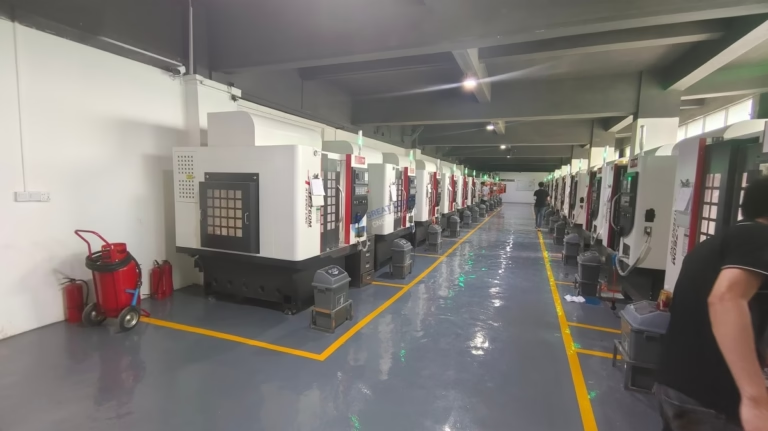
At GreatLight we run 27 three-axis machines, 12 four-axis mills, 16 simultaneous 5-axis machining centers and 16 mill-turn centers, plus a Ø400 mm rotary table for 4th-axis work. Maximum processing size is 4,000 mm, with travel options from 500 × 310 × 200 mm up to 4,000 × 400 × 150 mm.
Large gantry machines with 5 axes exist, but they are rare and expensive. If your part fits inside a 4,000 mm envelope on a 3-axis machine, adding axes usually adds cost without adding value.
Which axis count matches your part geometry
Start with the number of faces that carry features. A flat plate with holes on one side is a 3-axis job. A housing with pockets on two opposite faces usually needs a 4th axis, or two 3-axis setups with a flip.
Next, look for angular features. Ports drilled at 30° to the main bore, undercut slots, or blended fillets between two planes are hard on a 3-axis machine because the tool cannot reach them at the right angle. A 4th axis handles features that repeat around one centerline. A 5th axis handles features that tilt off that centerline.
Then check surface finish targets. On curved surfaces, a 3-axis machine leaves visible scallops because the tool tip sweeps an ellipse. A simultaneous 5-axis machine keeps the tool normal to the surface, so stepover stays even and you can hold Ra 0.8–1.6 μm with less hand polishing.
Finally, count the setups. If a part needs four or more 3-axis setups, the labor and fixture cost often exceeds the 5-axis machine rate. Two setups is the practical crossover point for most housings.
What the extra axes cost you in tolerance and time
Fewer setups is the main quality gain. Every re-clamp can shift a part by 0.01 to 0.03 mm even on a good fixture. A 5-axis machine that reaches five faces in one setup removes those shifts entirely. Our standard tolerance is ±0.005 mm, and a one-setup process makes that number realistic on complex parts.
Rigidity is the trade-off. A trunnion table hangs the part away from the machine bed, so heavy cuts chatter sooner. Deep pockets in steel may still run faster on a 3-axis machine with the part bolted flat to the table. Choose 5-axis for access, not for roughing volume.
Programming effort rises too. Simultaneous toolpaths need collision checking and a post-processor that matches the machine kinematics. A 4th-axis indexed job is far simpler: rotate, lock, cut, rotate again.
Cycle time can go either way. A 5-axis machine may cut slower per pass but finish in one setup, so total floor-to-floor time often drops on parts with three or more faces.
Seven steps to choose the axis count
- 1List every machined faceMark features on each face of the drawing. Count faces with tight tolerances or angular features separately from cosmetic faces.
- 2Count setups on a 3-axis planAssume one setup per face. If the total is three or more, price a 4-axis or 5-axis route before you commit.
- 3Check angular featuresAny hole or slot that tilts more than 15° off the main axes usually needs a 4th or 5th axis to reach cleanly.
- 4Check surface finishCurved surfaces at Ra 0.8–1.6 μm favor simultaneous 5-axis. Flat faces at Ra 1.6–3.2 μm are fine on 3 axes.
- 5Check part size and weightCompare the part envelope with available travels, from 500 × 310 × 200 mm up to 4,000 × 400 × 150 mm. Heavy parts may exceed rotary table limits.
- 6Check materialTitanium and Inconel cut slowly on a trunnion. If the part is mostly heavy roughing, keep it on a rigid 3-axis machine.
- 7Confirm quantity and lead timeOne prototype and a 10,000-part run can use different machines. Ask for the route that holds tolerance at your volume, not the fanciest one.
Axis count compared by part type
Use this as a first screen, then confirm with your own drawing.
| Axis count | Best for | Typical setups | Watch out for |
|---|---|---|---|
| 3-axis | Flat plates, brackets, simple pockets | 1 | Cannot reach side or undercut features |
| 4-axis | Shafts, round housings, repeated side holes | 1–2 | Rotary table limits part weight and swing |
| 5-axis | Curved surfaces, ports at angles, housings | 1 | Slower roughing, higher programming effort |
| Mill-turn | Round parts with milled flats or cross holes | 1 | Not ideal for block-shaped parts |
| 3+2 axis | Angled faces, moderate complexity | 1 | Indexed only, no continuous surfacing |
Pick the count from the part, not the brochure
Count the machined faces and angular features first. If a part needs three or more setups on a 3-axis plan, move to 4-axis or 5-axis. If it is mostly heavy roughing on flat faces, stay with 3 axes.
Frequently asked questions
Can a CNC machine have more than 5 axes?
Yes. Machines with 6, 7 or 9 controlled axes exist, usually for aerospace structures, complex impellers or medical implants. The extra axes are often a second spindle, a tool changer axis or a wrist on a robot cell.
For most machined parts, the extra motion does not reduce setups further, so the cost is hard to justify. A well-fixtured 5-axis process covers the majority of complex geometries.
Is 4-axis cheaper than 5-axis?
Machine rates and programming time are both lower for 4-axis work. A 4th-axis job is usually indexed, so the toolpath is simpler and collision checking is lighter.
The exception is a part that still needs three or more setups on a 4-axis machine. At that point the 5-axis route often wins on total cost because the setups disappear.
Do I need 5 axes for a curved surface?
Not always. A shallow curve with loose finish requirements can run on a 3-axis machine with a ball nose cutter. The trade-off is longer cycle time and visible scallops.
Choose 5-axis when the surface is steep, when the finish target is Ra 0.8–1.6 μm, or when the tool cannot reach the area without a long, flexible holder.
How do I tell a true 5-axis machine from 3+2?
Ask whether all five axes move at the same time during a cut. A 3+2 machine positions two rotary axes, locks them, then cuts with three linear axes.
Simultaneous 5-axis machines interpolate all axes along the toolpath. The control and post-processor are different, and so is the programming cost.
Does the axis count change the tolerance I can expect?
Indirectly, yes. The machine itself may be equally accurate, but more axes usually means fewer setups, and fewer setups means less stacked error from re-clamping.
Our standard tolerance is ±0.005 mm. Holding it on a multi-face part is much easier in a one-setup 5-axis process than across four manual flips.
What about 2-axis machines?
A basic lathe is a 2-axis machine: X and Z. It turns diameters and faces but cannot mill flats or drill off-center holes without a live tool.
Simple turned parts still run most economically on 2-axis lathes. Add axes only when the part needs cross features or milling in the same cycle.
Send your drawing and get a machine route back
We review the part, count the setups and recommend the axis count that holds tolerance at your volume. Quotation and free DFM analysis within 12 hours.
12-hour quote100% inspectionNo minimum order quantity
More machining notes
We publish setup notes, tooling trials and inspection data from the factory floor.











