
How Many Axes in a CNC Machine? A Practical Way to Count Them
Axes in a CNC machine are not a marketing number. They are the directions the tool or the part can move under program control. This guide is for engineers and buyers who need to read a machine spec, count axes in a CNC machine correctly, and pick a setup that fits the part.
In this article
- 1
- 2
- 3
- 4
- 5
- 6
- 7
Key takeaways on axes in a CNC machine
What counts as an axis in a CNC machine
An axis in a CNC machine is a direction of controlled relative motion between the cutting tool and the workpiece. The controller commands that motion through a servo drive, and the position is closed-loop feedback, not a hand wheel. If a slide or a table moves by motor under program control, it is an axis. If it only moves by hand for setup, it is not.
Most vertical machining centers use a fixed column and move the table in X and Y, while the spindle head moves in Z. The letters matter because they define direction, not hardware. X is normally the longest travel, Y is the cross travel, and Z is the spindle axis. Spindle rotation does not count as an axis. It is a separate function called the spindle.
Rotary axes follow the right-hand rule. A rotates about X, B rotates about Y, and C rotates about Z. On a trunnion table, the tilt is usually A and the table rotation is C. On a nutating head, the two rotary axes live in the spindle head itself. Both designs give you five simultaneous axes, but the work envelope and the rigidity differ.
A common mistake is counting a rotary table that only indexes. If the table positions to a fixed angle, locks, and then cutting starts, it is a positioning axis, not a simultaneous axis. That distinction changes what the machine can cut. Axes in a CNC machine that run simultaneously interpolate together during the cut and can follow a true 3D contour.
- 1Linear axesX, Y, Z move in a straight line along the machine bed.
- 2Rotary axesA, B, C turn about X, Y, Z respectively.
- 3SimultaneousAll axes move together to follow a contour.
- 4PositioningOne axis locks before cutting begins.
3-axis, 4-axis, and 5-axis setups explained
A 3-axis machine moves in X, Y, and Z only. The tool always points in the same direction, so undercuts and side features need a second setup. For a flat bracket with holes and pockets, 3-axis is fast and cheap. For a part with features on five faces, each extra setup adds fixture error, and that error stacks onto the tolerance budget.
A 4-axis machine adds one rotary axis, normally A about X, so the part can be indexed to any angle around one line. You can drill a ring of holes, mill a flat on a shaft, or cut a helix in one setup. It is the standard choice for cylindrical parts and for anything where the work wraps around one axis. If a feature points radially, 4-axis handles it well.
A 5-axis machine adds two rotary axes. The tool can approach the part from almost any angle, so deep cavities, impellers, and contoured surfaces cut in a single setup. The gain is not only speed. It is also tool access. A short, stiff tool reaches into a pocket that would need a long, flexible tool on a 3-axis machine, and a short tool holds tolerance better.
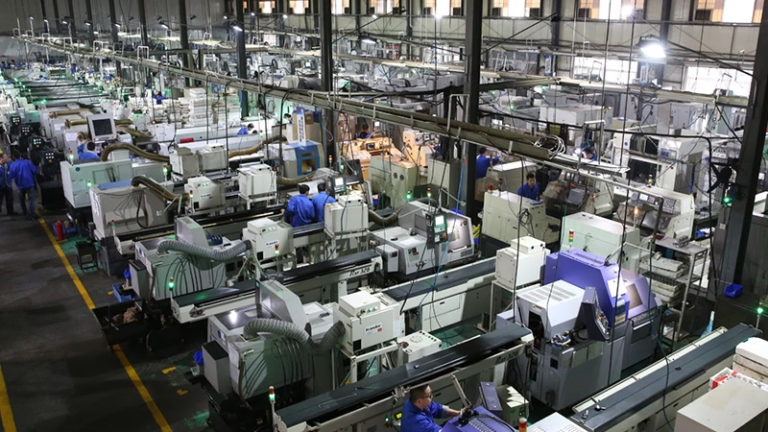
At GreatLight we run 16 simultaneous 5-axis machining centers, 12 four-axis mills, and 27 three-axis machines. That mix matters when you quote a job, because the right machine is the one that matches the part, not the most expensive one on the floor. A simple plate on a 5-axis center wastes spindle time, and a complex impeller on 3-axis wastes setups.
- 13-axisFlat, prismatic parts. One tool direction, multiple setups for complex work.
- 24-axisCylindrical or wrapped parts. One rotary axis, typically A.
- 35-axisContoured, deep, or multi-face parts. Two rotary axes, single setup.
How many axes in a CNC machine does your part need
Start with the number of faces that carry features. If every feature is reachable from the top, a 3-axis machine with a good vise is enough. Count the setups you would need on 3-axis. Two setups are normal. Four or more usually means the fixture cost and the re-datum error will hurt you more than the hourly rate of a 5-axis machine.
Look at the tool length. A deep pocket with a vertical wall needs a long tool on 3-axis, and a long tool deflects. On a 5-axis machine the head tilts, the tool stays short, and the surface finish holds. We hold ±0.005 mm on 5-axis work partly because the tool is stiffer, not only because the machine is more accurate.
Check the tolerance. For a part held to ±0.005 mm across several faces, each setup adds a re-clamping error. A 5-axis setup removes two or three of those errors. For a part with a looser tolerance, say ±0.05 mm, the extra setups are often cheaper than the 5-axis rate. Be honest about which tolerance the drawing actually requires.
Finally, look at the quantity. For one prototype, setup time dominates, so fewer setups win. For 10,000 parts, cycle time dominates, and a well-fixtured 3-axis line can beat a 5-axis cell on cost per part. The answer to how many axes in a CNC machine you need is the smallest number that reaches every feature within tolerance.
- 1Face countOne feature face, 3-axis. Three or more faces, consider 4 or 5-axis.
- 2Tool lengthDeep pockets favor a tilting head and a short tool.
- 3ToleranceEvery extra setup adds re-clamping error.
- 4VolumeLow volume favors fewer setups. High volume favors cycle time.
Reading a machine spec without getting fooled
Machine sellers sometimes count a spindle as an axis, or list a positioning table as a full axis. Read the spec for the word simultaneous. A true 5-axis machine interpolates five axes at once. A 3+2 machine positions two axes and locks them, then cuts with three. Both have five servo motors, but only one can follow a compound 3D contour in one pass.
Check the travels. A 5-axis machine with a trunnion table loses work envelope as the table tilts, because the part swings through a larger circle. Our large machines run 4,000 × 400 × 150 mm, and the medium class covers 750 × 1,150 × 550 mm or 600 × 600 × 600 mm. The rotary table on the compact class is Ø400 mm. If your part is bigger than the swing, the extra axes are useless.
Ask about the post-processor. A 5-axis machine is only as good as its CAM output. Tool axis control, collision checking, and singularity handling all live in the software. A shop that runs 5-axis without a proven post-processor will scrap parts at the first tight corner. That is a software cost, not a machine cost, and it shows up in your quote.
Look at the inspection plan. More axes mean more ways for a setup to drift. At GreatLight we inspect raw material on arrival, monitor in process, and do a final check on 100% of parts before shipment, with reports on request. That is how a 5-axis job stays inside ±0.005 mm instead of relying on the machine spec sheet.
- 1Simultaneous vs 3+2Only simultaneous axes follow a true 3D contour.
- 2Work envelopeA tilting table reduces the usable swing.
- 3Post-processorBad CAM output wastes good hardware.
- 4InspectionMore axes need more checks, not fewer.
Step by step: choosing the axis count for a job
- 11. Read the drawing by faceList every feature and the face it sits on. Mark features that point sideways or downward. That list is your setup count on 3-axis.
- 22. Count the setupsOne or two setups: 3-axis is likely fine. Three to four: price 4-axis. Five or more, or a contoured surface: price 5-axis.
- 33. Check tool accessMeasure the deepest pocket and its corner radius. If a rigid tool cannot reach the floor without a long overhang, a tilting head pays for itself.
- 44. Set the tolerance budgetGive each setup an error allowance. A ±0.005 mm part usually cannot absorb three re-clamping errors, so reduce setups instead of adding inspection.
- 55. Match the work envelopeCompare part size to travel and swing. Do not assume the biggest machine fits. A 4,000 mm bed is for long parts, not for tall ones.
- 66. Confirm the CAM pathAsk for a toolpath simulation before cutting. Check for collisions, gouges, and singularities near the rotary centerline.
- 77. Plan the first articleInspect the first part on all critical features. If the rotary axis drifts, correct it before the run continues. Do not wait for the final inspection.
Axes in a CNC machine compared by part type
Use this table to pick a starting point, then confirm with a DFM review.
| Axis count | Best for | Typical tolerance | Watch out for |
|---|---|---|---|
| 3-axis | Flat plates, brackets, simple pockets | ±0.01 mm or looser | Multiple setups, re-datum error |
| 4-axis | Shafts, rings, wrapped features | ±0.01 mm | Radial access limited to one line |
| 5-axis simultaneous | Impellers, deep cavities, contoured faces | ±0.005 mm | Higher hourly rate, CAM complexity |
| 3+2 positioning | Multi-face parts with flat features | ±0.01 mm | Rotary axes lock, no true contouring |
| Mill-turn | Turned parts with milled flats | ±0.01 mm | Bar size and chuck capacity limits |
Frequently asked questions about axes in a CNC machine
Does the spindle count as an axis?
No. The spindle rotates the tool, but its speed is not a controlled position axis. It is a separate drive function. A machine can have a 20,000 rpm spindle and still be a 3-axis machine.
Is a 3+2 machine a real 5-axis machine?
It has five servo axes, but the two rotary axes lock before cutting. It can position to any angle, but it cannot interpolate five axes at once. For flat features on angled faces, that is enough. For a true 3D contour, you need simultaneous motion.
Can a 4-axis machine cut a helical gear?
Yes, if the rotary axis interpolates with X, Y, and Z. That is a simultaneous 4-axis move. A pure indexer that only rotates and locks cannot do it, because the rotary motion stops during the cut.
How many axes do I need for a part with holes on five sides?
Five sides need at least a 3+2 or 5-axis setup to avoid a second op. On 3-axis you would need three setups, and each one adds a datum shift. Price both options before you decide.
Does more axes always mean better accuracy?
No. More axes add sources of error, and a poorly maintained 5-axis machine can be worse than a solid 3-axis one. Accuracy comes from the machine condition, the fixture, the tool, and the inspection plan, in that order.
What is the maximum part size for 5-axis work?
It depends on the machine class. Our large machines handle up to 4,000 mm in one direction. The medium class covers 750 × 1,150 × 550 mm or 600 × 600 × 600 mm, and the compact class uses a Ø400 mm rotary table. Check the swing, not just the travel.
Get a quote that matches the axis count to your part
Send us your drawing and we will tell you the setup count and the machine class, with a quotation and free DFM analysis within 12 hours.
12-hour quote100% inspectionNo minimum order
More from GreatLight
We publish setup notes, tooling trials and inspection data from the factory floor.











