
Indianapolis CNC Processing Services: How to Choose the Right Supplier
This guide is for engineers and sourcing managers in Indiana who need machined parts and want a supplier they can audit. It covers tolerance, lead time, MOQ, certifications and what to check before you release a purchase order.
In this article
- 1
- 2
- 3
- 4
- 5
- 6
- 7
- 8
Key takeaways
What to check in Indianapolis CNC processing services
Use this table to compare suppliers on the points that actually change your part cost and delivery risk.
| Criterion | Minimum acceptable | What to ask for | Red flag |
|---|---|---|---|
| Tolerance | ±0.005 mm on critical features | Capability study for your feature size | Blanket ±0.01 mm claim |
| Lead time | Quote in 12 hours, parts in 3–5 days | Written schedule with start date | No production start date given |
| MOQ | One piece to 10,000+ | Confirmation in the quote | Minimum order charge per line |
| Certifications | ISO 9001:2015 as baseline | Certificate number and scope | Certificate expired or scope mismatch |
| Inspection | 100% before shipment | Sample inspection report | Visual check only |
| Confidentiality | NDA on request, secure uploads | Signed NDA before drawings | Email-only drawing transfer |
| Materials | Full cert for aluminium and stainless | Mill certificate traceability | No material cert supplied |
| Finishing | In-house or verified partner | Finish thickness and color sample | Unspecified anodize class |
The short version
Choose a supplier on tolerance capability, real lead time, no MOQ and the certificates your industry requires. Everything else is negotiable. If any of those four is weak, keep looking.
Match the machine to the feature, not the drawing title
A drawing that says ±0.005 mm everywhere does not mean every shop can hold it. Tolerance is a function of feature size, material and how many setups the part needs. A 25 mm bore in 6061 aluminium on a 3-axis mill with a good vise is routine. The same callout on a 400 mm thin-wall housing is a different job. Ask which machine will run your part before you accept the tolerance.
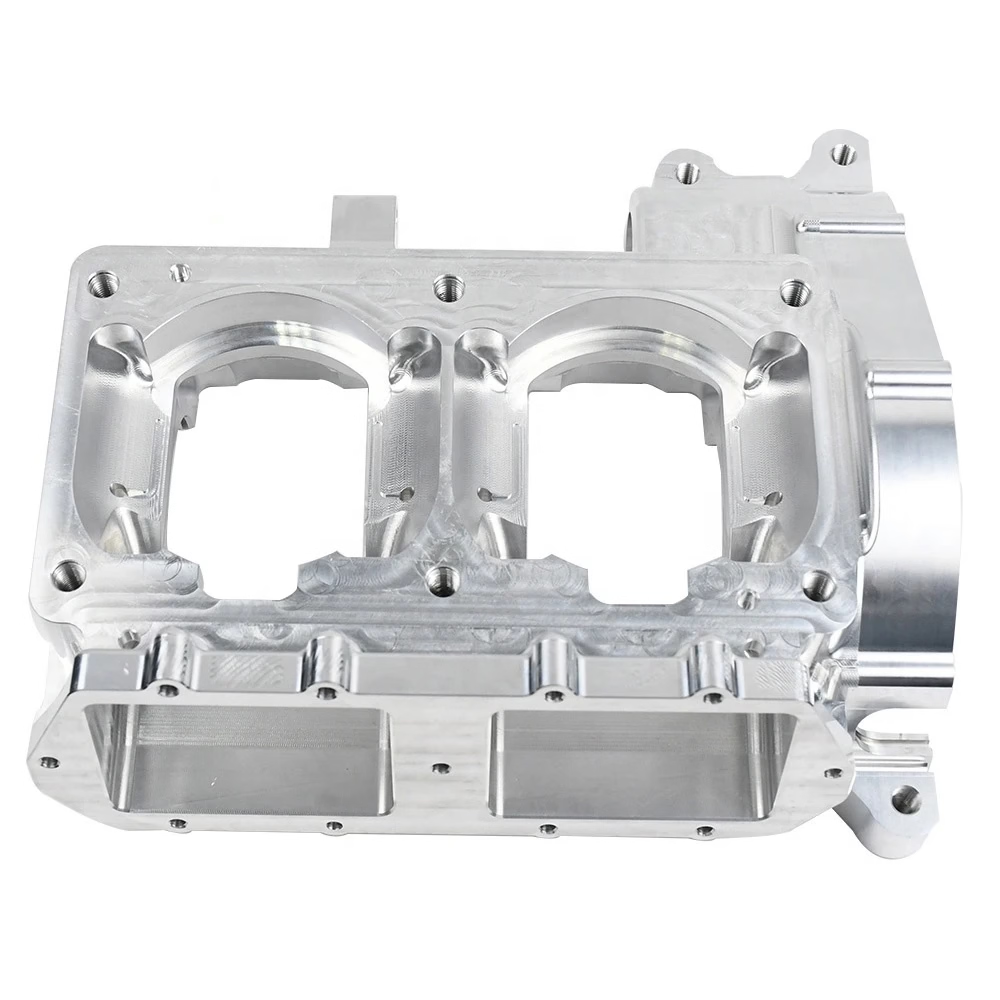
Five-axis work pays off when a part has angled faces, deep pockets or features that would otherwise need three or four setups. Each extra setup adds stack-up error and handling time. On a part like an engine cover with ports on four sides, one 5-axis cycle removes most of that error. On a simple flat bracket, a 3-axis machine is faster and cheaper.
Threads, bore depth and wall thickness are the calls that cause most scrap. A 2:1 length-to-diameter ratio in a deep hole is safe. Past 4:1, you need peck drilling or a gun drill, and the quote should reflect that. Thin walls under 1 mm deflect under cutting force unless the shop uses light passes and support fixtures.
- 1Ask for the machineWhich spindle and which axis count will run your part.
- 2Check the datumA drawing with unclear datums will be quoted with assumptions.
- 3Watch the wallUnder 1 mm, plan for light passes and a support fixture.
- 4Confirm the finishRa 0.8–1.6 μm is standard; Ra 0.2–0.8 μm needs a finishing pass.
Read the schedule as three separate numbers
Suppliers often quote one lead time and hide three. Separate them. First, how long to return a quote and a DFM analysis: for a well-prepared RFQ this should be within 12 hours. Second, how fast production starts after PO: 24 hours is realistic when raw material is in stock or the shop carries common grades. Third, how long the run takes: 3–5 days for typical prototype and low-volume work.
Capacity matters more than the headline number. A shop with 127 high-precision machines and 16 simultaneous 5-axis centers can absorb a rush job without pushing your parts aside. Ask how many machines are dedicated to your part size. A 4,000 mm travel machine is not the same resource as a 500 mm compact mill, and swapping between them changes the schedule.
Late delivery risk is measurable. Ask a supplier for their historical on-time rate. A figure below 2% late is a strong sign that scheduling is realistic. If the number sounds too good, ask what counts as late and whether partial shipments count against it.
Do not accept a verbal promise. A written schedule with a production start date and a ship date gives you something to manage against. It also tells you whether the quote was built from real capacity or from hope.
- 1Quote turnaround12 hours including DFM feedback.
- 2Production startWithin 24 hours of PO and material release.
- 3Run time3–5 days for most prototypes and small batches.
Why a low MOQ usually means a better fit
A no-minimum policy tells you the shop is set up for one-off and prototype work. That means quick changeover, flexible fixturing and operators used to small lots. It is the opposite of a high-volume shop that optimizes for long runs and charges a minimum to cover setup. For a design still under revision, the no-MOQ shop is the safer partner.
Cost at low volume is dominated by setup, programming and fixturing, not by cycle time. Ask for these as separate line items in the quote. If a supplier only gives one number, you cannot tell whether the price is driven by a complex fixture or an expensive material. Split pricing also helps when you later scale to 10,000+ parts: you can see which costs disappear.
Material choice moves the price more than most engineers expect. 6061-T6 aluminium is cheap and machines fast. 17-4PH stainless and Ti-6Al-4V cost several times more per kilogram and cut much slower. Inconel is slower still. If the design allows aluminium, the same geometry can cost a fraction of the stainless version.
Finishing is another hidden line. Anodizing, electroless nickel and powder coating each add a step, a lead time and a handling risk. Ask whether finishing is done in-house or through a partner, and get the finish class in writing.
- 1No minimum order quantityFrom one prototype to 10,000+ part runs.
- 2Split the quoteProgramming, fixturing, material, machining and finishing as separate lines.
- 3Get material certsTraceability matters for aerospace, medical and automotive.
Which certificate actually applies to your part
Certificates are not interchangeable. ISO 9001:2015 is the baseline quality management system and fits general industrial work. IATF 16949:2016 adds automotive-specific requirements such as PPAP support and traceability; without it, an automotive customer may not accept the parts. ISO 13485:2016 covers medical device quality systems. ISO 27001:2022 covers information security, which matters when you send proprietary CAD files.
Check the scope on the certificate, not just the logo. A certificate that covers machining but not finishing does not cover a part that was anodized. Ask for the certificate number and verify the expiry date. Any supplier should send a current PDF without hesitation.
For regulated industries, ask how inspection records are stored and for how long. A supplier that can pull the inspection report for a part shipped two years ago is a different risk profile from one that cannot. This is also where an NDA matters: get it signed before you release drawings, not after.
Confidentiality is a real selection criterion for Indianapolis buyers sending proprietary designs overseas. Secure upload links, restricted access and a signed NDA are the minimum. Ask who inside the shop can see the files.
- 1ISO 9001:2015Baseline for general industrial parts.
- 2IATF 16949:2016Required for automotive and EV programs.
- 3ISO 13485:2016Medical device quality system.
- 4ISO 27001:2022Information security for your CAD data.
Pick the material before you pick the finish
The material list tells you how broad a shop's experience really is. Aluminium grades 6061, 7075 and 2024 cover most brackets, housings and heat sinks. Stainless 303, 304, 316L and 17-4PH cover food, medical and marine environments. Steel 1018, 1045, 4130 and 4140 cover shafts and structural parts. Titanium TC4 and Inconel appear in aerospace and high-temperature work.
Each material changes the cutting parameters and the achievable finish. Aluminium cuts fast and takes a fine finish easily. Stainless work-hardens, so light passes and sharp tools matter. Titanium runs hot and needs coolant and lower surface speed. If a quote seems low for Inconel, ask what cutting data was assumed.
Finishing choices follow the material. Anodizing only works on aluminium. Electroless nickel suits steel and copper alloys. Powder coating adds thickness, so it cannot be used on a tight-tolerance mating surface without masking. Black oxide is thin and keeps dimensions. Bead blasting changes the surface but also removes sharp edges.
Laser marking has a practical limit: minimum character height 1.5 mm. If your part number or logo is smaller than that, plan for a different marking method or a larger area. This is a small detail that causes rework when it is missed.
- 1Aluminium6061-T6, 7075, 2024, 6082 and ADC12.
- 2Stainless303, 304, 316L, 17-4PH and 440C.
- 3Titanium and specialTC4 (Ti-6Al-4V), Inconel, magnesium AZ31B.
- 4PlasticsPOM, PEEK, PC, ABS and carbon fibre.
How to prepare an RFQ that gets a usable quote
Follow these steps in order. Skipping step 2 is the most common reason a quote comes back with assumptions you did not intend.
- 1Send a 3D model and a 2D drawingSTEP or IGES for geometry, PDF for tolerances and notes. A model alone leaves every tolerance open to interpretation.
- 2Mark critical featuresFlag the dimensions that matter with a symbol or a note. If everything is critical, nothing is, and the price goes up.
- 3State the material and finishGive the grade, not just 'aluminium'. 6061-T6 and 7075 machine and cost differently. Name the finish class and the color.
- 4Give the quantity and the target dateOne prototype and 500 parts are different quotes. State the date you need parts in hand, not the date you want to order.
- 5Ask for DFM feedbackA good shop will point out a 0.5 mm wall or a 6:1 deep hole before quoting. This should come within 12 hours.
- 6Review the quote line by lineCheck that material, machining, finishing, inspection and shipping are all included. Ask what is excluded.
- 7Sign the NDA before releasing full drawingsIf the part is proprietary, get the NDA in place first. Secure uploads are standard.
- 8Confirm the first article inspectionFor a new part, ask for a first article report before the full run. It catches fixture and programming errors early.
Questions buyers ask before choosing a supplier
How tight a tolerance can Indianapolis CNC processing services actually hold?
±0.005 mm is achievable on critical features when the material, fixture and machine support it. That figure applies to specific dimensions, not to the whole part.
On a 400 mm part, thermal expansion alone can move a dimension by more than the tolerance. Ask the supplier which features will be held at ±0.005 mm and which will be looser.
What is a realistic lead time for a prototype?
Quote and DFM feedback within 12 hours is realistic for a complete RFQ. Production can start within 24 hours once the PO and material are released.
Most prototype parts ship in 3–5 days. Complex 5-axis parts with finishing may take longer, and the quote should say so.
Is there a minimum order quantity?
A shop set up for prototypes will run from one piece to 10,000+ parts with no minimum order quantity.
If a supplier quotes a minimum charge per line, that is a sign the setup is optimized for volume, not for design iteration.
Which certifications should I require?
ISO 9001:2015 is the baseline. Add IATF 16949:2016 for automotive, ISO 13485:2016 for medical, and ISO 27001:2022 if you are sending sensitive CAD data.
Always check the scope and expiry date on the certificate, not just the logo on the website.
How do I protect my design when sending files?
Sign an NDA before releasing drawings, and use a supplier that offers secure uploads. Ask who inside the shop can access the files.
For regulated work, confirm how inspection records and revisions are stored and for how long.
What should be excluded from a quote?
Freight, tariffs, tooling that is not reused, and third-party finishing are common exclusions. Ask directly so there is no surprise later.
If a line item is missing, ask why. A quote with no material line usually means material is bundled into the machining rate.
Send your drawing and get a quote in 12 hours
Upload a STEP file and a 2D drawing. We return pricing and DFM feedback within 12 hours, and production can start within 24 hours.
12-hour quoteNo MOQ100% inspectionNDA on request
More from GreatLight
We publish setup notes, tooling trials and inspection data from the factory floor.











