
Common Metal Materials and Surface Treatment: An Engineer's Explainer
This page covers how the main alloy families behave on a CNC, and what each surface treatment actually does to the part. It is written for design engineers and buyers who need to pick a material and a finish without guessing. By the end you should be able to tell when a pairing works and when it will fail at the drawing stage.
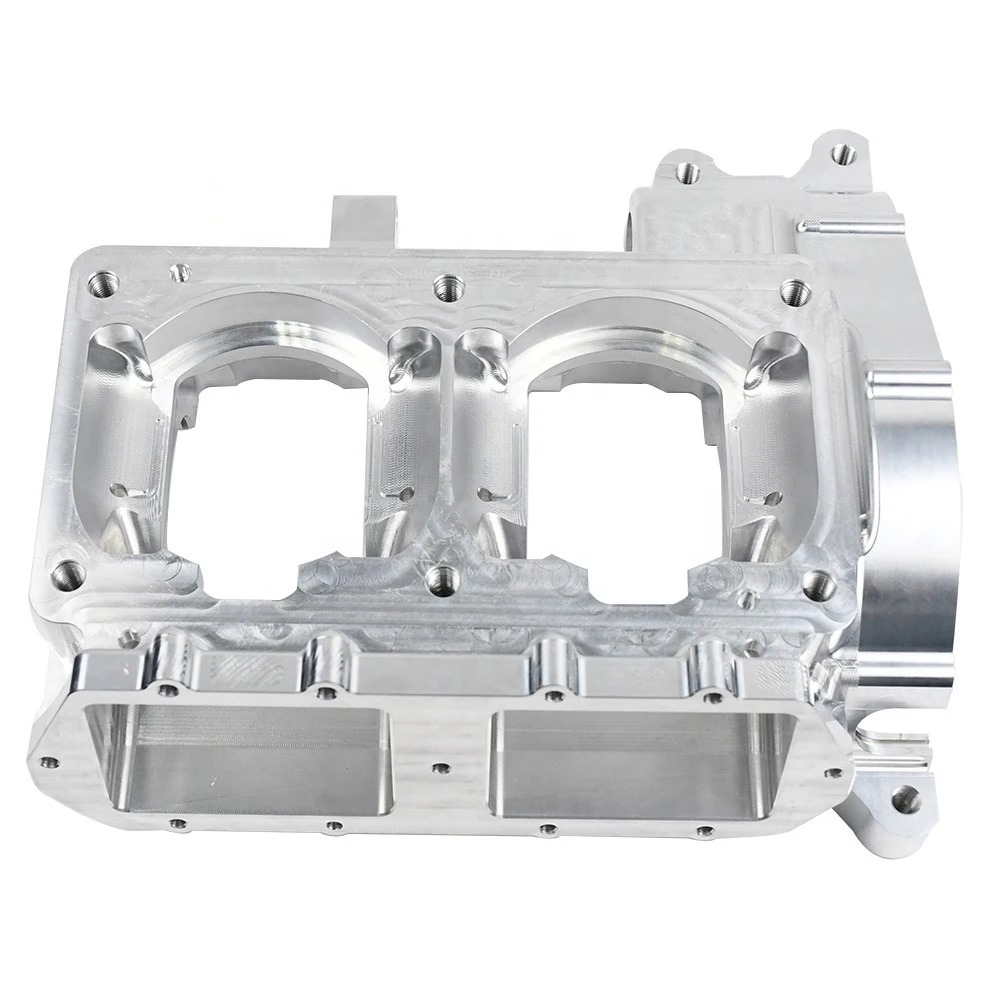
How the main metal groups behave at the spindle
Material choice starts with the alloy group, not the grade number. Aluminum, stainless, carbon steel, copper alloys and titanium each cut differently, and that difference shows up in cycle time, tool wear and the finish you can hold. A part that runs clean in 6061 may need three passes in 17-4PH. Before you fix a grade, decide which of these five families the part belongs to.
Aluminum is the default for housings, brackets and heat sinks. 6061-T6 machines fast, takes anodizing well and holds ±0.005 mm on a rigid setup. 7075 is stronger but galls more and costs more per kilo. 2024 has better fatigue life, though it needs a protective finish because it corrodes faster than 6061 in humid air.
Stainless 303 and 304 cover most turned and milled parts. 303 is free-machining, so it produces short chips and good finishes. 304 work-hardens if the tool rubs instead of cuts, which is the single most common cause of a scrapped stainless part. 316L and 17-4PH come in when corrosion resistance or strength matters more than cycle time.
Carbon and alloy steels like 1018, 1045 and 4140 are cheap, stiff and easy to weld. They rust, so they almost always need plating, black oxide or paint. 4140 machines well in the annealed state but gets difficult above 30 HRC. Titanium TC4 and Inconel sit at the other end: low thermal conductivity, high tool pressure, and a real risk of work hardening if the feed is too light.
- 1AluminumFast to cut, anodizes well, good for housings and heat paths.
- 2StainlessCorrosion resistance, but work-hardens if the tool rubs.
- 3Carbon steelCheap and stiff, needs a coating to stop rust.
- 4TitaniumStrong and light, slow to cut, watch the heat.
Machinability is a cost driver, not a spec
Two parts with the same tolerance can cost very different amounts because of machinability. A 6061 bracket might run in one op with a 12 mm end mill. The same bracket in 316L needs slower speeds, more coolant and possibly a second op to relieve stress. The drawing looks the same. The quote does not.
The number to watch is the cutting speed the alloy tolerates. Aluminum runs at high surface speed, so cycle time drops. Stainless runs at roughly a third of that. Titanium and Inconel run lower still, and tool life falls off quickly when you push them. This is why we ask about function before we quote a tight tolerance on an exotic alloy.
Thin walls and deep pockets make it worse. A 1 mm wall in 6061 is routine. The same wall in 17-4PH will move during and after cutting, so we either leave stock for a finishing pass or recommend a different grade. If the wall is structural, changing the alloy is often cheaper than adding fixtures and stress-relief steps.
Surface finish follows the same logic. As-machined parts sit around Ra 1.6–3.2 μm. Getting to Ra 0.8–1.6 μm is normal on a good setup. Pushing to Ra 0.2–0.8 μm needs a dedicated finishing pass, sharp tooling and often a vibration-free machine. On soft aluminum that is achievable. On gummy copper alloys it is a fight.
- 1Rough first, then finishLeave 0.2–0.5 mm for the finishing pass on tight walls.
- 2Match tool to alloyAluminum-specific geometry for aluminum, never for steel.
- 3Stress reliefAdd it when the part is thin, long or will be heat treated later.
What surface treatment actually does to a part
A surface treatment changes three things: corrosion resistance, wear resistance and appearance. Sometimes all three. Anodizing on aluminum grows a hard oxide layer that resists scratching and can be dyed. Hardcoat anodizing goes thicker and is used on sliding surfaces and wear pads. It adds a few micrometres per side, so thread and bore allowances need to be planned before the part is cut.
Plating works differently. Electroless nickel deposits an even layer on complex shapes, including internal channels, and gives good wear and corrosion performance. Zinc plating is cheaper and common on steel brackets, but it is a sacrificial coating: it protects by corroding first. Silver and gold plating are for conductivity and contact resistance, mostly on electronics hardware.
Black oxide and powder coating are mostly about appearance and light corrosion protection. Black oxide is a chemical conversion that barely changes dimensions, which makes it useful on tight-tolerance steel parts. Powder coating is thicker, typically 60–100 μm, and can bridge small features. Do not specify it on a mating surface that needs to slide.
Mechanical finishes come before chemical ones. Bead blasting gives a uniform matte look and hides tool marks. Tumbling deburrs edges on small parts in volume. Brushing leaves a directional grain that shows on flat panels. Polishing reaches the lowest Ra values but costs the most labor. The order matters: blast first, then anodize, or the finish will look patchy.
- 1AnodizingAluminum only. Adds 5–25 μm per side depending on type.
- 2Electroless nickelEven coverage on complex geometry, good wear.
- 3Bead blastingUniform matte, hides machining marks before coating.
- 4Laser markingMinimum character height 1.5 mm for legible marks.
Pairing materials with the right finish
Most finish problems come from a mismatch, not from a bad coating line. Aluminum and anodizing are a natural pair because the oxide grows from the metal itself and bonds permanently. Steel and anodizing is impossible. Steel wants plating, black oxide or paint. Stainless often needs nothing at all, though passivation is common after machining to remove free iron from the surface.
Copper and brass are usually left bare or given a clear lacquer. They tarnish quickly, and plating them changes the conductivity that made you choose them. If the part is a busbar or a contact, keep the surface bare and control the finish with machining instead. If it is decorative, a thin nickel or gold layer holds the look without hurting performance.
Titanium is a special case. It forms its own oxide layer, so it does not need a coating for corrosion. Anodizing titanium changes color through oxide thickness and is used for identification and medical instruments. It is not a wear coating. If you need wear resistance on titanium, plan for a hard coating instead.
Magnesium alloys like AZ31B and AZ91D corrode easily and need a conversion coating or paint. They are light and machine well, but they are also a fire risk in fine chip form, so the shop has to handle them carefully. If you can use aluminum instead, do. The weight saving is real but the finishing burden is higher.
- 1Aluminum + anodizingProven pair. Plan thread allowances around the growth.
- 2Steel + plating or black oxideBlack oxide for tight tolerances, zinc for cost.
- 3Stainless + passivationRemoves free iron after machining. No color change.
When a material or finish is the wrong choice
If the part sees salt spray, bare carbon steel is the wrong answer no matter how good the plating looks. Plating scratches at assembly, and once the barrier is broken, rust starts at the scratch. Choose stainless or aluminum with a hard anodized layer instead. The cost difference is smaller than a field failure.
If the part runs at high temperature, be careful with coatings that are organic. Powder coating and some paints break down above 150 °C. Anodizing and nickel plating hold up better. Above 400 °C, even anodizing changes, and you should be looking at a different base material rather than a coating.
If the part needs to conduct electricity, anodizing is the wrong choice. The oxide layer is an insulator. Use a conductive anodizing type or leave the surface bare and mask the contact areas. Masking adds an operation, so tell us where the contact points are on the drawing.
If the part is a prototype that may change, skip the expensive finish. Run the first article as-machined, check the fit, then finish it once the design is frozen. A finish that has to be stripped and redone costs more than waiting a week.
- 1Salt sprayAvoid bare carbon steel and thin sacrificial coatings.
- 2High temperatureOrganic coatings fail above 150 °C.
- 3Electrical contactAnodizing insulates. Mask the contact zones.
Material and finish pairing at a glance
Use this to shortlist before you send a drawing.
| Material group | Typical finish | Corrosion | Watch out for |
|---|---|---|---|
| Aluminum 6061 | Anodizing | Good | Dimension growth on threads |
| Aluminum 7075 | Hardcoat anodizing | Good | Higher cost per kilo |
| Stainless 303 / 304 | Passivation | Very good | Work hardening if rubbed |
| Stainless 17-4PH | Passivation | Very good | Hard on tooling |
| Carbon steel 1018 | Black oxide or zinc | Poor bare | Rust at scratches |
| Alloy steel 4140 | Electroless nickel | Moderate | Difficult above 30 HRC |
| Copper / brass | Bare or clear lacquer | Tarnishes | Plating changes conductivity |
| Titanium TC4 | Anodizing for color | Excellent | Slow cutting, tool wear |
The short version
Pick the material for strength, corrosion and machinability first, then choose the finish that protects it. If the part must stay conductive, leave it bare. If it must resist wear, anodize aluminum or plate steel. Never pick a finish that fights the base metal.
Common questions
Does anodizing change the part dimensions?
Yes. Type II anodizing typically adds 5–15 μm per side and hardcoat adds more. On a ±0.005 mm part, that matters.
Tell us the critical dimensions before anodizing and we will adjust the pre-plate size so the finished part lands in tolerance.
Can you anodize stainless steel?
No. Anodizing only works on aluminum, titanium, magnesium and a few other metals that grow a stable oxide.
Stainless is usually passivated instead, which removes free iron from the surface without adding a coating.
Which finish is best for outdoor aluminum parts?
Hardcoat anodizing is the default for outdoor use. It resists scratching, UV and salt spray better than clear anodizing.
If color matters, type II anodizing with a dye holds up well, though it will fade in strong UV over years.
How tight a tolerance can you hold after plating?
We hold ±0.005 mm on machined features, and we plan plating allowances into the pre-plate dimensions.
Electroless nickel is more uniform than electrolytic plating, so it is easier to control on complex shapes.
Do you need a minimum order quantity for a finished part?
No. We run from one prototype to 10,000+ part runs.
A single anodized prototype is fine, though the setup cost per part is naturally higher than on a batch.
Send us the drawing and the working environment
We will come back with a material and finish recommendation, a DFM note and a price within 12 hours.
12-hour quote100% inspectionNDA on request
More from the shop floor
We publish setup notes, tooling trials and inspection data from the factory floor.











