
Fuyin CNC Machining Technology: How the Fifth Axis Works
Fuyin CNC machining technology is five-axis CNC work that adds rotation to the spindle, the table, or both. This page explains the mechanism, the real limits, and which part geometries justify the extra setup. Written for engineers and buyers who need to decide before quoting.
In this article
- 1
- 2
- 3
- 4
- 5
- 6
- 7
What fuyin CNC machining technology actually adds
A three-axis mill moves the tool along X, Y and Z. The part stays clamped at one angle, so any feature facing away from the spindle needs a second setup. Each setup brings a new fixture, a new zero point, and a new stack of positional error.
Fuyin CNC machining technology keeps the three linear axes and adds rotary motion. On a trunnion machine the table tilts and rotates; on a spindle-tilt head the tool swings instead. Either way the cutting edge can reach five faces of a part without unclamping it.
That single-setup idea is the whole point. Fewer setups mean fewer datum shifts and tighter true position between features. On a bracket with bores on four sides, three-axis work might need four fixtures. Five-axis work needs one.
The trade is rigidity and cost. A rotary axis holds the part further from the spindle nose, so long tools deflect more. Deep pockets in hard steel still favor a rigid three-axis setup with a short tool.
- 1Simultaneous vs indexedSimultaneous moves all five axes at once; indexed locks the rotary axes between cuts.
- 2Trunnion vs headTrunnion tilts the table; head tilts the spindle. Table size sets the part envelope.
- 3One datumFeatures on five faces share a single zero point, so position error does not accumulate.
How the fifth axis is configured on the floor
Rotation can sit on the table, on the spindle, or on both. A trunnion table with a Ø400 mm rotary table suits parts up to roughly that diameter. Larger work moves to a head-tilt machine where the table stays flat and only the tool articulates.
GreatLight runs 16 simultaneous five-axis machining centers, 12 four-axis mills, 27 three-axis machines, and 16 mill-turn centers. Maximum processing size reaches 4,000 mm, with travels of 4,000 × 400 × 150 mm on the largest frame and 750 × 1,150 × 550 mm on mid-size machines.
Simultaneous five-axis means all rotary and linear axes interpolate at the same time. That is what lets a Ø12 mm ball tool sweep a contoured blade or a port without leaving witness lines. Indexed five-axis is cheaper to program and often enough for hole patterns.
Post-processor quality decides the result as much as the machine does. A wrong rotary center offset shows up as a taper in a bored hole. We probe the rotary center and re-check it after any crash or spindle service.
- 1Probe firstRotary center and tool length are measured before the first cut, not assumed.
- 2Short toolsKeep tool overhang under 4× diameter where the geometry allows.
- 3Stock onLeave 0.3–0.5 mm on contoured surfaces for the finishing pass.
Which parts belong on five axes, and which do not
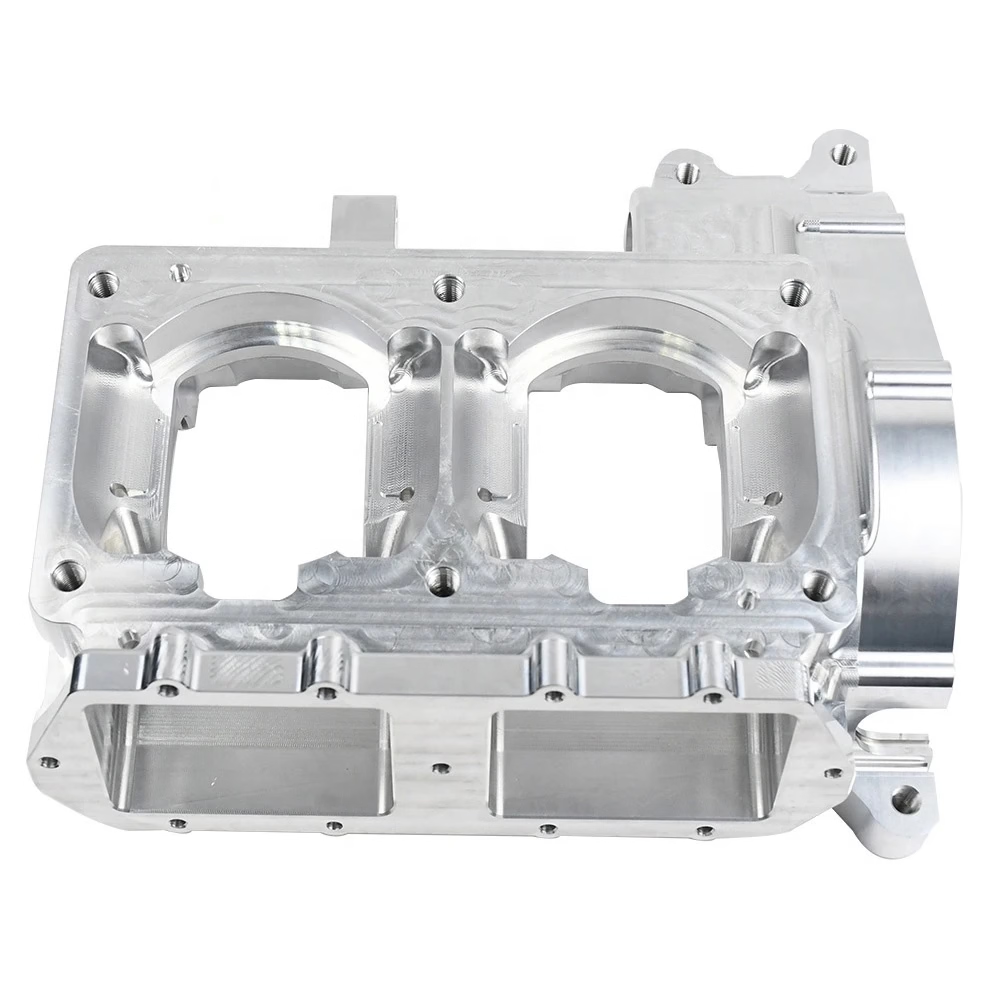
Five-axis work pays off when features sit on multiple faces, when the part is a one-off and fixtures would cost more than machining, or when a contoured surface needs a continuous tool path. Aerospace structural brackets, impellers, and medical housings fall into this group.
It also helps when the part is hard to hold. A five-axis setup can angle the part so the tool reaches a wall without a tall, flexible cutter. That keeps chatter down on thin ribs made from 7075 or 17-4PH.
Some jobs should stay on three axes. A flat plate with holes on one face, a simple shaft turned on a lathe, or a prismatic block with pockets will run faster and cheaper on a rigid three-axis machine. Programming time is lower and the fixture is simple.
Very deep small-diameter holes are another case for three axes. A long drill in a rotary setup flexes, and the hole drifts. If the part needs a Ø3 mm hole 60 mm deep, drill it on a three-axis machine before the five-axis op.
Material matters too. Aluminium 6061 and 6082 cut cleanly at high spindle speed. Titanium TC4 and Inconel need lower surface speed, more coolant, and shorter tool life, so the five-axis cycle is longer and the cost per part climbs.
- 1Good fitMulti-face features, contoured surfaces, one-off complex parts, thin ribs.
- 2Poor fitSingle-face plates, simple turned shafts, very deep small holes.
- 3Cost driverHard alloys and long tools raise cycle time more than axis count does.
Tolerance, finish, and what the numbers mean
GreatLight holds ±0.005 mm (±0.0002 in) on qualifying features. That number is a capability under controlled conditions, not a promise on every dimension of every part. Thin walls, long bores, and hard alloys widen the band.
Surface finish depends on the pass. As-machined surfaces land at Ra 1.6–3.2 μm. A high-finish cut reaches Ra 0.8–1.6 μm, and fine finishing with a small stepover gets to Ra 0.2–0.8 μm. Each step adds time, so specify only what the function needs.
A sealing face or a bearing bore usually needs Ra 0.8 μm or better. A cosmetic cover often does not. Over-specifying finish is one of the most common ways to inflate a five-axis quote without adding value.
Inspection closes the loop. We check raw material on arrival, monitor in process, and inspect 100% before shipment, with reports on request. For five-axis parts the report typically covers the datum faces and the contoured features that drove the setup.
- 1Capability±0.005 mm on qualifying features under stable conditions.
- 2Finish stepsRa 3.2 → 1.6 → 0.8 → 0.2 μm, each adding cycle time.
- 3ReportDimensional reports on request, covering datums and key contours.
Materials, tooling, and post-machining steps
Aluminium covers 6061, 6061-T6, 2024, 5052, 5083, 6063, 6082, 7075, and ADC12. Stainless grades include 303, 304, 316, 316L, 420, 430, 431, 440C, and 17-4PH. Steels run from 1018 and 1045 through 4130, 4140, 4340, and A36 to tool steel.
Copper and brass work includes C101, C103, C110, beryllium copper, C27400, C28000, and C36000. Titanium and special alloys cover TA1, TA2, TC4 (Ti-6Al-4V), Inconel, and magnesium AZ31B / AZ91D. Plastics range from ABS and PC to POM, PEEK, PP, HDPE, and carbon fibre.
Tool choice follows the material. Aluminium runs best with 2- or 3-flute carbide at high speed and air blast. Titanium and Inconel need coated carbide, lower surface speed, and flood coolant to keep the edge alive.
Finishing often follows machining. Anodizing in clear, colour, hardcoat, or conductive grades suits aluminium. Electroless nickel, zinc, silver, and gold plating cover wear and conductivity needs. Powder coating and black oxide handle appearance and corrosion.
Bead blasting, tumbling, brushing, and polishing tune the surface. Laser marking and engraving are available down to a minimum character height of 1.5 mm, which matters when a part carries a serial number.
- 1AluminiumHigh speed, air blast, watch for built-up edge on soft 5052.
- 2TitaniumCoated carbide, low surface speed, flood coolant, short tool life.
- 3FinishesAnodizing, plating, powder coat, blasting, laser marking.
From file to finished part: the practical sequence
It starts with a 3D model and a drawing. We review the file and return a quotation with a free DFM analysis within 12 hours. The DFM note flags features that will be hard to hold, thin walls, and tolerances that cost more than they are worth.
Once the design is agreed, production can start within 24 hours. Programming builds the tool path, the post-processor converts it to machine code, and the operator proves the setup on the first article before running the batch.
Parts ship in 3–5 days for typical work. There is no minimum order quantity, so a single prototype and a 10,000+ part run go through the same process. Historical late-delivery probability sits below 2%.
Uploads stay secure and confidential. An NDA is available on request, which matters for aerospace and medical programs where the drawing itself is controlled.
Nothing here replaces a drawing review. Send the file and the critical dimensions, and we will tell you where the five-axis setup helps and where a simpler process is cheaper.
- 1QuoteQuotation and free DFM analysis within 12 hours.
- 2StartProduction can start within 24 hours of approval.
- 3ShipTypical parts ship in 3–5 days.
Three-axis vs indexed five-axis vs simultaneous five-axis
Match the part to the cheapest process that holds the tolerance.
| Criterion | 3-axis | Indexed 5-axis | Simultaneous 5-axis |
|---|---|---|---|
| Best part shape | Flat plates, single-face pockets | Multi-face holes and pockets | Contoured blades, ports, organic ribs |
| Number of setups | 2–4 typical | 1–2 | 1 |
| Position error | Accumulates per setup | Low, shared datum | Lowest, one datum |
| Programming effort | Low | Medium | High, needs a post-processor |
| Typical cycle time | Shortest per face | Medium | Longest on hard alloys |
| Fixtures | Simple, cheap | Moderate | Often a single soft jaw or vise |
| When to avoid | Features on 4+ faces | Free-form surfaces | Simple prismatic work |
| Rigidity | Highest | Good | Lowest, part sits off the nose |
Pick the axis count that matches the geometry
If features sit on three or more faces or include free-form contours, choose simultaneous five-axis. If the part is a flat plate or a simple prismatic block, stay on three axes and spend the savings on finishing.
Common questions about fuyin CNC machining technology
Is fuyin CNC machining technology the same as five-axis machining?
In practice, yes. The term describes CNC work where one or more rotary axes move the spindle or the part, on top of the three linear axes.
The distinction that matters on the floor is simultaneous versus indexed motion. Simultaneous interpolates every axis at once; indexed locks the rotary axes between cuts and is closer to a multi-setup three-axis job.
What tolerance can five-axis work hold?
We hold ±0.005 mm (±0.0002 in) on qualifying features. That figure assumes stable conditions, a rigid setup, and a feature that is not a thin wall or a long bore.
Hard alloys such as Inconel and thin ribs in 7075 will run wider. Tell us which dimensions are functional so we can focus the process where it counts.
Which materials are available?
Aluminium, stainless steel, carbon and alloy steel, copper and brass, titanium, Inconel, magnesium, and engineering plastics including PEEK and carbon fibre.
Specific grades are listed in the materials section above. If your grade is not listed, send the specification and we will confirm before quoting.
Can you handle a single prototype?
Yes. There is no minimum order quantity. One prototype and a 10,000+ part run use the same quoting and inspection process.
For prototypes we often recommend five-axis work because there is no fixture to build, which keeps the first article cheap and fast.
How is quality checked on a five-axis part?
Raw material is checked on arrival, the process is monitored in run, and 100% inspection happens before shipment. Dimensional reports are available on request.
For contoured parts the report usually covers the datum faces and the surfaces that drove the five-axis setup.
Do you sign an NDA?
Yes, an NDA is available on request. Uploads are handled as secure and confidential.
That applies to aerospace, medical, and any program where the drawing or the model is controlled.
Send the drawing, get a five-axis answer in 12 hours
Upload your model and critical dimensions. We will return a quotation with a free DFM analysis and tell you whether five-axis work is worth it for this part.
12-hour quoteNo minimum order quantity100% inspection
More from GreatLight
We publish setup notes, tooling trials and inspection data from the factory floor.











