
Is a Spack Cutter a CNC Machine?
A spack cutter is the tooling block in a die-cutting press, and in some shops that press is fully CNC controlled. This page explains the mechanism, the boundary between manual and CNC versions, and how to tell which one you are actually quoting. Read it before you buy or reverse-engineer one.
In this article
- 1
- 2
- 3
- 4
- 5
- 6
- 7
- 8
- 9
What decides the answer
What a spack cutter actually is
A spack cutter is a cutting tool or tool holder used to punch, trim or crease sheet material in a die-cutting press. The name shows up most often in packaging, gasket and leather shops. The tool itself is passive: a steel body with a shaped edge, sometimes with adjustable blades. It does not move on its own. It only cuts when something drives it into the workpiece.
That distinction matters because people ask whether a spack cutter is a CNC machine. The honest answer is that the cutter is one component. The machine is the frame, the ram, the table and the control that position it. You can bolt the same cutter into a manual fly press or into a CNC-controlled press with servo feed axes. Same tool, different machine.
In our shop we see this confusion most often on quote requests for gasket tooling and trim dies. A buyer sends a drawing of a cutter block and asks for CNC machining. What they usually need is the block itself machined to tight tolerance, then mounted in whatever press they already own.
So when someone asks is a spack cutter a cnc machine, the useful reply is another question: which part of the system are you buying? If it is the cutter body, it is a machined part. If it is the press with servo axes and a controller, that is the CNC machine.
- 1CutterThe shaped steel tool that does the cutting.
- 2PressThe frame and ram that supply force.
- 3ControlThe axes, servos and program that make it CNC.
How the cutting action is generated
Manual spack cutting relies on a lever, a flywheel or a hydraulic ram. The operator places the sheet by hand, trips the press, and the cutter descends on a fixed stroke. Depth is set by shims or a mechanical stop. Repeatability depends on the stop and on how hard the operator pulls. On soft gasket paper this is fine. On 0.5 mm stainless shim it drifts within a few hundred strokes.
A CNC version replaces the fixed stroke with a programmed axis. The Z axis moves the cutter to a commanded depth, often to ±0.01 mm or better on a good servo. The X and Y axes index the sheet between hits so a single cutter can produce a nested pattern. The controller stores the pattern as G-code, so the same job can be repeated next month without re-setting stops.
There is a middle ground. Many presses are CNC on the feed axes but still use a mechanical punch stroke. The sheet is positioned by servo, then a hydraulic ram fires. This is common in high-volume packaging because it is faster than a full CNC stroke. The cutter is still the same passive block.
The practical result: CNC control changes where and how deep the cutter lands, not what the cutter is made of. Tool steel, carbide insert and coated HSS all behave the same way once the control is set. If your problem is pattern accuracy, the control helps. If your problem is edge wear, the control does not.
- 1ManualFixed stroke, shim-set depth, operator-fed sheet.
- 2CNC feedServo X and Y position the sheet, ram still fires.
- 3Full CNCProgrammed Z depth plus servo feed, stored as G-code.
Where the CNC label stops being useful
The label stops being useful when the cutter is the only thing on the quote. A cutter body is a machined part: it needs flatness, a sharp edge and a mounting interface. Calling it CNC does not change how it is made. It is milled, ground and hardened, then inspected. The control on the press is irrelevant to that work.
It also stops being useful when the buyer assumes CNC means automatic. A CNC press with a spack cutter still needs setup: tool height, sheet registration, clamp pressure, stripper clearance. Those are mechanical settings. Software does not remove them. On a short run of 200 parts, setup often costs more than the cutting.
One more boundary: material. A spack cutter is built for sheet and web. It is not a milling cutter and it is not a drill. If you need pockets, threads or 3D contours, you need a milling machine, not a die press with a shaped block. We quote both, and the drawings look completely different.
So the accurate statement is narrow. A spack cutter can be part of a CNC machine. It is not, by itself, a CNC machine. Anyone who tells you otherwise is selling a category, not a specification.
How we machine and inspect spack cutter bodies
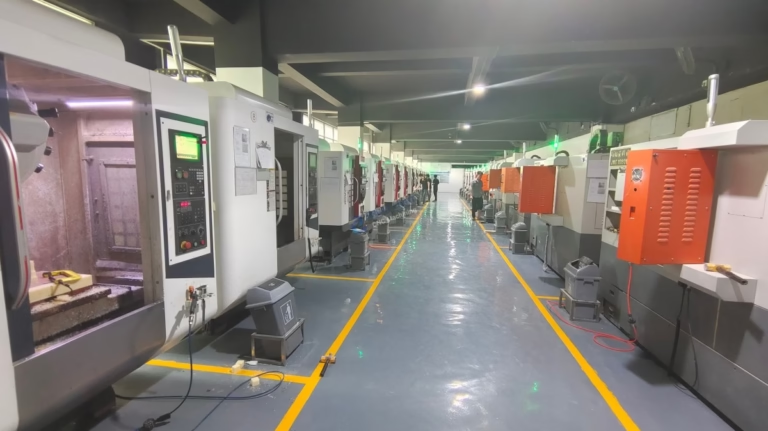
We machine cutter bodies on 3-axis and 5-axis centers depending on the edge geometry. A flat block with a straight blade seat goes on a 3-axis mill. A curved trim edge or an angled relief needs 5-axis so we can cut the profile and the clearance in one setup. That single setup keeps the edge concentric with the mounting bore.
Typical tolerance on the mounting bore and blade seat is ±0.005 mm. Blade seat flatness matters more than the outer profile; a seat that rocks by 0.02 mm will chip the edge on the first hit. We hold seat flatness to 0.01 mm over the full length and check it on a granite plate before hardening.
Hardening depends on the material. O1 and D2 tool steel go to 58-60 HRC, then we grind the cutting edge to Ra 0.2-0.8 μm. If the customer wants a replaceable insert, we machine the pocket to ±0.005 mm and supply the insert separately so they can swap it without re-machining the body.
Inspection is 100% before shipment. We check raw material certificates, monitor the critical dimensions in process, and run a final dimensional report on the finished body. Reports are available on request. For gasket and packaging tooling we also mark the part number by laser; minimum character height is 1.5 mm.
- 13-axisStraight blade seats, flat blocks, simple trim profiles.
- 25-axisCurved edges and angled relief, one setup.
- 3MaterialsO1, D2 tool steel, 4140, 17-4PH, 6061 for fixtures.
What to put on the drawing
If you are buying a cutter body, the useful drawing calls out the mounting interface first: bolt pattern, bore diameter and seat depth. Those three control whether the tool fits your press. Edge geometry comes second. Profile tolerance comes third, and only on the surfaces that form the cut.
Add the material and hardness you need, plus the surface finish on the cutting edge and the seat. State whether the edge is a solid ground edge or a replaceable insert. If it is an insert, give the pocket tolerance and the retention method. Those choices drive the machining time more than the outer shape.
If you are buying the press instead, the drawing is irrelevant. You need to specify stroke, tonnage, table size, feed axes and control. That is a machine purchase, not a machining job. Mixing the two on one quote slows everything down.
We ask for a 2D PDF plus a 3D STEP file when possible. The PDF tells us the tolerances and datum scheme; the STEP tells us the true form. With both, we return a DFM note and a quotation within 12 hours. Production can start within 24 hours after approval.
When the cutter fails, not the machine
Most spack cutting problems trace back to the tool, not the control. Chipped edges come from a rocking blade seat, wrong clearance angle, or hitting a double sheet. If the edge chips in the same spot every run, check the seat flatness first. If it chips randomly, check the sheet feed and the stripper.
Short edge life usually means the hardness is wrong for the material being cut. A 58-60 HRC edge lasts on paper and gasket board. On abrasive filled polymer or glass-filled sheet, it dulls fast. In that case we switch to a carbide insert or a coated edge, and sometimes increase the clearance angle by 2 to 3 degrees.
Burrs on the cut edge point to clearance. Too little clearance and the sheet tears; too much and the edge folds rather than shears. For 0.2 mm to 1.0 mm sheet, a clearance of 5% to 8% of thickness per side is a practical starting point. Adjust from there based on the cut face.
None of these fixes involve the CNC control. That is the point. Buying a CNC press will not solve a dull edge or a bad seat. Fix the tool geometry first, then decide whether the machine needs upgrading.
- 1ChippingSeat flatness, clearance angle, double sheet.
- 2Short lifeHardness mismatch, switch to carbide or coating.
- 3BurrsClearance wrong; start at 5%-8% of thickness.
Five checks before you call it CNC
Run these on the machine in front of you, not on the brochure.
- 11. Count the servo axesOpen the control cabinet or the parameter list. If X, Y and Z show servo drives with position feedback, it is CNC on those axes. A single-speed motor on the ram is not.
- 22. Look for stored programsA CNC control holds part programs. If the operator re-sets mechanical stops for every job, there is no program. Ask to see the program directory.
- 33. Check the depth methodProgrammed depth means the Z value is typed in. Shim or stop-block depth means it is manual. This single check answers most of the question.
- 44. Measure pattern repeatabilityRun 20 hits and measure hole position with a CMM. Within ±0.01 mm points to servo feed. Drift of ±0.1 mm or more points to manual indexing.
- 55. Read the cutter drawingIf the drawing only defines the tool block, you are buying a machined part. The CNC question belongs to the press, not the cutter.
Manual vs CNC spack cutting
Use this to decide which machine your part actually needs.
| Factor | Manual press | CNC feed press | Full CNC press |
|---|---|---|---|
| Depth control | Shims or hard stop | Fixed ram stroke | Programmed Z axis |
| Pattern accuracy | Operator dependent | ±0.05 mm typical | ±0.01 mm or better on good servo |
| Sheet handling | Hand fed | Servo X and Y | Servo X, Y and Z |
| Best run size | Under 500 parts | 1,000 to 100,000 parts | Prototype to 10,000 parts |
| Setup time | 5 to 15 minutes | 30 to 60 minutes | 30 to 90 minutes |
| Cutter body | Same machined block | Same machined block | Same machined block |
| Where it fits | Job shop, repair | High-volume packaging | Nested or curved patterns |
The clear answer
If you are buying the cutting tool, it is a machined part and the press decides the CNC label. If you need nested patterns and repeatable depth, buy a CNC press. If you need a sharp, flat, correctly hardened cutter body to fit the press you already own, buy the machined block. Do not pay for a control system to fix a tool geometry problem.
Questions we get on this topic
Can the same spack cutter be used on a manual and a CNC press?
Often yes, if the mounting interface matches. The cutter body bolts to a holder or a ram face, and that interface is what has to line up.
Check the bolt pattern, bore diameter and seat depth against both machines before ordering. If they differ, we can machine an adapter plate rather than a second cutter.
Does a CNC press give a better cut edge?
Only indirectly. Cut edge quality comes from clearance, sharpness and sheet support. A CNC press holds depth and position better, which keeps the clearance consistent over a long run.
On a short run with a well-set manual press, the edge can look identical. The CNC advantage shows up in repeatability, not in the first part.
What tolerance can you hold on a cutter body?
We hold ±0.005 mm on the mounting bore and blade seat. Blade seat flatness is held to 0.01 mm over the full length.
The cutting edge is ground to Ra 0.2-0.8 μm after hardening. We inspect 100% before shipment and can supply a dimensional report on request.
Which materials do you machine cutter bodies from?
Common choices are O1 and D2 tool steel hardened to 58-60 HRC, plus 4140 and 17-4PH for holders and adapters. Aluminium 6061 is used for fixtures and test blocks.
For abrasive sheet we machine a pocket for a replaceable carbide insert so the body does not have to be re-made when the edge dulls.
Do you supply the press as well?
No. We machine the tooling, holders and adapters. The press itself is a machine purchase from a press builder.
If you send us the press interface drawing, we will match the cutter and any adapter plate to it. That is the part we control.
How fast can you quote and ship a cutter body?
Quotation and DFM analysis come back within 12 hours. Production can start within 24 hours after approval, and parts ship in 3-5 days.
There is no minimum order quantity. We run from one prototype to 10,000+ part runs, and uploads are kept confidential with an NDA available on request.
Send the cutter drawing, get a real answer
Upload a 2D PDF and a STEP file. We will tell you whether you need a machined cutter body, an adapter, or a different machine entirely.
12-hour quote±0.005 mm tolerance100% inspectionNo MOQ
More from the shop floor
We publish setup notes, tooling trials and inspection data from the factory floor.











