
Should I Buy a CNC Machine or Laser Cutter?
Two machines, two different ways of removing material. This page explains how each one cuts, where each hits its limit, and how to decide from the part drawing rather than from a sales sheet.
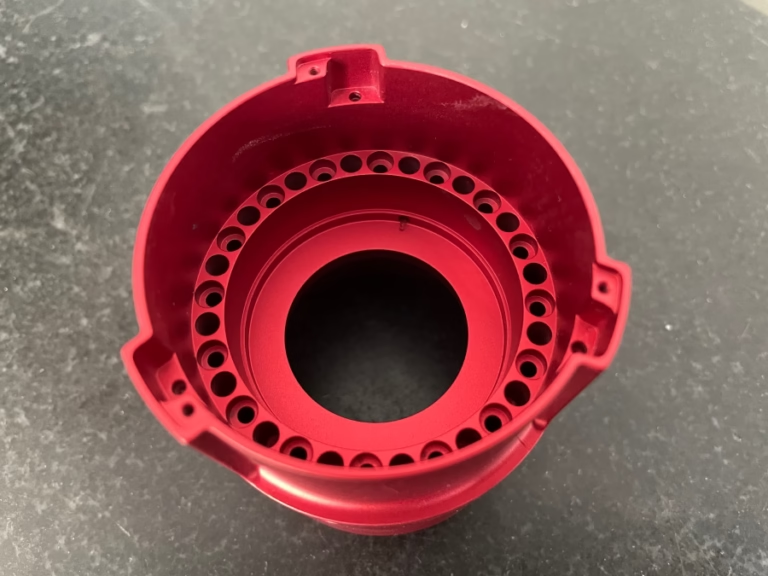
In this article
- 1
- 2
- 3
- 4
- 5
- 6
- 7
Key takeaways
How a CNC machine and a laser cutter remove material
A CNC machine removes material with a rotating cutting tool. The tool is fed along a programmed path, and the spindle axis defines how many directions that path can move at once. A 3-axis mill moves in X, Y and Z. A 5-axis center tilts the tool or the table, so undercuts and organic surfaces become reachable in one setup. The cut is mechanical, so it works on any machinable metal or plastic regardless of how reflective or how thick it is, up to 4,000 mm of travel on our large machines.
A laser cutter removes material with a focused beam. The beam melts, burns or vaporizes the material along a contour, and the kerf width is set by the focus spot, not by a tool diameter. The motion is essentially flat: the head moves in X and Y over a sheet, and the depth of cut is fixed by the power and speed. That is why a laser produces a 2D profile and cannot form a pocket floor or a spherical seat.
The practical consequence is simple. If the feature exists only in the outline of a flat part, both processes can make it. If the feature has a depth, a curve in the third axis, or an internal geometry, only the CNC machine can produce it. This single distinction resolves most of the cnc machine or laser cutter question before cost is even discussed.
- 1Subtractive by toolCutting edges shear material away. Heat stays in the chip, not in the part.
- 2Subtractive by beamEnergy heats the material until it separates. Heat stays in the part around the cut.
- 3Fixture mattersCNC needs workholding. Laser needs only a flat bed and a focus offset.
Tolerance, edge quality and the heat-affected zone
Milling accuracy comes from machine geometry, tool rigidity and thermal stability. A well-set-up mill holds ±0.005 mm (±0.0002 in) and finishes at Ra 0.8–1.6 μm as a normal production target, with Ra 0.2–0.8 μm available when a surface really needs it. Those numbers come from a controlled cut, not from a brochure, and they apply to the features the tool can actually reach.
Laser accuracy is limited by kerf, taper and heat. On thin mild steel a fiber laser can hold roughly ±0.1 mm, and the cut edge carries a heat-affected zone plus a small taper from top to bottom. Dross on the underside usually needs deburring or grinding before the part is acceptable. On acrylic and wood the edge may be clean, but it can be charred or micro-cracked near the kerf.
This is where the two processes stop being interchangeable. A bracket outline at ±0.1 mm is fine for laser. A bearing bore, a dowel hole or a sealing face at ±0.005 mm is not. If the drawing has a tolerance block tighter than ±0.05 mm, plan on CNC or plan on a second finishing operation after laser.
- 1Laser taperA few tens of microns of wall angle on thicker sheet. It grows with thickness.
- 2CNC tool marksVisible on side walls. Bead blasting or polishing hides them.
- 3HAZ checkAsk for a cross-section if the part sees fatigue or a weld later.
What each process can and cannot cut
CNC machining covers aluminium grades such as 6061, 7075 and 2024, stainless 303 through 17-4PH, alloy and tool steels, copper and brass, titanium TC4, Inconel, magnesium and engineering plastics from POM to PEEK. The limit is not the material family but the machinability, the tool access and whether the part can be held without distortion. Hardened or gummy materials simply need slower parameters and more setup.
Laser cutting is narrower. Fiber lasers cut mild steel, stainless and aluminium, but highly reflective metals such as copper and brass are difficult because the beam bounces back into the optics. Thickness is the other wall: the capability notes on this subject often cap practical cutting well under 25 mm, and edge quality drops as thickness rises. Non-metals behave differently again. Acrylic, MDF and wood cut well. PVC should be avoided because it releases corrosive fumes.
So the material often makes the decision for you. Titanium, Inconel, thick copper or a 30 mm steel block points to CNC. A 2 mm acrylic panel or a 3 mm stainless cover points to laser. Where the material works in both, go back to the drawing and check the geometry.
- 1Reflective metalsCopper and brass are a laser risk. CNC handles them normally.
- 2PlasticsPMMA and POM machine well. Laser can char edges on some grades.
- 3CompositesCarbon fibre machines with the right tool. Laser cutting can delaminate it.
Setup, throughput and where the cost curve crosses
Laser is cheap per part once the program exists, because there is no tool wear per feature and no fixturing for a flat sheet. Nesting packs many parts onto one sheet, so material yield is high. A run of 10,000 flat brackets is a laser job almost every time. The setup is short: load a sheet, focus, run.
CNC has more setup. Workholding, tool changes and first-article inspection all take time, and a 5-axis job with a tight tolerance takes longer still. That cost is spread across the run, so at low volume the per-part price is higher than laser. At high volume on a simple flat part, laser usually wins on price alone.
The crossover is not only about price. A part that needs a tapped hole, a counterbore and a milled face cannot ship from a laser without added operations, and those operations erase the laser advantage. Count the features, not just the pieces. If three secondary steps are needed after cutting, the CNC route is often cheaper and always more repeatable.
- 1Short setupLaser: one program, one sheet, no fixture.
- 2Long setupCNC: fixture design, tool list, first-article check.
- 3Hidden costDeburring, tapping and re-fixturing after laser cutting.
If you are buying a machine, not a part
Some readers are not choosing a supplier but choosing a machine for their own floor. The same logic applies, with two additions. First, floor space and power: a fiber laser needs a chiller, extraction and a level bed. A CNC mill needs a foundation, three-phase power and a way to move stock up to 4,000 mm. Second, the skill set. Laser programming is quick to learn. CNC programming, fixturing and tool selection take longer to get right.
Look at the parts you already make. If 80 percent of them are flat and under 6 mm thick, a laser pays back fastest. If they have pockets, threads, bores or any 3D form, the laser will sit idle while you outsource the hard parts. A shop that owns both usually routes flat blanks to the laser and machined details to the mill.
One caution on machine specs. A 5-axis center with a Ø400 mm rotary table and 4,000 × 400 × 150 mm of travel is a different class of purchase from a 3-axis knee mill. Match the envelope to the largest part you actually quote, not the largest part you hope to win. Oversized machines cost money every month whether they run or not.
- 1Power and servicesChiller, extraction and compressed air for laser. Rigid foundation for CNC.
- 2Operator depthLaser: weeks to competent. CNC: months to confident.
- 3Spare capacityOutsource the odd complex job instead of buying a second machine.
CNC machine or laser cutter: decision table
Use this against your drawing. If a row conflicts, the tighter requirement wins.
| Factor | CNC machine | Laser cutter |
|---|---|---|
| Geometry | 3D pockets, threads, contours | 2D profiles through flat stock |
| Typical tolerance | ±0.005 mm (±0.0002 in) | About ±0.1 mm on thin sheet |
| Edge condition | Tool marks, no heat damage | Heat-affected zone, some dross |
| Materials | Metals, plastics, titanium, Inconel | Mild steel, stainless, acrylic, wood |
| Practical thickness | Up to 4,000 mm travel | Often under 25 mm, less on reflective metal |
| Setup effort | Fixture, tool list, first article | Load sheet, focus, run |
| Best volume fit | One prototype to 10,000+ parts | High volume flat parts, 10,000+ pieces |
| Secondary work | Usually none after machining | Deburr, tap, grind, re-fixture |
The short answer
If the part is flat, thin and needed in volume, choose laser cutting. If it has depth, threads, tight tolerance or an exotic material, choose a CNC machine. When a design needs both, cut the blank on a laser and machine the critical features.
Questions engineers ask next
Can a laser cutter replace a CNC machine for metal parts?
No, not for parts with depth. A laser cuts an outline through flat stock. It cannot create a pocket floor, a counterbore, a thread or a curved wall.
It can replace CNC for flat brackets, covers and plates where the tolerance is looser than about ±0.05 mm and the edge needs no machining after cutting.
Which process is cheaper for a prototype?
For a flat part, laser is usually cheaper because there is almost no setup. For a part with several features, CNC is often cheaper overall once you count the secondary operations a laser part would need.
There is no minimum order quantity on our CNC work, so a single prototype is a normal job for us.
How thick can each process go?
CNC travel on our largest machines reaches 4,000 × 400 × 150 mm, so thickness is limited by tool reach and workholding rather than by a hard cap.
Laser cutting is more restricted. Practical capability notes often stay under 25 mm, and edge quality and taper get worse as thickness climbs.
Will laser cutting change the material properties?
Yes, along the cut edge. The heat-affected zone can harden the material or leave a thin recast layer, and it may matter if the part is welded, bent or cycled in fatigue.
If that zone is a concern, request a cross-section or move the critical edge to a machined operation.
What tolerance should I put on a laser-cut part?
Around ±0.1 mm is a realistic general callout for thin sheet. Do not put a ±0.005 mm tolerance on a laser profile unless a later machining step will hold it.
Tighter callouts belong on CNC features, where ±0.005 mm is a normal production capability.
Do I need both machines in my own shop?
Only if your part mix justifies it. A shop making mostly flat sheet parts gets more from a laser. A shop making housings, brackets with bores and mechanical assemblies gets more from a mill.
Outsourcing the occasional job is often cheaper than carrying a second machine that runs a few days a month.
Send the drawing and we will tell you which process fits
Upload your files and our engineers will return a quotation plus a free DFM analysis within 12 hours, covering both routes if the part suits either one.
12-hour quote100% inspectionNDA on request
More process notes from the shop floor
We publish setup notes, tooling trials and inspection data from the factory floor.











